Leak below a leader
Basement seepage appears on the wall directly beneath where a leader comes down outside.
Sump pumps & drainage · Jersey City, NJ
In New Jersey, downspouts are called leaders, and most of them empty right beside the house. We bury solid pipe from each leader to an outlet well away from your foundation, so roof water stops ending up in your basement.
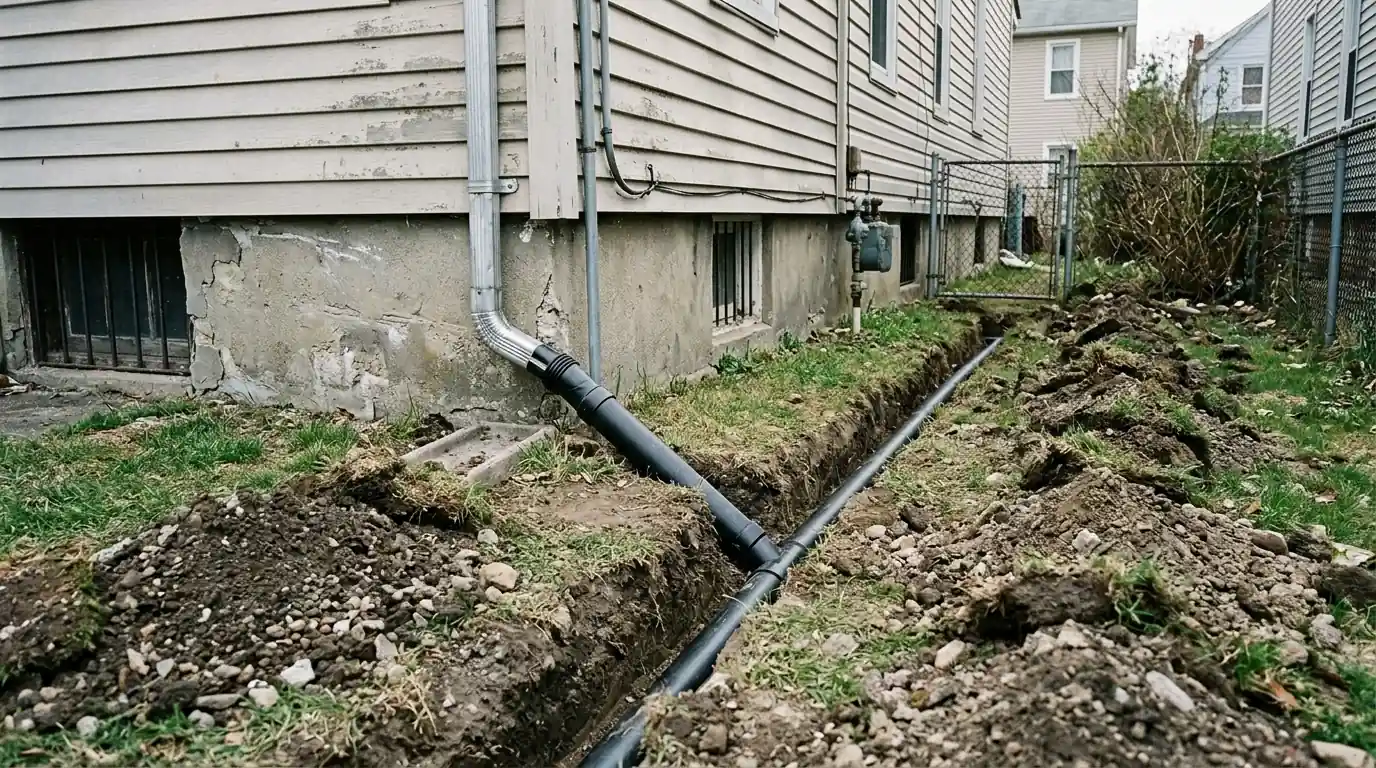
In Jersey City, we tie each leader (downspout) into buried solid pipe that carries roof water away from the foundation to a pop-up emitter, a dry well or a curb outlet where the town allows one. We also camera, clear or replace old clay leader lines that have clogged or collapsed. Call (201) 578-5199 to have your leaders traced.
Roof water adds up faster than most people expect. One inch of rain on 1,000 square feet of roof is about 623 gallons, and nearly all of it funnels into your gutters and down a handful of leaders. A long nor'easter or a summer thunderstorm can drop several inches, which means thousands of gallons concentrated at three or four points around a house. If those points sit at the foundation, that's exactly where the water goes.
A leader that empties onto a splash block puts all that roof water right against the wall, where it soaks down along the foundation, loads the soil with hydrostatic pressure and finds the cove joint, the cracks and the old mortar. A lot of basement leaks in frame houses in Greenville and the Heights trace back to one leader dumping in the wrong spot, a pattern we cover in why Jersey City basements leak. Moving that water is often the simplest repair on the property.
Rowhouses with flat roofs add a twist. Many of those roofs shed water off the back through a scupper into a leader box, and the leader drops straight into a paved rear yard a few inches from the basement wall. Others drain through an internal pipe inside the building. Before we plan a buried line, we trace where your roof water travels from the top down, so the fix starts at the right leader.
Basement seepage appears on the wall directly beneath where a leader comes down outside.
Soil is eroded or the splash block has sunk at the base of the leader.
During rain, water overflows where the leader enters the ground instead of draining away.
Gutters spill over in heavy rain even when clean, a sign the buried line below is blocked.
A trench-shaped dip across the yard shows where an old pipe has collapsed.
The leader simply empties onto the ground right beside the foundation.
Leader drains are buried in solid, smooth-walled pipe, not the perforated pipe used in a French drain. The goal is to carry roof water to an outlet without losing any of it along the way, and perforated pipe beside a foundation would leak roof water back into the very soil we're trying to keep dry. Each leader joins the line through a proper adapter, add a cleanout or debris filter at the base where it helps, and lay the pipe with a steady fall to the outlet.
Depth matters in New Jersey winters. Pipe that's too shallow, or that sags, can hold water that freezes and splits the line or blocks it until spring. We bury the line deep enough to protect it, keep the fall even so it drains between storms, and backfill with clean material that won't crush it. Where a line has to cross a walk or a driveway, we cut and patch the concrete rather than running pipe over the top.
We note where each leader comes down and where its water goes now. Old buried lines get a camera inspection.
We pick an emitter, dry well or curb outlet to suit your lot and local rules. You see the route before digging starts.
We dig from each leader to the outlet, by hand near foundations and walks. Concrete crossings are saw-cut cleanly.
We set solid pipe on a steady fall and connect it to each leader with a proper adapter. Cleanouts go where future clearing will be needed.
We install the emitter, dry well or curb outlet and connect the line. Then we run a hose down each leader to prove the flow.
We backfill, compact and restore lawn, stone or concrete. The work area is left clean.
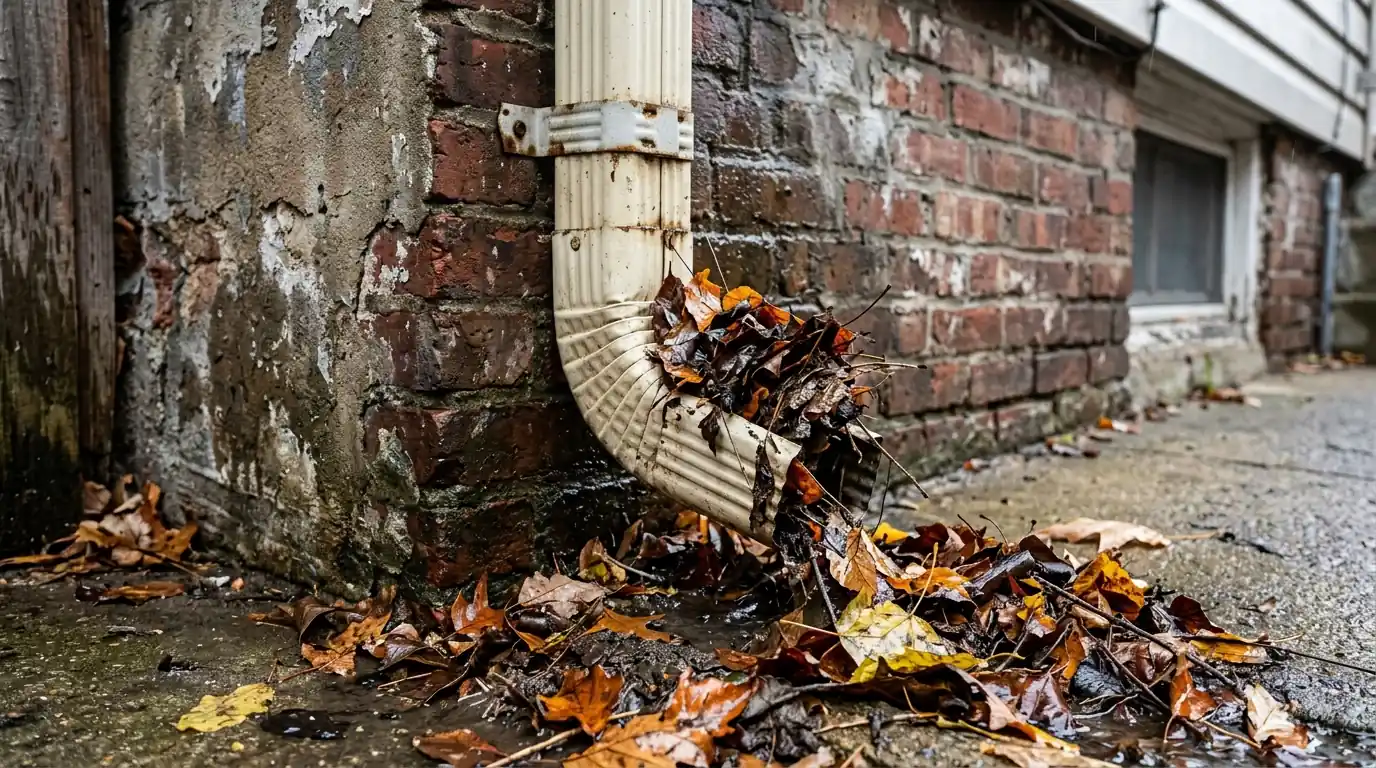
Many older Jersey City houses already have buried leader lines, often clay tile laid generations ago and run to the sewer or the curb. Over a century, roots work into the joints, sections crack or shift, and leaves and grit pile up until the line is full. The leader still looks connected, but the water backs up underground and spills out at the base of the foundation, which is exactly where it was never supposed to go.
We run a camera through old lines to see what's left: roots, crushed sections, offset joints or a pipe packed solid with debris. Some lines clear with a jetter and keep working. Others are broken in too many places, and we replace them with new solid pipe. On rowhouses in Van Vorst Park and the other downtown districts, old leaders sometimes tie into the combined sewer; whether that connection stays or changes is set by local rules, and we tell you what applies before we touch it.
A pop-up emitter is a small round cap set flush with the lawn at the end of the line. When water flows, pressure lifts the cap and the water spills onto the grass well away from the house, then the cap drops back down. It suits lots with some yard and a slope away from the building. A dry well is a buried chamber surrounded by stone that holds the water and lets it soak into the soil slowly, which helps when there's no good place to release it on the surface.
On narrow city lots, the line sometimes runs to the curb and out through the curb face to the street gutter, where the town allows that connection. Rules on curb outlets and sewer tie-ins are set locally, so we check before planning one. Where a sump pump discharge or a French drain also needs an outlet, they can often share a route, and pairing the work with regrading keeps surface water moving the same direction.
| Outlet | Works best | Watch for |
|---|---|---|
| Pop-up emitter | Lawns with room and a slope away from the house | Needs open grass around it; can freeze shut in deep cold |
| Dry well | Flat lots with soil that drains | Low, wet ground near the rivers can keep it full |
| Curb outlet | Narrow city lots facing the street | Only where the town allows the connection |
$38 to $84
per linear ft, typical range
Most jobs land between $38 and $84 per linear foot of buried line, with the outlet planned into the price. Length and what sits between the leader and the outlet set the final number.
Not listed? See every area we serve or call (201) 578-5199.
Membranes, sealers, pumps and dehumidifiers we work with come from makers such as
It's simply the regional word. Around New York and New Jersey, the vertical pipe that carries water down from the gutter is a leader, and the buried pipe that carries it away is a leader drain. Same part, same job. Whatever you call it, the problem is the same if it empties against your foundation.
Some older Jersey City houses have leaders piped into the combined sewer. Whether that connection can stay, be repaired or must be moved is set by local rules, not by us. We check what applies to your property before changing anything, and where a new outlet is needed, we plan an emitter, dry well or curb line instead.
Common signs are water overflowing at the base of the leader during rain, gutters spilling over even when clean, a sinking strip of lawn along the pipe's path and a wet basement wall under that leader. A camera inspection shows exactly where the line is blocked or broken, so we repair only the section that needs it.
They can in hard cold, so we pitch the line to drain empty between storms, which keeps most water out of the pipe when temperatures drop. Where an emitter would sit in deep shade or a low pocket, we may suggest a dry well instead. Keeping snow and leaves off the cap helps it open when water arrives.
Call (201) 578-5199 and tell us what you're seeing. We'll set up a visit and give you a typical range before any work starts.