Crack that darkens in rain
A crack that turns wet or drips after storms runs through the wall and is letting groundwater in.
Basement & foundation · Jersey City, NJ
A single crack running down a poured basement wall can soak a corner of the floor every time it rains. We inject it from inside, seal leaking tie-rod holes, and reinforce wider cracks so the wall stays dry and stable.
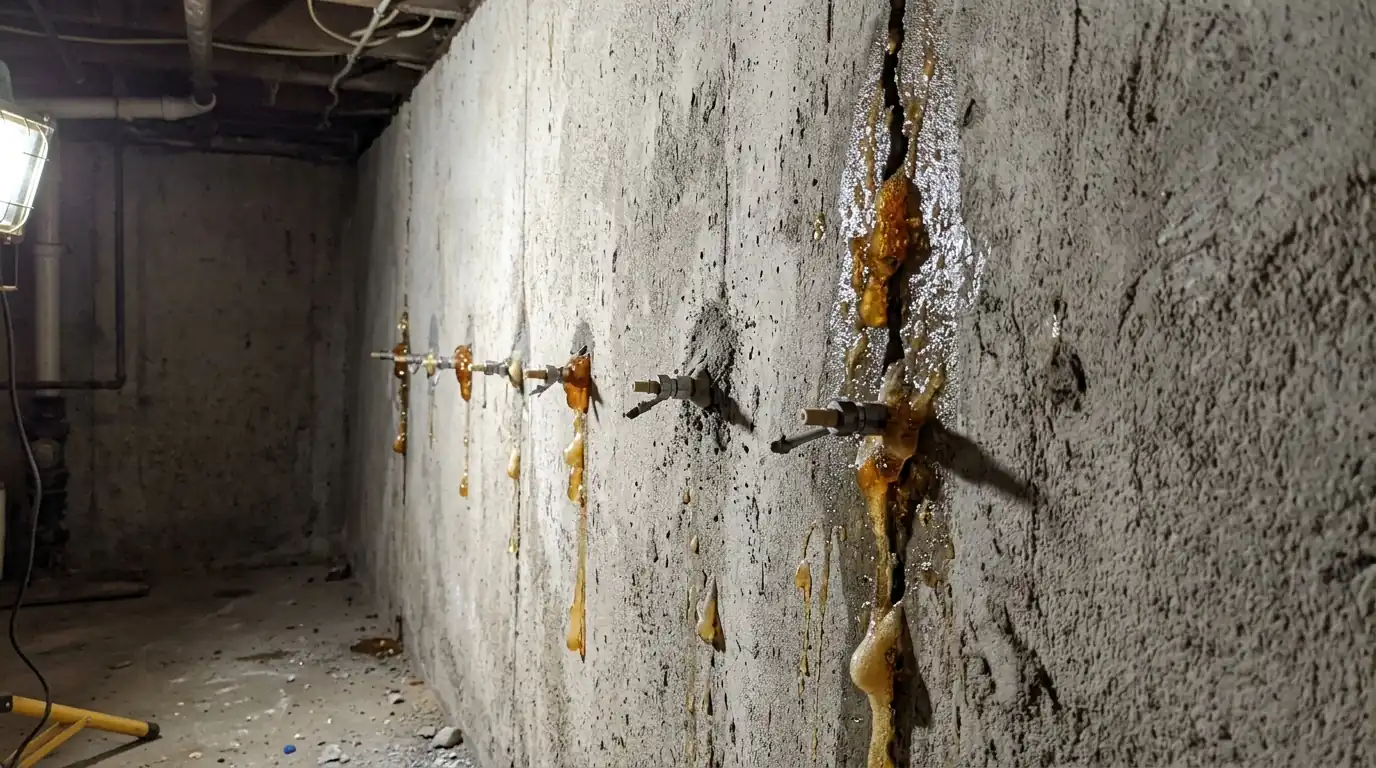
Most leaking cracks in poured concrete foundations are sealed from inside by injecting polyurethane, which expands to fill the crack through the full wall thickness and stops water. Cracks that need strength get epoxy, and wider ones get carbon fiber stitches. We repair foundation cracks and tie-rod holes across Jersey City, usually in a single visit. Call (201) 578-5199 to have one looked at.
Poured concrete shrinks as it cures, and almost every poured wall develops a few hairline cracks in its first years. They're usually vertical or slightly angled, often starting at a window corner or near the middle of a long wall, and they're thinner than a credit card. Most of them never matter structurally. The trouble is that a crack that runs through the full wall thickness also gives groundwater a straight path into the basement once the soil outside is saturated.
Tie-rod holes are the other usual suspect. When a wall is poured, metal ties hold the formwork together, and their ends are snapped off and patched afterward. Those patches often loosen, leaving a neat grid of small round spots that darken and drip after heavy rain. In newer Jersey City buildings with poured foundations, these two leak points account for a large share of the wet basement calls we answer.
Location tells us a lot. On the Heights, where rock sits close to the surface, water tends to run along the rock and pour through any crack it meets, so a single crack can leak hard even when the rest of the wall stays dry. Near the rivers, where the water table rises after long storms, cracks low on the wall leak first and the cove joint often joins in. We note where each crack sits, when it leaks and how fast, because that pattern helps us decide whether injection alone will do the job.
A crack that turns wet or drips after storms runs through the wall and is letting groundwater in.
Orange streaks under a small round spot usually mark a corroding tie-rod end that's leaking.
A tapered crack can indicate settlement and deserves a closer look before repair.
Horizontal cracking often means soil pressure pushing the wall inward. An engineer should review it first.
White crust tracing a line on the wall shows where water has been moving through a crack over time.
Hydraulic cement smeared over a crack that keeps leaking around the edges hasn't sealed the wall's depth.
Injection is done from inside. We clean the crack, set small ports along its length, seal the surface between them, then pump resin in from the bottom port upward until it shows at the next one. That way the resin fills the crack through the whole thickness of the wall, not just the face. When it cures, we remove the ports and grind the surface smooth.
The resin we choose depends on what the crack needs. Polyurethane foam reacts with water, expands and stays flexible, so it's the standard choice for stopping a wet crack, especially one that opens and closes slightly with the seasons. Epoxy cures hard and bonds the two sides of the crack back together, restoring strength, but it needs a drier crack and doesn't flex. For a typical shrinkage crack that only leaks, polyurethane is the better tool. For a crack where the wall needs to act as one piece again, epoxy is.
Tie-rod holes get the same treatment on a smaller scale. We clean out the old patch, set a single port, and inject polyurethane until it fills the void around the rod end. A wall with a few dozen tie-rod holes can be done in one visit, and we usually seal every one in a leaking section, since the dry ones tend to start weeping once their neighbors are plugged. Block and stone walls are different: resin can't fill hollow cores or rubble, so those walls usually call for drainage or repointing.
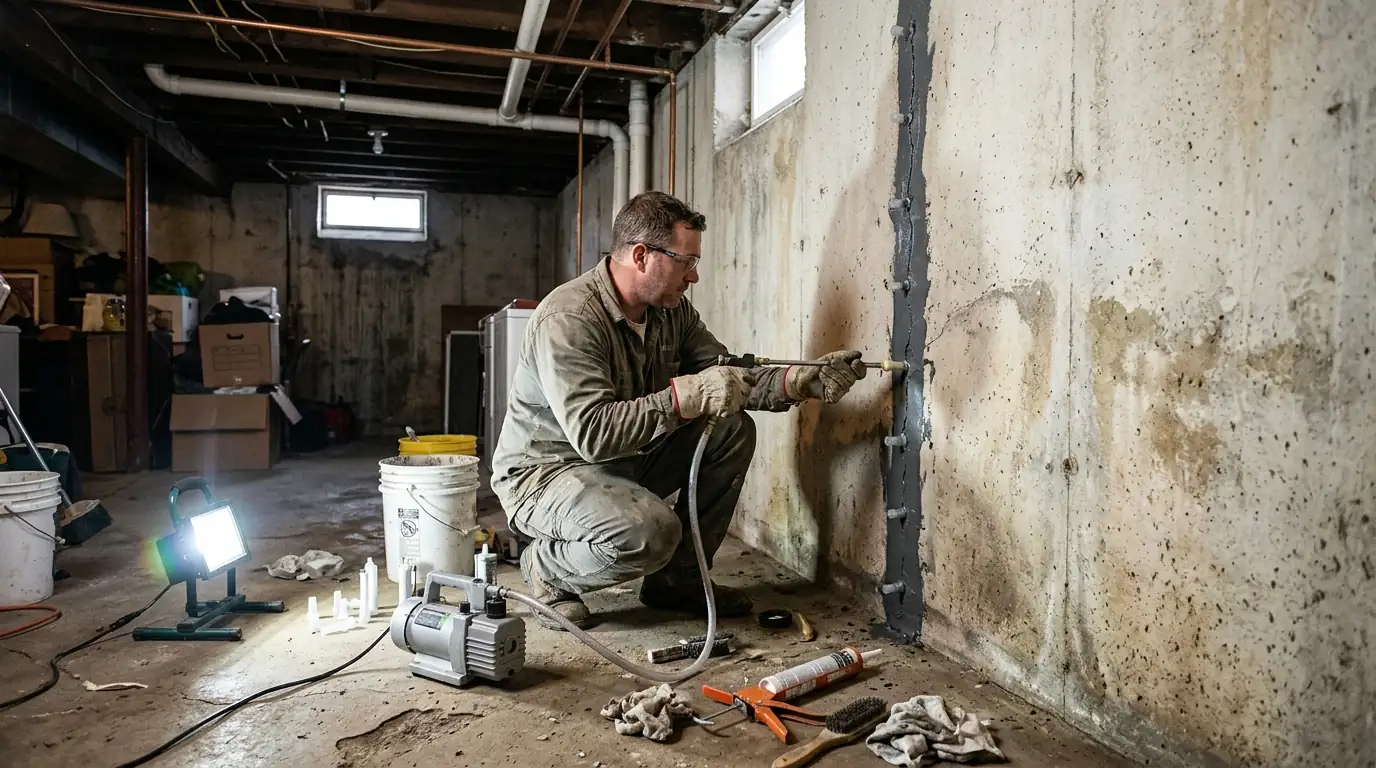
We check each crack for width, length, offset and moisture, and look at the wall for lean. That tells us whether to inject, reinforce or bring in an engineer.
We grind away paint, old patch material and efflorescence along the crack. The resin needs a clean surface to seal against.
Injection ports go in at intervals along the crack and the surface between them is sealed. Tie-rod holes get their own ports.
We pump polyurethane or epoxy from the lowest port upward until each section is full. The resin fills the crack through the wall thickness.
Wider stable cracks get carbon fiber stitches set in epoxy across them. This keeps the crack from opening again.
After curing, we remove the ports and smooth the surface. We look at the repair after the next heavy rain if you want a second visit.
Some cracks are wider than injection alone should handle, or show a slight offset between the two sides. Where the wall isn't actively moving, we can reinforce across the crack with carbon fiber stitches: short staples set into slots cut across the crack and set in epoxy. They hold the two sides together so the crack can't open further, and the crack itself is still injected to stop water.
Carbon fiber is thin and sits nearly flush with the wall, so it doesn't take up floor space. For a whole wall that's leaning inward, stitches aren't enough; that's a job for bowing wall repair with full-height straps or anchors. We tell the difference by measuring the crack, checking the wall for lean with a level, and looking at the pattern of cracking across the room.
We're careful about the line between a leak and a structural problem. Signs that point beyond a simple shrinkage crack include horizontal cracks partway up a wall, stair-step cracking in block, cracks wider at one end than the other, an inward lean, or doors and windows upstairs that have started sticking. Any of these can mean soil pressure or settlement, not just curing shrinkage.
When we see those signs, we recommend a structural engineer look at the wall before we seal or reinforce anything. Sealing a crack that's still moving only hides the movement. Once an engineer has given a direction, we carry out the waterproofing and reinforcement that fits it. If your basement leaks along many cracks and joints at once, a whole-basement approach may serve you better than injecting crack after crack, and we'll say so.
Outside the wall, the soil often explains why a crack keeps getting wetter. A leader dumping beside the foundation, a yard sloping toward the house or a clogged window well drain can load the soil at exactly the spot where the crack sits. When we inject a crack, we also look outside for those sources and tell you what to change. Redirecting a downspout costs little and keeps the repaired crack from being the only thing standing between a saturated corner of the yard and your basement.
| Method | What it fixes | Best for |
|---|---|---|
| Polyurethane injection | Stops water; stays flexible | Leaking shrinkage cracks and tie-rod holes |
| Epoxy injection | Bonds the crack for strength | Dry or drying cracks where the wall must act as one piece |
| Carbon fiber stitches | Holds wider cracks closed | Stable cracks with some width or slight offset |
| Surface patching | Covers the face only | Cosmetic touch-up; rarely stops a leak |
$485 to $1,180
per crack, typical range
Most single-crack repairs land between these figures. Several cracks in one visit or added reinforcement change the total, and our waterproofing cost guide shows how repairs compare with full systems.
Not listed? See every area we serve or call (201) 578-5199.
Membranes, sealers, pumps and dehumidifiers we work with come from makers such as
Yes, for poured concrete walls that's the normal approach. We inject resin from inside through ports along the crack, and it travels through the full wall thickness to the soil side. No digging outside is needed. It works best on poured walls; cracks in block, brick or stone foundations behave differently and usually call for other repairs.
They're left over from the metal ties that held the formwork together when the wall was poured. The tie ends were snapped off and patched, and over the years those patches loosen and the metal can corrode, opening a small path for water. We drill out or clean each hole and inject it with polyurethane so it seals through the wall.
Not before someone checks why it formed. Horizontal cracks partway up a wall often come from soil pushing the wall inward, and injecting one doesn't stop that movement. We recommend a structural engineer review it first. Afterward we can seal the crack and install reinforcement such as carbon fiber straps or anchors, depending on the engineer's direction.
Because it only plugs the face of the crack. Water still travels through the crack inside the wall and finds its way around the patch edges. Concrete also moves slightly with temperature, and a rigid surface patch can pop loose. Injection fills the crack through its depth, which is why it holds where surface patching doesn't.
Call (201) 578-5199 and tell us what you're seeing. We'll set up a visit and give you a typical range before any work starts.