Musty odor
A stale, earthy smell that hits you on the stairs, stronger in summer.
Basement & foundation · Jersey City, NJ
A basement can be free of leaks and still smell musty, sweat on the pipes and grow mildew on stored boxes. We install whole-basement dehumidifiers that drain on their own and keep the air dry all summer.
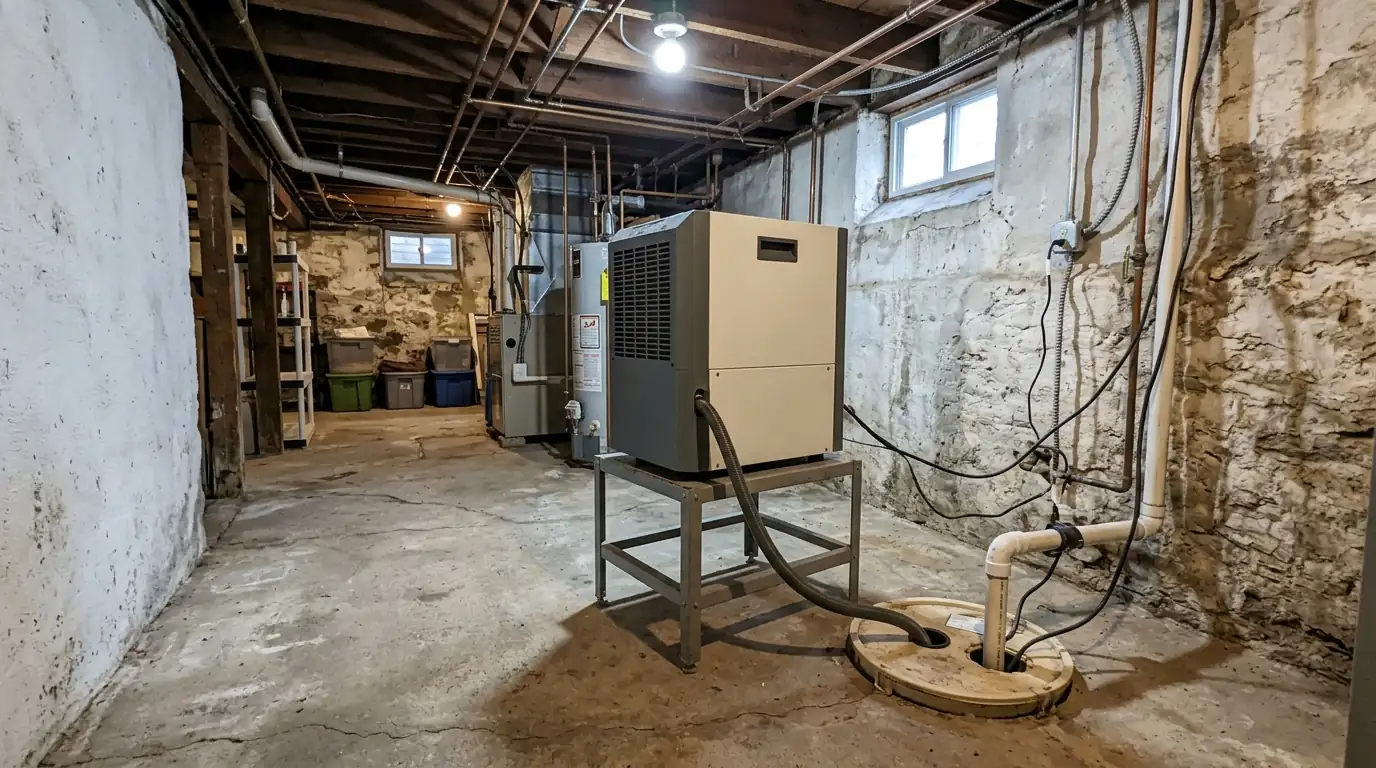
We install whole-basement dehumidifiers in Jersey City houses and walk-ups. Our technicians size the unit to the basement, set it where air can circulate, and drain it to a sump or condensate pump so nobody empties a bucket. The aim is holding humidity around 45 to 55 percent. Call (201) 578-5199 and we will check the basement's moisture before recommending a unit.
Basement walls and floors sit against cool ground. In July and August, warm humid air drifts down the stairs and in through gaps, hits those cool surfaces and gives up its moisture. Add some vapor coming through the concrete or old brick, and basements commonly sit above 60 percent relative humidity through the summer. That is where the musty smell, the mildew on stored boxes and the sweating cold water pipes come from.
Older brick and stone foundations under rowhouses and brownstones let more vapor through than poured concrete, so those basements tend to run damper even when they never actually leak. Basements on low, filled ground near the Hudson and Newark Bay also sit closer to groundwater. Neither situation means something is broken. It means the basement needs steady drying, not a box fan running once a week.
Daily life adds to it. A washer and an unvented or poorly vented dryer in the basement, laundry hung to dry on a line, a second kitchen or a bathroom in a two-family basement unit all put water into the air. In a pre-war walk-up near Journal Square or a frame house in the Heights, those habits can push an otherwise sound basement into the musty range by midsummer.
We measure relative humidity and look at the walls, floor and stored items. We also check for active seepage that should be fixed first.
We size the dehumidifier to the area, layout and how damp the basement runs. You get the reasoning, not just a model number.
The unit goes where air can circulate and where it is easy to service. Ducting is added if a closed room needs dry air.
We run the drain hose to the sump or install a condensate pump to a sink or drain line. Nothing needs emptying by hand.
We set the humidistat in the 45 to 55 percent range and run the unit. Then we confirm it drains properly.
We show you how to clean the filter and read the display. You will know what normal looks like.
A portable dehumidifier from a big-box store is built for a room, not a basement. It has a small bucket, a compressor that struggles in cool air and a fan that only reaches a few feet. Most of them stop when the bucket fills, which tends to happen overnight in a humid week. Owners end up with a machine that runs, fills, shuts off and sits there while the humidity climbs again.
A whole-basement unit is designed for cooler air and long run times, moves far more air, and drains continuously through a hose. It can be ducted so dry air reaches a back room or a finished space behind a wall. It costs more up front, but it actually holds the basement where you set it instead of chasing it. The comparison table below lays out the main differences side by side.
There is also the matter of running cost and noise. A properly sized whole-basement unit runs efficiently because it is working within its design range, and it cycles off once the humidistat is satisfied. A struggling portable unit, by contrast, can run around the clock without ever reaching the target. Most whole-basement models are also quieter at the same output, which matters if the basement is a living space or sits under a bedroom.
Sizing starts with the basement's area and layout, then accounts for how damp it runs. A long, open rowhouse basement and a chopped-up basement under a two-family house need different setups even when the square footage matches. We note stored items, the laundry, any old brick walls and any signs of past water before picking a unit, so it is neither too small to keep up nor oversized for the space.
Drainage is what makes the system hands-free. If there is a sump basin, the unit drains straight into it. If not, we add a small condensate pump that lifts the water to a laundry sink or a drain line. We set the humidistat in the 45 to 55 percent range, show you how to check it, and tell you how often to clean the filter.
Placement matters as much as size. A unit jammed into a corner behind storage dries that corner and little else. We set it where air can move across the basement, keep it off a floor that might see water, and leave room to service it. In divided basements, a short run of ducting can push dry air into a closed back room so it does not stay damp while the main space reads fine.
Waterproofing stops liquid water. It does not change the humidity of the air. After we install an interior drain or seal a wall, the basement often still carries years of moisture in its concrete and framing. A dehumidifier dries that out over the first season and then holds it there, which matters most before anyone hangs drywall or lays carpet.
Be honest about what the unit can and cannot fix. A dehumidifier will not stop water coming through a crack, up a floor drain or under a door. If you see puddles, efflorescence that keeps coming back or a tide line on the wall, start with a waterproofing inspection and size the dehumidifier to the dry basement you end up with. Our guide to why local basements leak covers the water side.
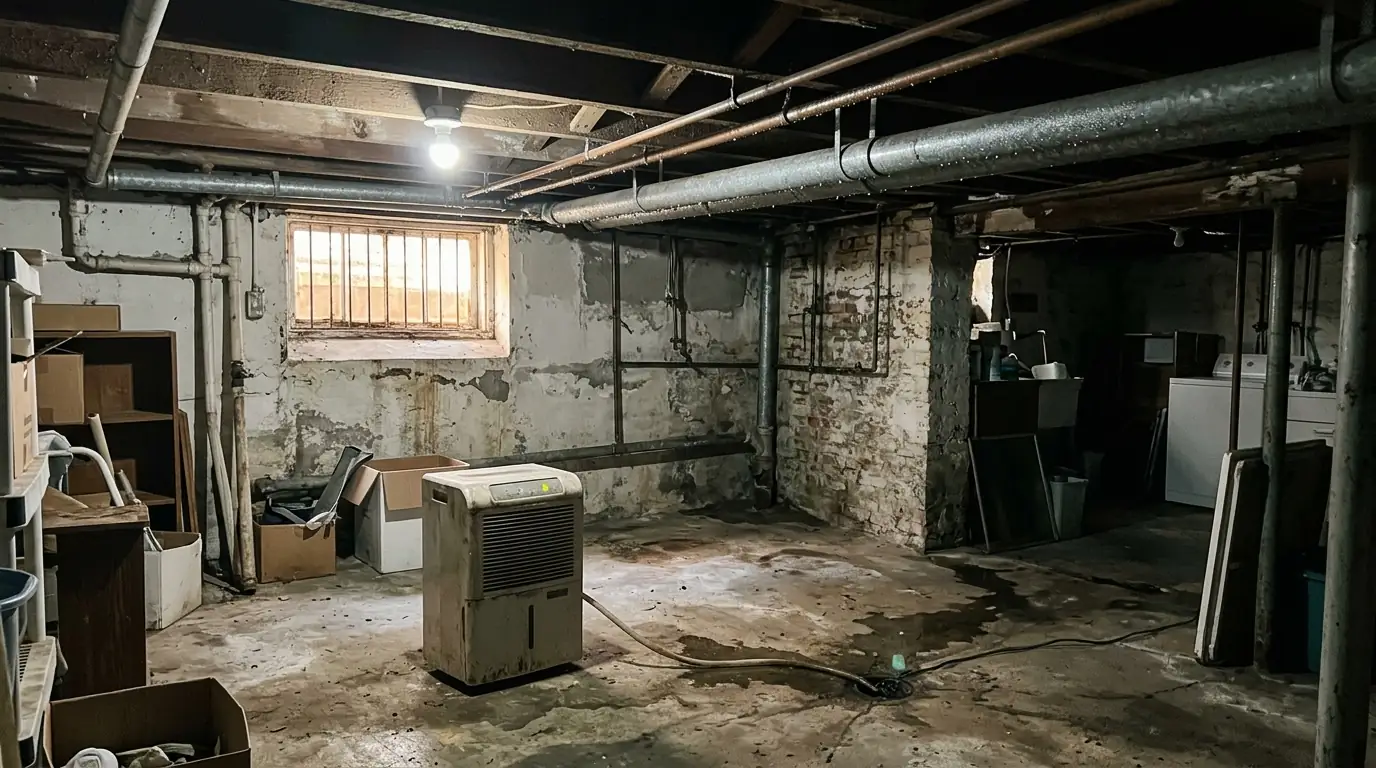
A stale, earthy smell that hits you on the stairs, stronger in summer.
Cold water lines and the water tank dripping with condensation in humid weather.
Spots on cardboard boxes, leather, wood furniture or the bottom edge of drywall.
The basement feels clammy, and laundry hung there takes ages to dry.
Tools, shelving and appliance legs rusting even though no water reaches the floor.
Paint peeling from a foundation wall that never actually leaks.
$1,680 to $3,250
installed, typical range
Most installed whole-basement dehumidifiers land between $1,680 and $3,250. That is a typical range, not a quote; the size of the basement and how the unit drains do most of the moving.
| Feature | Portable store unit | Whole-basement unit |
|---|---|---|
| Built for | A single room at room temperature | A cool basement and long run times |
| Drainage | Bucket, or a hose to a floor drain | Continuous drain to a sump or condensate pump |
| Coverage | A few feet around the unit | The whole basement, ductable to closed rooms |
| Day to day | Stops when the bucket fills | Runs on a humidistat without attention |
| Up-front cost | Lower | Higher, but holds the target humidity |
Not listed? See every area we serve or call (201) 578-5199.
Membranes, sealers, pumps and dehumidifiers we work with come from makers such as
A target of roughly 45 to 55 percent relative humidity works for most basements. Basements here commonly sit above 60 percent in summer, which is where musty odors and mildew start. Going much lower than the target just runs the unit harder without much benefit. We set the humidistat during installation and show you how to read it, so you can adjust it if a corner still smells.
Into a sump basin if the basement has one, which is the simplest setup. If there is no sump, we install a small condensate pump that pushes the water up and over to a laundry sink or a drain line. Either way the unit drains continuously, so there is no bucket to empty and the machine never shuts off just because it is full.
No. A dehumidifier dries the air; it does not stop liquid water. Seepage through a crack, the cove joint or old mortar needs a waterproofing fix such as crack injection, an interior drain or repointing. Once the water is handled, the dehumidifier deals with the moisture left in the air and the concrete and keeps the basement from going musty again.
Often, yes, especially if you plan to finish the space. Waterproofing stops water from entering, but walls and floors that were wet for years keep releasing moisture for a while, and summer air is humid regardless. A dehumidifier dries everything out over the first season and keeps the air in a range where drywall, carpet and stored belongings stay sound.
Call (201) 578-5199 to set up a visit. We'll photograph what we find and tell you what can wait and what can't.