Recessed or sandy joints
Mortar that sits back from the brick face or rubs out as sand under a fingertip is no longer keeping water out.
Walls, terraces & decks · Jersey City, NJ
Rain driven sideways by a nor'easter finds every open mortar joint on a brick wall, then shows up as stained plaster, peeling paint or a damp closet inside. We cut out the failed joints and repoint them with mortar that suits the brick.
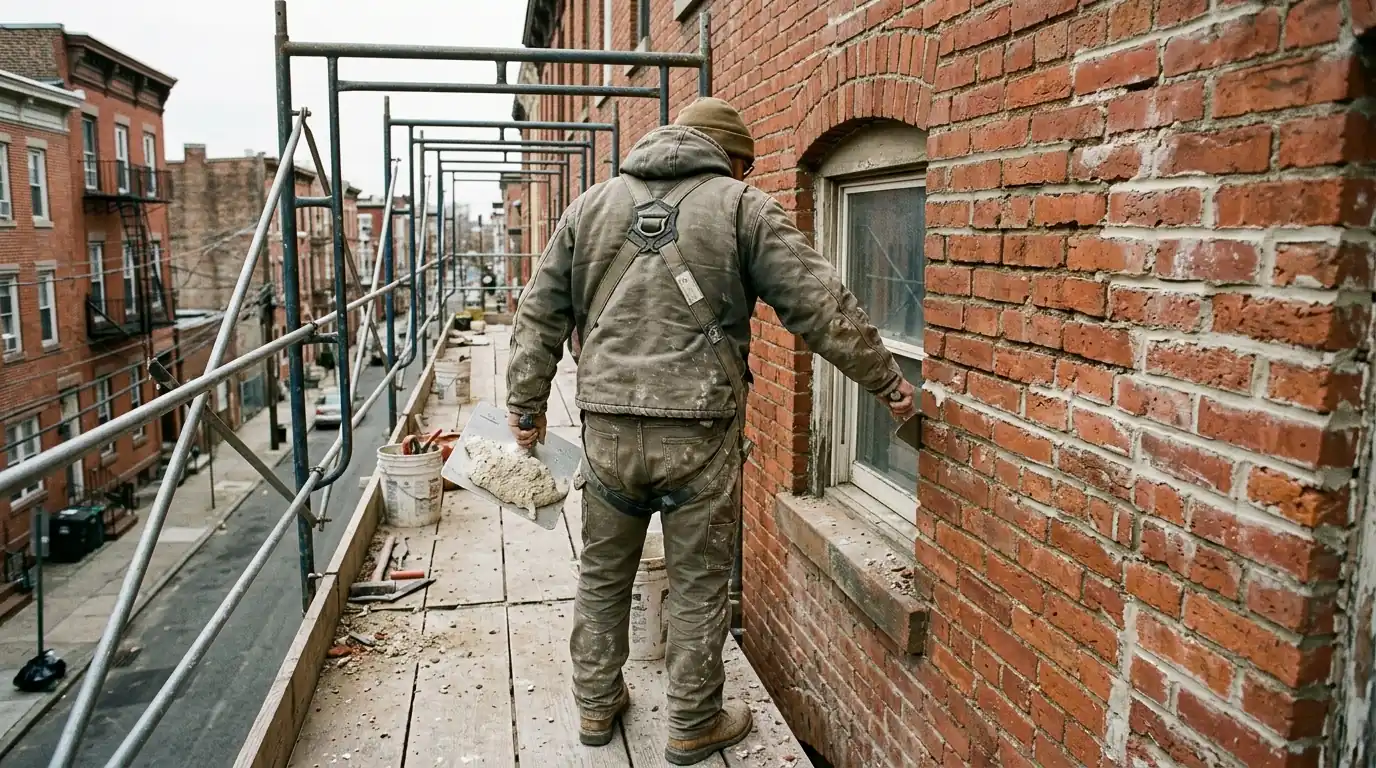
In Jersey City, we repoint brick facades, exposed side walls, parapets and chimneys where eroded mortar lets wind-driven rain into the wall. Our crew cuts the old joints out to sound depth, packs in a lime-based mortar matched to the brick, tools it to the original profile and keeps it damp while it cures. Call (201) 578-5199 at any hour to set up a look at your wall.
Brick sheds a fair amount of water on its own. The joints are the weak link. On a 19th-century rowhouse around Hamilton Park or Van Vorst Park, the original mortar was a soft lime mix, and after a century of rain, freeze-thaw and salt air, much of it has washed back from the face of the wall. Once a joint is recessed or cracked, a nor'easter drives rain straight into the wall core. A solid brick wall has no cavity to drain that water, so it keeps moving inward until it reaches plaster, wood lintels or joist pockets.
Inside, that looks like a band of blistered paint under a window, a brown stain where the ceiling meets the front wall, or a closet that smells damp after every storm. Owners often suspect the roof first, and sometimes the roof is part of it. A top-floor stain that follows the line of the facade rather than sitting in the middle of the ceiling usually points to the wall. We probe the joints with a pick and take moisture readings on the inside face before anyone opens plaster, so you're not paying to chase the wrong leak.
Mortar that sits back from the brick face or rubs out as sand under a fingertip is no longer keeping water out.
Bubbling paint or brown tide lines under windows or along an outside wall after wind-driven rain.
Brick faces spalling next to hard gray patches usually means an earlier repair used mortar that was too strong.
Efflorescence on the outside or inside face shows water moving through the wall and leaving salts behind.
Gaps near the top of a chimney freeze hardest and let water down into the flue walls and the attic.
Bricks you can wiggle at a parapet, corner or window jamb mean the mortar has failed through its full depth.
A top-floor room or closet that only smells damp after nor'easters points at the wall more than the roof.
The brick on most downtown rowhouses was fired softer than modern brick, and it was laid in lime mortar on purpose. The mortar is meant to be the sacrificial part of the wall: softer and more porous than the brick, so moisture and seasonal movement work through the joint instead of through the brick face. When someone repoints that wall with a hard, cement-rich mix, the order flips. The joint stays rigid, trapped water leaves through the brick instead, and after a few winters the brick faces start spalling off in flakes and sheets.
So we match the mortar to the wall, not to whatever is easiest to mix. On old soft brick we use a lime-based mortar. Where a building has later patches in harder brick, we adjust the mix for that section rather than forcing one recipe across the whole elevation. Color and texture count too, especially on a front facade in a designated historic district, where exterior work goes through the city's Historic Preservation Commission review. We tell you at the first visit when a job is likely to need that review, so it doesn't surprise you halfway through planning.
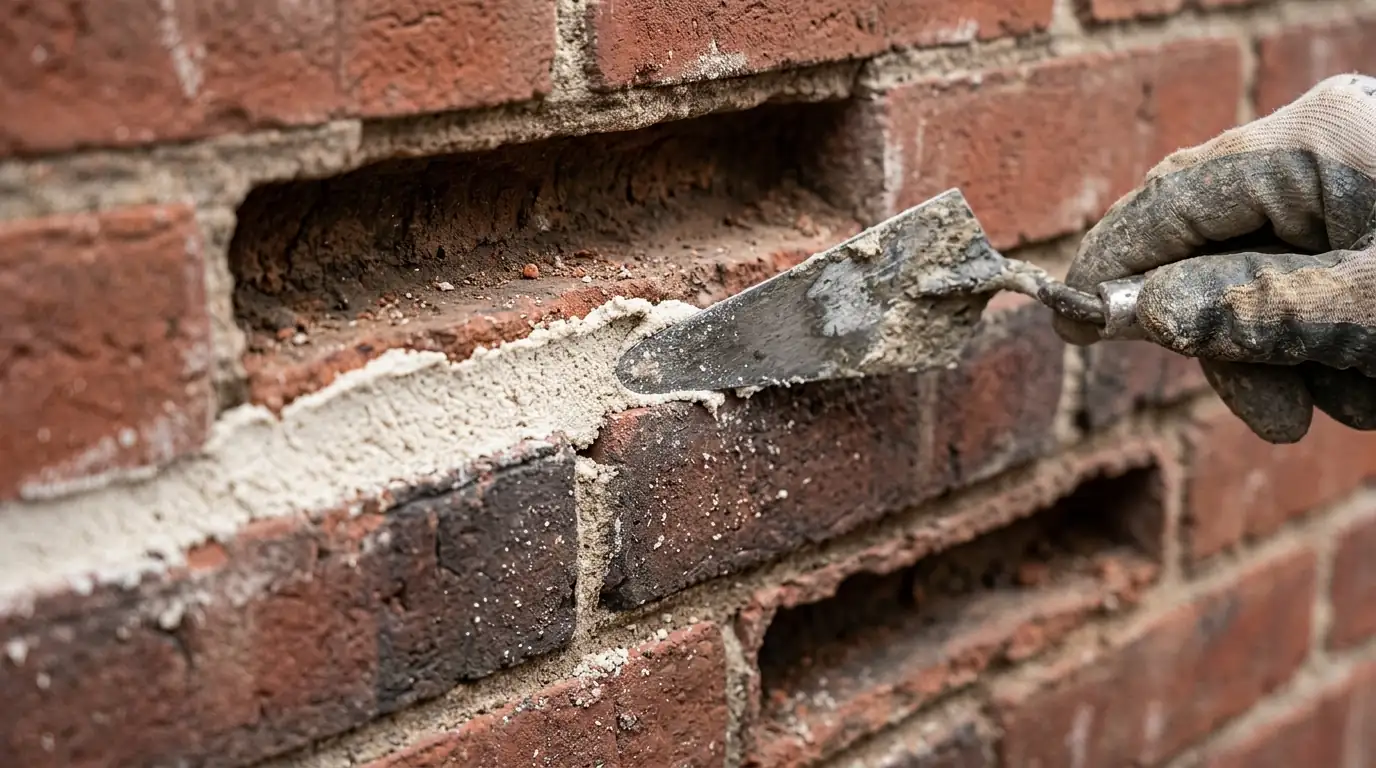
We walk each elevation, test joints with a pick and take moisture readings on the inside face. That separates the walls that leak from the walls that only look tired.
We check the brick hardness and the existing mortar, then choose a lime-based or adjusted mix and match color with small test panels. If the facade sits in a historic district, we flag the likely commission review before scheduling.
We set ladders or scaffolding, protect the sidewalk, stoop and windows, and plan around parking on narrow blocks. On attached houses we cover the neighbors' nearby openings against dust.
Our crew removes the old mortar to sound depth with grinders and hand chisels. Every joint is cleaned and dampened so the new mortar bonds.
We pack mortar in layers, tool it to match the original joint profile and brush off the excess. Loose or broken bricks get reset or replaced as we go.
We mist and shade the new joints for several days while they cure. Afterward we compare inside moisture readings with the first visit.
Good repointing is mostly preparation. We cut the old mortar out to sound material, usually to a depth of about twice the joint width, using grinders on long bed joints and hand chisels near soft or chipped brick edges. Shallow scratching followed by a thin skim of new mortar is the repair that fails within a couple of winters, because the thin layer pops off at the first hard freeze. After cutting, we blow out the dust and dampen each joint, so dry old brick doesn't pull the water out of the fresh mortar before it can set.
We pack the new mortar in layers rather than one thick fill, pressing each lift hard into the back of the joint. When it reaches thumbprint hardness, we tool it to match the existing profile, whether that's flush, concave or a struck joint. Then comes the step that hurried jobs skip: curing. Lime mortar wants to stay damp for several days, so we mist it and shade it from direct sun and drying wind. Cold weather changes the schedule, since fresh mortar must not freeze before it has cured.
Not every wall needs repointing at once. The front facade takes plenty of weather, but exposed side walls, where a neighboring building is shorter or was demolished, often look worse because they were never built to face the street. Parapets and chimneys stand fully exposed above the roof and freeze hardest, so their joints usually go first. Up on the Heights, ridge-top wind makes every one of these problems worse. We'll show you which elevations need work this season and which can reasonably wait a few years.
Repointing often connects to other work at the same visit. A chimney with eroded joints may also need chimney crown and flashing repair, and a parapet with open joints usually leaks through its coping as well, which we handle under parapet wall waterproofing. Once fresh joints have fully cured, some owners add a breathable water repellent as part of exterior wall waterproofing. We only suggest that on brick that can still dry out through its face.
| What matters | Lime-based mortar | Hard cement-rich mortar |
|---|---|---|
| Hardness compared with old brick | Softer than the brick, as intended | Often harder than the brick |
| Where moisture leaves the wall | Through the joint | Through the brick face |
| Effect on soft 19th-century brick | Protects brick edges | Can cause spalling after freeze-thaw |
| Best fit | Rowhouses and brownstones with original brick | Modern hard brick and concrete block |
| Curing | Slow, needs damp curing for days | Sets faster |
$9.40 to $21.60
per sq ft, typical range
Most repointing jobs land between $9.40 and $21.60 per square foot of wall. That's a typical range for planning, not a quote; we price your wall after we've seen the joints up close.
Not listed? See every area we serve or call (201) 578-5199.
Membranes, sealers, pumps and dehumidifiers we work with come from makers such as
Well-done lime repointing on a sheltered wall can last for decades. Exposed elevations, parapets and chimneys wear faster because they take wind-driven rain and harder freezes. Rather than following a fixed schedule, check the joints every few years. If mortar sits back more than about a quarter inch from the face or crumbles to sand, that section is due. Repointing only the worst areas first is common and sensible.
Fresh mortar can't be allowed to freeze while it cures, and lime mortar cures slowly. We schedule most repointing from spring through fall. If a wall is actively leaking in winter, we can repoint a limited section during a mild stretch with enclosures and protection, or make a temporary repair and come back for the full job once temperatures hold.
If the stain follows the front or side wall, open joints are a likely cause and repointing usually stops it. If it sits in the middle of the ceiling, the roof or a flashing is the more likely source. We take moisture readings and look at both before recommending anything, and we can check the parapet and coping during the same visit.
Exterior work on buildings in designated districts such as Hamilton Park, Van Vorst Park, Paulus Hook and Harsimus Cove goes through the city's Historic Preservation Commission review. Mortar color, joint profile and cleaning methods are the kinds of details that matter there. We tell you when your job will likely need review and prepare mortar test panels so you have something concrete to show.
Sometimes, but not by default. Old soft brick needs to dry out, and a film-forming sealer can trap moisture and make the face spall. Where a wall still takes heavy wind-driven rain after repointing, a breathable silane or siloxane repellent can help. We wait for the new mortar to cure fully, then decide based on how the wall behaves.
Call (201) 578-5199 and tell us what you're seeing. We'll set up a visit and give you a typical range before any work starts.