Seams lifting
Lap edges that lift or show dark water lines are letting moisture into the layers.
Roof waterproofing · Jersey City, NJ
Water is coming through the top-floor ceiling from a flat roof leaking at a seam, a blister, a parapet base or a clogged drain. We find the failure and seal it with material that bonds to your membrane.
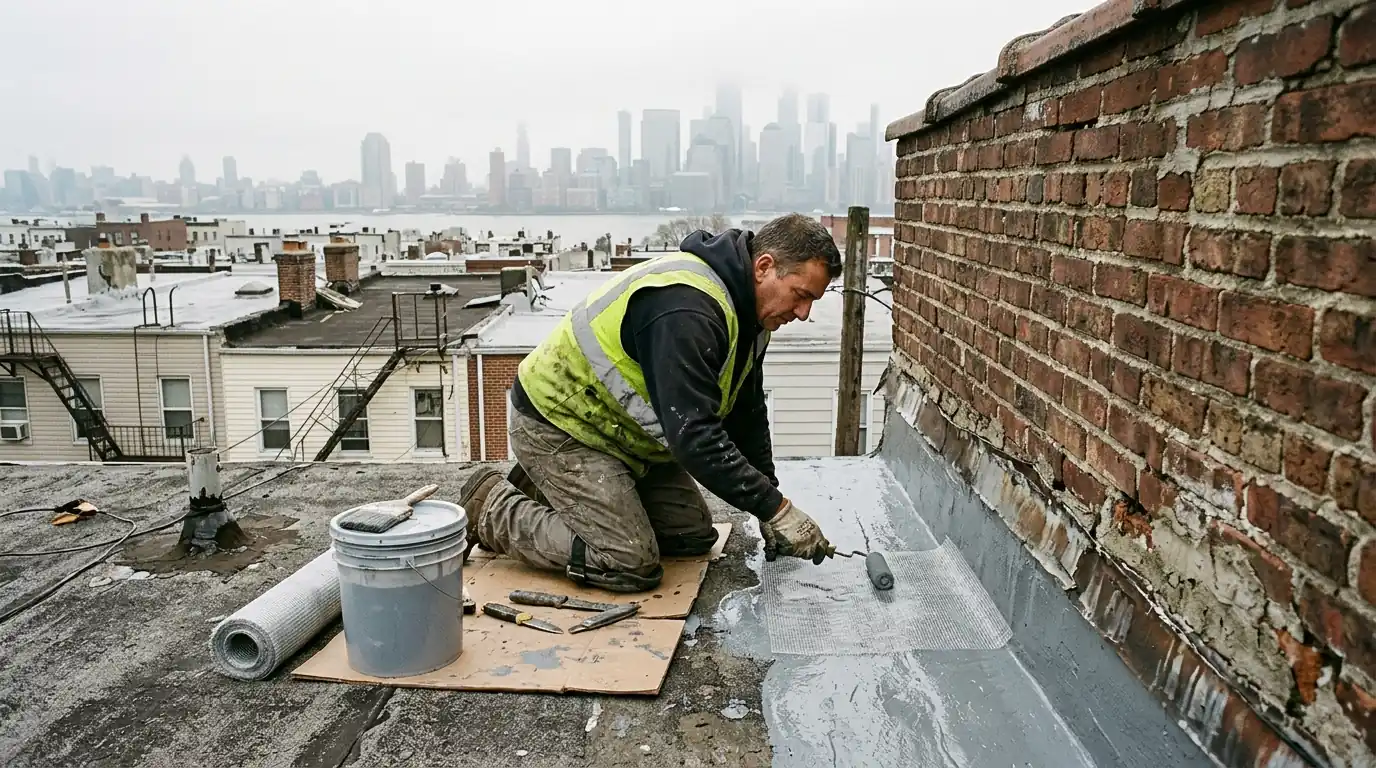
For a leaking flat roof in Jersey City, call (201) 578-5199; we answer 24/7 and can send an emergency crew the same night when one is free. Our technicians identify the membrane, find the failure (usually a lap seam, parapet base flashing or a blocked drain) and seal it with compatible material: mod bit cap sheet, EPDM primer and tape, heat-welded TPO, or a reinforced liquid patch.
Lap edges that lift or show dark water lines are letting moisture into the layers.
Blisters that squish underfoot or have cracked open hold water against the deck.
Split or sagging base flashing where the roof meets the wall is the top flat-roof leak point.
Water still standing 48 hours after rain stresses seams and adds weight to the structure.
Deep cracking across the surface means UV has broken down the top layer.
Without a working strainer, leaves and gravel block the drain and back water up.
EPDM that bridges corners and tents the wall flashing has started to shrink.
Flat roofs aren't truly flat, and they aren't supposed to be. They need a gentle pitch toward a drain or scupper, and on many older Jersey City buildings that pitch has sagged over a century of settling. Where water sits, the membrane works harder: sun heats it, freeze-thaw stresses it, and every lap seam in a puddle spends days under water instead of minutes. Older roofs here are often built-up tar and gravel or modified bitumen; newer ones are EPDM, TPO or mod bit, and each leaks in its own way.
The edges take the rest. A rowhouse roof is boxed in by parapets, and the base flashing that turns up those walls cracks as it ages and the brick moves. Coping joints open, mortar falls out, and water gets behind the flashing from above. On pre-war walk-ups around Journal Square and McGinley Square, internal drains clog with leaves and gravel and back water across the whole roof. Our guide on parapet walls as a leak source shows how often the wall, not the membrane, is to blame.
We confirm whether the roof is mod bit, EPDM, TPO, built-up or coated. That decides every material we use.
Seams, flashing, drains and blisters in the leak area are probed and checked. Wet insulation is found with a meter or probe cut.
Damaged and wet material comes out until we reach dry, well-adhered layers. Soft deck boards get replaced.
New insulation or cover board goes in where needed, then compatible membrane is lapped over the area. Seams are rolled, welded or sealed closed.
Base flashing near the repair is rebuilt, and drains are cleared and resealed. Water should leave the roof freely.
We water test where the leak was hard to find and photograph the finished work. You get the photos and notes on anything else we saw.
Failed lap seams show up as edges that lift when you run a putty knife along them, or as dark lines where water has wicked in. Blisters are raised pockets where moisture or air got trapped between layers; in summer sun they swell, and walking on them cracks the top. Small dry blisters can be left alone and watched. Ones that are soft, wet or cracked need to be cut open, dried and sealed.
Alligatoring is the cracked, scaly surface you see on old asphalt roofs and aging coatings, caused by years of UV breaking down the oils in the material. It's a sign the surface is near the end of its life, not an emergency on its own. If the membrane underneath is still dry, the fix may be a localized repair followed by a roof coating; if it's wet throughout, the membrane has reached the end of its life.
Shrinkage is the EPDM version of old age. Rubber membranes slowly pull back from walls and corners, tenting the flashing until it tears or lifts off the brick. You'll see it as a tight, bridged corner where the membrane no longer sits flat in the angle. We release the tension, add new flashing membrane at the wall, and secure the edge so it can't pull again.
The wrong patch material is the most common bad repair we see. Asphalt roof cement on EPDM never bonds properly, because rubber and asphalt don't get along. Silicone on a roof that will later get an acrylic coating creates a spot nothing else will stick to. So before we seal anything, we confirm what the roof is made of, sometimes with a small test cut, and choose materials that belong on it.
On modified bitumen we clean, prime and apply a new cap sheet patch lapped well past the damage. On EPDM we clean with the right wash, prime, and use seam tape or cured cover strip rolled down hard. TPO gets cleaned and heat-welded, which only works if the old sheet still welds, so we test a corner first. Built-up roofs get cut back, re-plied and the gravel re-embedded. On cluttered or mixed surfaces, a reinforced liquid patch often bridges materials better than any sheet.
Base flashing at parapets is usually rebuilt rather than patched, the same way we handle roof flashing repair: old flashing comes off, the wall gets primed, and new flashing runs up the wall and under a termination bar or counterflashing. Drains get a new clamping ring and a membrane tie-in at the bowl. If standing water caused the leak, we look at ponding water repair so the same seam isn't sitting in a puddle next spring.
Most leaking flat roofs we see in Jersey City can be repaired at least once more. The signs a roof is still worth sealing: the membrane is flexible when you press it, seams outside the problem area are tight, and the insulation under it is dry. A focused repair on that kind of roof often buys years, especially when we also clear the drains and rebuild the parapet flashing.
When leaks keep appearing in new places but the deck and insulation are mostly dry, full roof waterproofing with a liquid-applied membrane seals every detail at once instead of chasing them. When core cuts show wet insulation across a large share of the roof and the membrane cracks when bent, it has reached the end of its life and needs replacing. We tell you that plainly, along with how the parapets and details around it should be waterproofed into the new surface.

$385 to $1,870
per repair, typical range
Most flat roof leak repairs land between $385 and $1,870. It's a typical range, not a quote, and your price is given after we've seen the roof and found the failure.
| Membrane | Common failure | Typical repair |
|---|---|---|
| Modified bitumen | Open laps, cracked cap sheet, brittle flashing | Primed cap sheet patch lapped past the damage |
| EPDM rubber | Seam tape letting go, shrinkage at walls | Clean, prime, new seam tape or cover strip |
| TPO | Failed welds, punctures, cracking on older sheets | Heat-welded patch after a weld test |
| Built-up (tar and gravel) | Blisters, exposed felts, failed pitch pockets | Cut out, new plies, gravel re-embedded |
| Coated roof | Coating peeling or worn through to the substrate | Clean, prime, reinforced liquid patch |
Not listed? See every area we serve or call (201) 578-5199.
Membranes, sealers, pumps and dehumidifiers we work with come from makers such as
No, and it's one of the most common mistakes we fix. Asphalt cement doesn't bond to EPDM rubber and can soften it over time. A proper EPDM repair uses a dedicated cleaner, primer and seam tape or cured cover strip, rolled down hard. Done that way, the patch becomes part of the membrane instead of a crust sitting on top of it.
Only some of them. A small, firm blister that isn't growing or cracked is often left alone and watched. A blister that is soft, wet, growing or cracked gets cut open, dried, and sealed over with new membrane. Cutting every blister on sight creates more seams that can fail, so we judge each one.
We remove the old base flashing, clean and prime the brick, and install new flashing that runs up the wall and laps onto the roof membrane. The top edge goes under a termination bar or counterflashing, and any open mortar or coping joints above it get sealed so water can't get behind the new work.
We answer 24/7, and when a crew is free we can come the same night. In heavy rain a permanent seal usually can't be built on a wet surface, so the first visit focuses on stopping the water: clearing blocked drains, tarping or temporarily sealing the failed area. We return in dry weather to make the lasting repair.
Call (201) 578-5199. Someone answers at any hour and can talk you through the next few minutes while a crew is lined up.