Parking Garage Waterproofing
Drips onto parked cars, rust stains on the ceiling and water reaching the storage rooms or shops below a garage deck all mean water is getting.
DetailsJersey City neighborhood
Newport's condo and rental towers keep water out with membranes, coatings and seals that age. Garages below grade, elevator pits in groundwater and terraces over occupied units all need care, and the work has to fit around a building full of residents.
For leaking parking garages, elevator pits, terraces and amenity decks in Newport towers, property managers and condo boards call (201) 578-5199, which is answered 24/7. We inspect the leak, explain the cause in plain terms, give a written scope with typical cost ranges, and schedule the work around residents, loading docks and garage access.
Newport towers sit close to the Hudson on low ground, so the parts below grade live in groundwater. Parking garage walls crack and weep, expansion joints let water drip onto cars, and elevator pits slowly fill until a sump pump runs constantly or the pit floods. Garage decks open to the weather take road salt and freeze-thaw cycles that break down the traffic coating and let water reach the concrete and rebar. None of this is sudden. It shows up as rust stains, white streaks and puddles that never dry. A drip on a garage ceiling can mean salt water is reaching the steel in the slab.
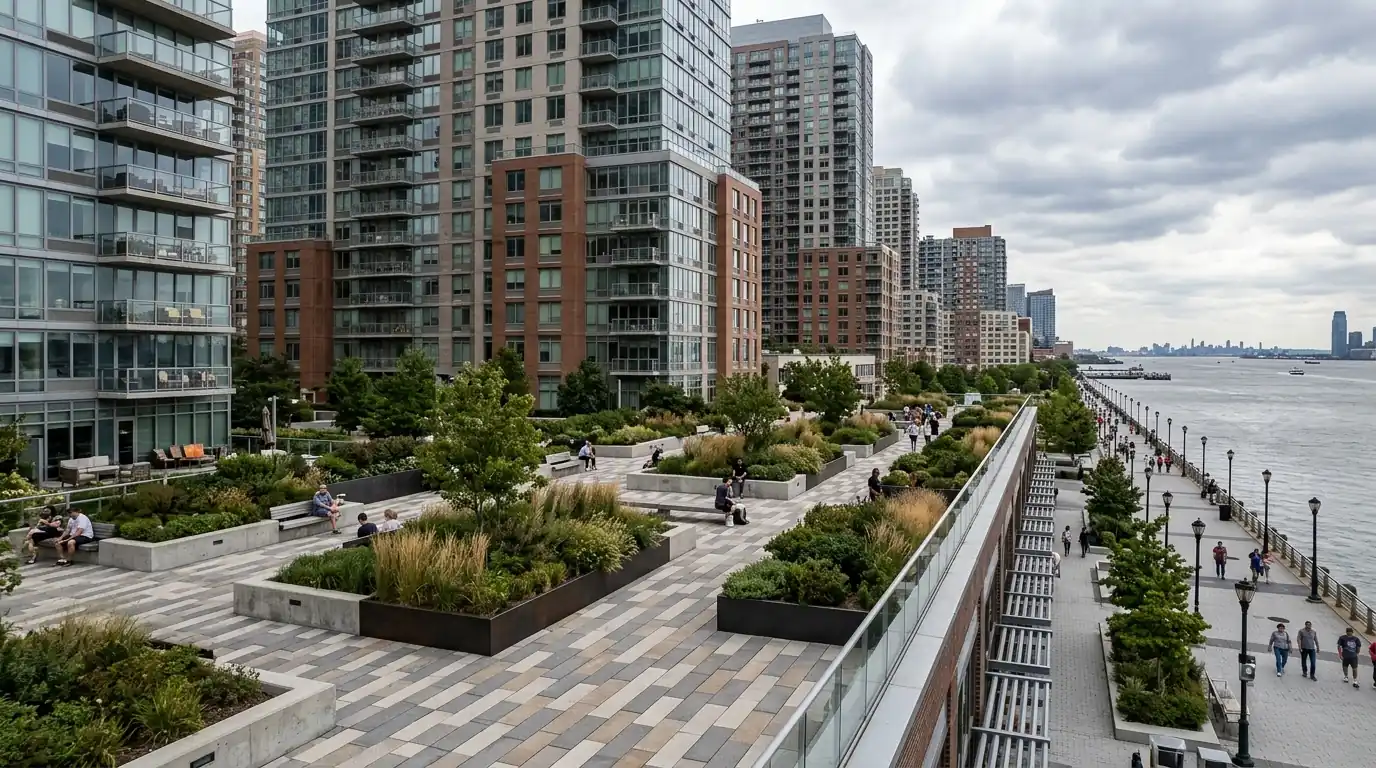
Higher up, the trouble moves to terraces and amenity decks. Pavers sit on pedestals over a membrane, and planters, sleepers and railing posts all pierce or load that membrane. When a seam or a penetration fails, water travels under the pavers and drips into the unit below, often far from the actual hole. Our balcony and terrace waterproofing work starts by lifting pavers along the suspected path, because guessing from a ceiling stain on the floor below is how money gets wasted. Penetrations for lighting, irrigation and railing posts are the next suspects after the field seams.
Every Newport job runs through the property manager or the condo board. We meet on site, look at the leak history, and put a written scope together that says exactly what we will open, repair and test, and which areas are common elements. Boards need that clarity to approve the work and to explain it to owners. Scheduling follows the building: loading dock windows, elevator reservations for material, garage spaces closed in sections so residents keep parking, and noisy work kept to daytime hours. We also give the manager a short written update after each phase so the board and residents know what has been completed and what comes next.
Garage work is done in phases. We clean and prepare one bay at a time, inject wall and slab cracks, rebuild failed expansion joints and apply parking garage waterproofing coatings that can take car traffic and salt. Elevator pits are treated with crystalline sealers or injection, coordinated with the elevator contractor so the cab is locked out safely while we work in the pit. Terraces get the same planning, with furniture and planters moved and stored before we lift pavers. When the work is complete we hand over a short record of what was repaired, where, and with which materials, for the building file.
Based on the buildings here, these are the calls we expect from Newport. Every other service on our list is available too.
Drips onto parked cars, rust stains on the ceiling and water reaching the storage rooms or shops below a garage deck all mean water is getting.
DetailsWater in an elevator pit is more than a nuisance: it rusts equipment, can take a car out of service and tends to show up on inspection reports.
DetailsWater from a terrace or balcony is showing up in the unit below, at the door frame, or as rust stains on the concrete.
DetailsWater is coming through the ceiling under your rooftop deck, and nobody can see the membrane because the deck sits on top of it.
DetailsA leak in a commercial building costs more than the repair: damaged stock, closed storefronts, unhappy tenants and an anxious board.
DetailsThe amenity deck is often the hardest leak in a Newport tower, because it covers apartments, a lobby or a garage, and it carries planters, pavers and heavy furniture. Leaks usually come from planter drains, pedestal punctures, failed flashing at walls and doors, or seams opened by thermal movement in strong summer sun. We test sections with controlled water, mark the path, and repair or replace the membrane in that zone. Our guide to decks and the roof underneath covers how these systems are built. Testing one section at a time is slower than guessing, but it finds the actual opening.
Some towers need a broader look at the whole envelope: window perimeters, balcony slab edges and roof flashing. We handle those through commercial waterproofing scopes priced per building. Smaller buildings toward Harsimus Cove and up the river in Hoboken have similar decks on a smaller scale. On the main roof, we repair membrane leaks, reseal flashing and clear drains so the roof keeps shedding water toward its outlets. Window perimeter leaks in the towers usually come from failed sealant joints, and we reseal those from the balcony side wherever access allows.

That depends on whether the terrace is a common element or a limited common element under your building's documents, which the board and its manager decide. What we provide is a clear written finding of where the water enters and which part of the system failed, so the board has facts to work from when assigning the repair.
The elevator has to be locked out while we work in the pit, so some downtime is unavoidable. We plan around it with the elevator contractor, often during low-use hours, and in buildings with more than one car we take one out at a time. Crystalline and injection treatments keep the pit work short.
Usually water is getting through a cracked deck, a failed expansion joint or a worn traffic coating on the level above. Salt and freeze-thaw cycles speed up that wear. We find the leaking joints and cracks, inject or rebuild them, and recoat the deck so water runs to the drains instead of through the slab.
Call (201) 578-5199 any time. Tell us the address and what you're seeing, and we'll take it from there.