Stains beside the chimney
Water marks on the ceiling or wall right next to where the chimney passes through.
Roof waterproofing · Jersey City, NJ
Water is running down the wall beside the chimney or staining the ceiling around it. The source may be the flashing at the roof line, a cracked crown, a missing cap, or brick and mortar soaking up rain like a sponge.
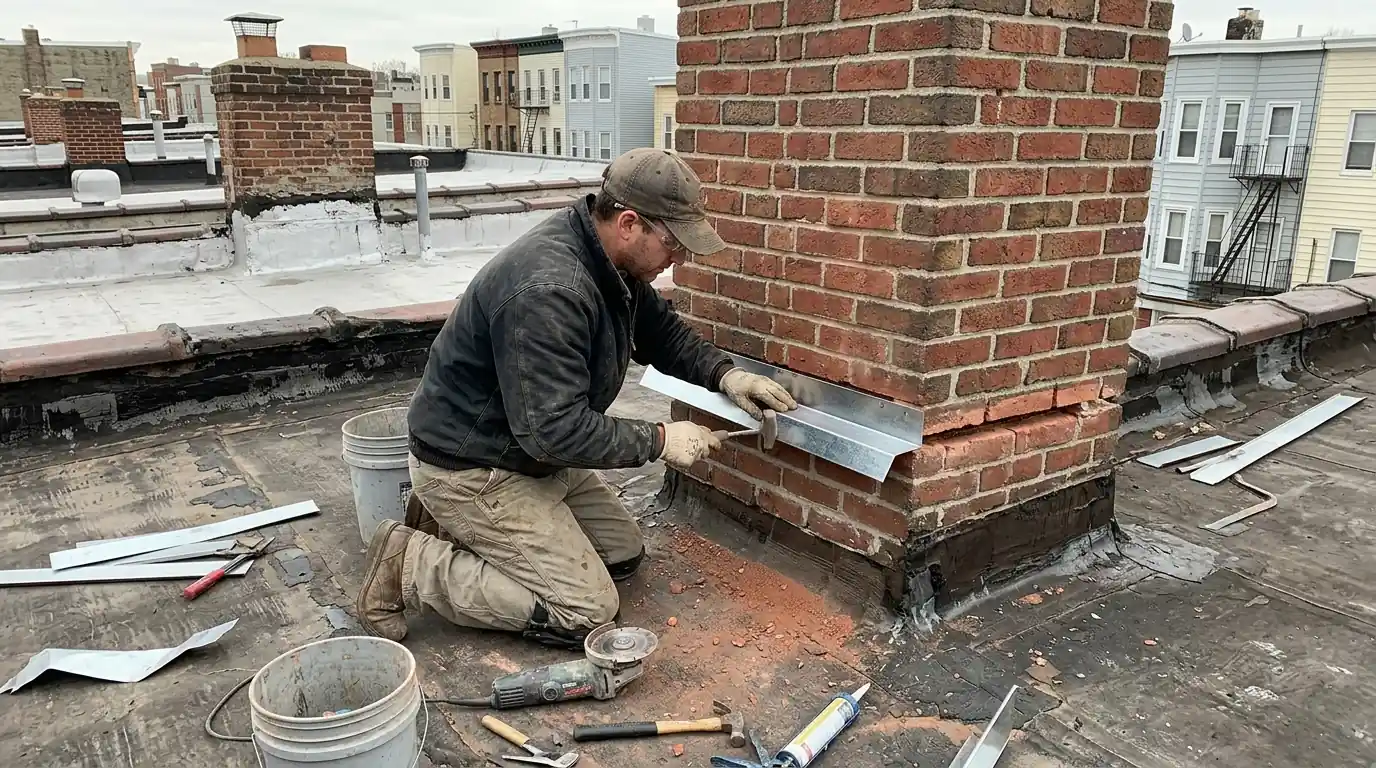
Chimney leaks in Jersey City come from four places: failed flashing where brick meets roof, a cracked crown, an open flue with no cap, and old brick and mortar absorbing water. Call (201) 578-5199 and our crew checks all four, rebuilds flashing with counterflashing cut into the mortar joints, seals the crown, caps the flue and treats sound brick with a breathable repellent. Failing masonry gets an honest call for a mason first.
A chimney is a brick box pushed up through the roof, exposed on four sides and across the top, and the joint where it meets the roof is one of the hardest spots on a building to keep dry. The roof and the masonry move differently with temperature, the brick absorbs water, and the chimney blocks the flow of rain running across the roof. Add freeze-thaw cycles and snow drifting against the uphill side, and it's easy to see why chimney leaks are among the calls we take most in winter.
In Jersey City we see two main settings. Frame two- and three-family houses in the Heights and Greenville often have a brick chimney rising through a pitched front roof, sealed with step flashing and counterflashing. Brick rowhouses downtown usually have chimneys on a flat roof, often several in a row along the party wall, sealed with membrane base flashing and metal counterflashing. Both fail in predictable ways, and both are fixable when the brick is still sound.
Water marks on the ceiling or wall right next to where the chimney passes through.
Metal glued to the face of the brick with caulk instead of set into the mortar joints.
Black tar smeared over the chimney base, often cracked and peeling.
Cracks across the top slab, or pieces missing from the edges.
An open flue with rain falling straight in.
Brick that stays dark after rain or shows white efflorescence, a sign it is soaking up water.
Spalled brick faces or joints you can rake out with a finger.
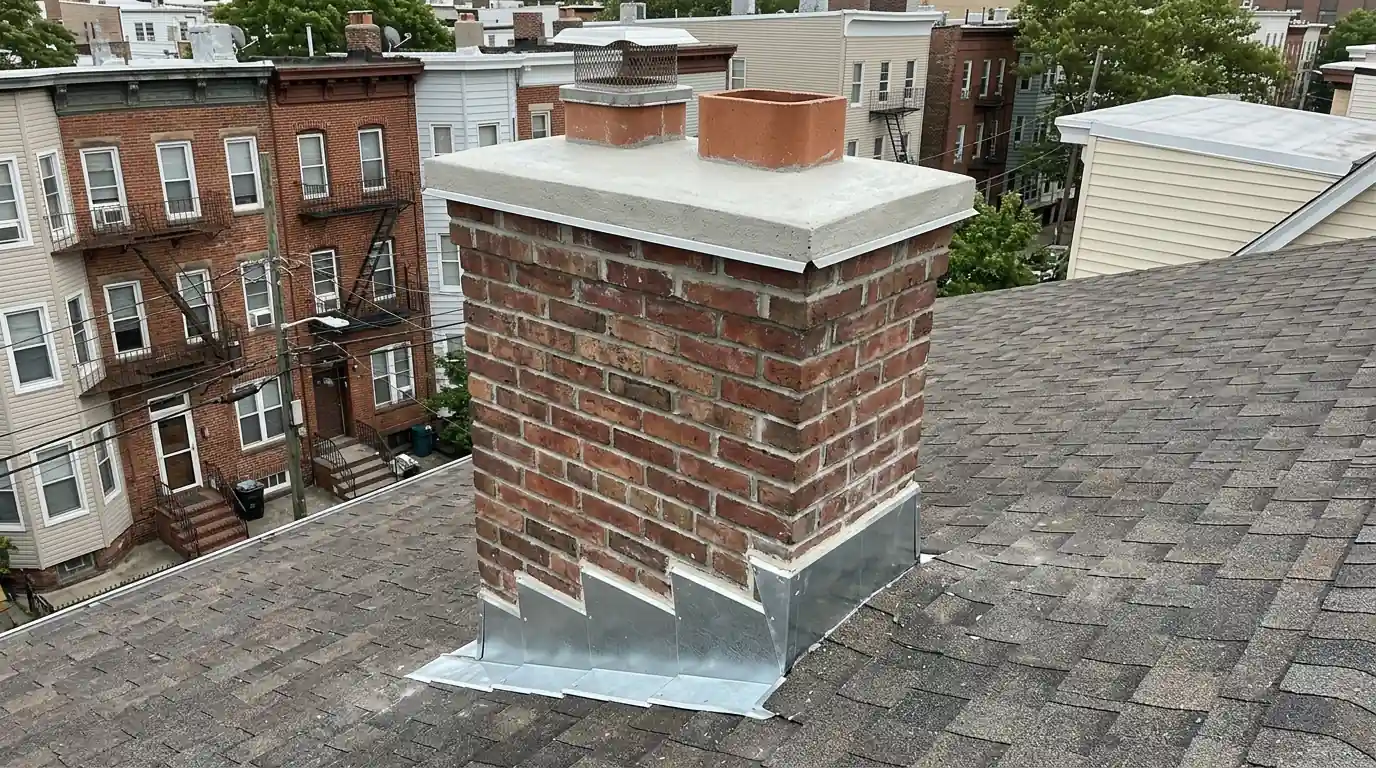
On a flat roof, membrane base flashing runs up each face of the chimney and is covered by counterflashing. The base flashing needs enough height that ponding water or drifted snow can't reach its top, and the corners need reinforcement because that's where cracks start. On a pitched roof, the sides get step flashing woven in course by course, with counterflashing over it, an apron at the front and a back pan or cricket at the rear. When one piece is missing or wrong, water finds the gap.
The most common shortcut we find is counterflashing that was never cut into the brick. Instead, it's surface-mounted and sealed with a bead of caulk, or the whole joint is smeared with roof cement. That holds for a season or two, then cracks. A proper repair grinds a clean slot into the mortar joint, sets the counterflashing into it and seals it with a compatible sealant or mortar. The methods are the same ones we use in roof flashing repair elsewhere on the roof.
Water trapped behind a wide chimney is its own problem. On a pitched roof a cricket, a small peaked ridge behind the chimney, splits the flow around both sides. On a flat roof, water dams against the uphill face and sits on the flashing for days, and a membrane cricket built during ponding water repair sends it toward the drains instead.
We check the cap, crown, brick, mortar and every piece of flashing. The masonry condition decides what comes next.
If the brick or mortar is failing structurally, we tell you a mason is needed first. Otherwise, we move ahead with the waterproofing.
Old counterflashing and roof cement come off. The membrane or roofing around the base is opened only as far as needed.
New base or step flashing goes in, with a cricket where water dams. Counterflashing is set into ground mortar joints and sealed.
Crown cracks are sealed, a cap goes on if one is missing, and open joints are repointed. Sound brick gets a breathable repellent.
We run water at the repaired faces and check inside. You get photos of the finished chimney.
Not every chimney leak starts at the roof line. The crown, the concrete or mortar slab on top, cracks with freeze-thaw and lets water straight into the core of the chimney. A missing cap lets rain fall down the flue. Both produce leaks that look exactly like flashing failure. We seal small crown cracks with a flexible crown sealer, fit caps where they're missing, and check that the crown overhangs and sheds water past the brick instead of onto it.
Then there's the brick itself. Old soft brick and washed-out lime mortar absorb rain through every face, and that water travels down inside the chimney until it reaches the roof line or a ceiling below. Where the joints are open, they get repointed with a compatible mortar. Where the brick and joints are sound but thirsty, we apply a breathable silane or siloxane repellent so the chimney sheds liquid water while vapor from the flue can still escape. Paint and film sealers trap that vapor, and we don't use them on chimneys.
Many rowhouse and walk-up roofs carry old chimneys that no longer serve anything. Nobody maintains them, so the crown cracks, the cap rusts away, the mortar washes out and the base flashing gets buried under decades of tar. These abandoned chimneys are one of the most common leak sources we find on flat roofs downtown and around Journal Square.
Options depend on the chimney's condition. A sound one can be capped with a solid cover, its crown sealed, its brick treated and its base reflashed so it stops taking water. A deteriorating one can be taken down below the roof line by a mason, after which we close and waterproof the opening so it disappears into the roof surface and stops feeding water into the top floor. When the brick is spalling, the chimney leans or the mortar is mostly gone, flashing won't hold, and we say so plainly rather than sealing a wall that needs rebuilding first.
$395 to $1,480
per chimney, typical range
Most chimney leak repairs land between $395 and $1,480. That's a typical range, not a quote; chimney size, roof type and how many sources are leaking move it the most.
Not listed? See every area we serve or call (201) 578-5199.
Membranes, sealers, pumps and dehumidifiers we work with come from makers such as
Because that's when the most water hits the uphill side of the chimney. Light rain runs past a marginal back flashing; heavy rain and melting snow pile up behind it and find any gap. That pattern often points to a missing cricket or a failed back pan. We check the back of the chimney first when the leak shows up only in big storms.
Yes. Proper counterflashing is set into a slot ground into the mortar joints, then sealed. That way water running down the brick flows over the flashing, not behind it. Counterflashing glued to the brick face with caulk fails within a few seasons as the caulk dries and cracks. Most chimney flashing we redo was installed that way.
It depends on its condition. A sound abandoned chimney can be capped, its crown sealed and its base reflashed so it stops taking water. A deteriorating one can be taken down below the roof line by a mason, and we close and waterproof the opening. We'll look at it and explain which makes more sense for your building.
Yes. Old soft brick and eroded mortar absorb rain on every face, and the water runs down inside the chimney to the roof line or a ceiling below. If the flashing tests dry, we look at the brick next. Open joints get repointed, and sound but absorbent brick gets a breathable silane or siloxane repellent.
It can. A cracked crown lets water into the top of the chimney, where it runs down through the brick and shows up near the roof line, looking just like a flashing leak. We check the crown on every chimney call. Small cracks can be sealed with a flexible crown sealer; a badly broken crown is mason work.
Call (201) 578-5199 and tell us what you're seeing. We'll set up a visit and give you a typical range before any work starts.