Chalky or faded surface
EPDM or an old coating rubs off gray or white on your hand. The surface is weathering but may still be sound.
Roof waterproofing · Jersey City, NJ
Your flat roof is chalky, crazed on the surface and baking the top floor every summer, but it isn't leaking yet. That is exactly when a properly prepared coating adds real years instead of hiding trouble.
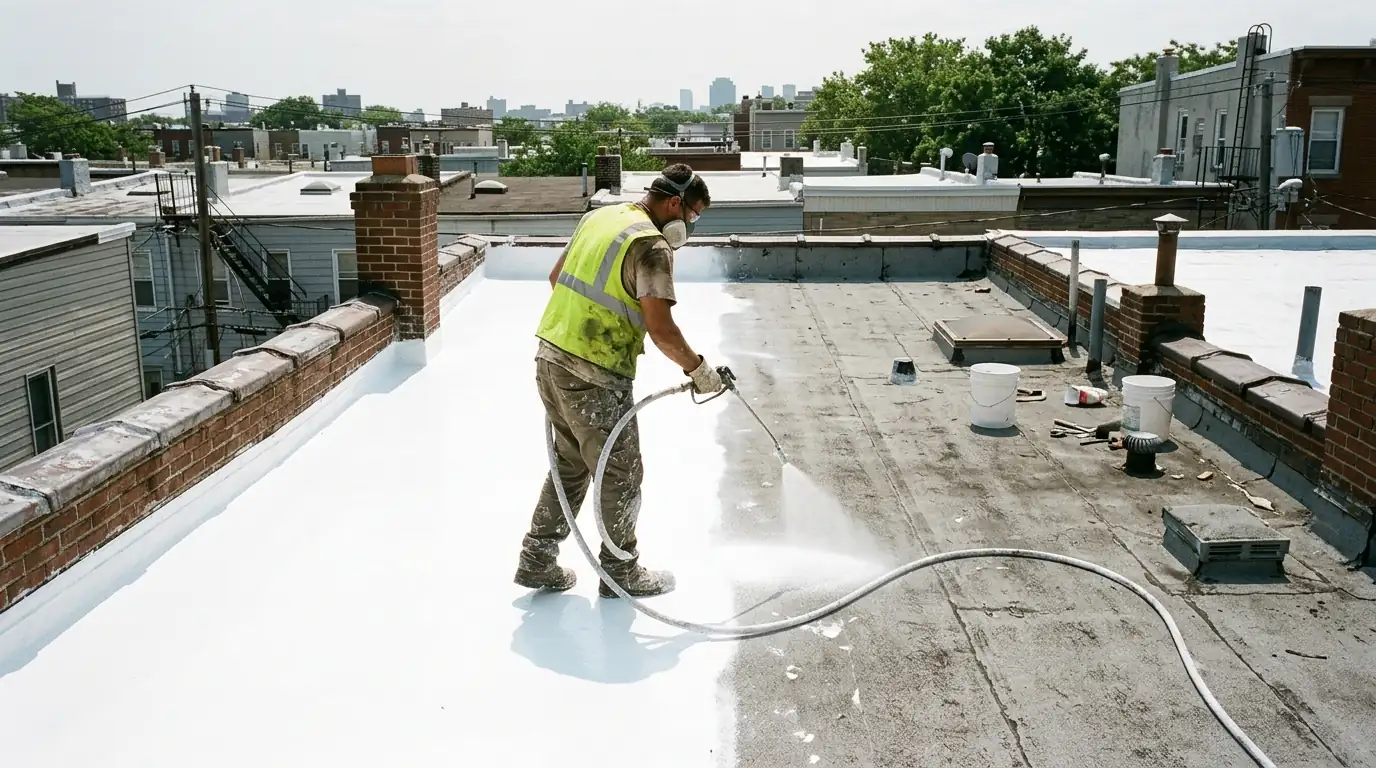
A roof coating only works over a roof that is dry and sound, so every Jersey City coating job we take starts with a moisture survey. Call (201) 578-5199 and our technicians check the membrane, cut out any wet spots, clean and prime the surface, reinforce seams and flashings with fabric, then apply silicone, acrylic or aluminum at a measured mil thickness. If the roof is too far gone, we say so plainly.
A coating is a restoration step for a roof that still keeps water out but is losing its surface. Think of a modified bitumen roof whose granules have worn thin, an EPDM roof turning chalky, or an aluminum-painted built-up roof that has gone dull and started to craze. The membrane underneath is still attached, the seams are mostly tight, and the insulation is dry. On a roof like that, a coating renews UV protection, closes small surface cracks and keeps the membrane working for a good stretch of years.
It is the wrong call when the roof is already wet inside. Water trapped in insulation or between plies keeps rotting the deck and will blister any coating laid over it. It is also the wrong call on a roof with seams failing everywhere, heavy ponding that never dries, or a deck that flexes underfoot. A roof with a few open seams gets targeted leak repairs first. One that is saturated across most of its area has reached the end of its life and needs replacing; a coating sold onto it is money spent twice.
We probe and core the roof to find any wet insulation. The result decides whether a coating is the right fix at all.
Any wet areas are cut out and replaced with dry insulation and membrane. Blisters and loose seams are fixed at the same time.
The roof is washed, dried and primed to suit its surface. Without this step, even a good coating peels.
Seams, flashings, drains and penetrations get a fabric-reinforced base coat. These are the places a roof cracks first.
The coating goes on in passes to a specified mil thickness. We gauge it as we work so there are no thin spots.
We check the finished surface, clear drains and photograph the roof. You'll know what was done and how to keep it clean.
You can't see wet insulation from the surface. A roof can look fine and still hold water in a few soft areas around a drain or along a parapet. So before we price a coating, we walk the roof, probe suspect areas and take small core samples where readings or soft spots suggest moisture. Each core is patched the same day.
If the survey finds a few wet sections, those get cut out, dried in with new insulation and membrane, and then the whole roof is coated. If it finds a large share of the roof is wet, coating stops making sense, and we'll show you the cores so you can see the problem yourself. That honesty matters on Jersey City walk-ups and condo buildings where several owners share the cost and need to understand why one plan was chosen over another.
The survey also tells us which coating chemistry fits. Some old roofs have been coated before, and not every product sticks to every other product. Silicone, for one, bonds poorly to almost anything except more silicone once it has weathered a few seasons. Asphalt-based roofs can bleed oils into some white coatings and stain them tan within a season, so on those we use a bleed-blocking base coat or a product made to sit over asphalt.
Coatings fail at the prep stage far more often than at the product stage. Dirt, soot, biological growth and loose granules all stop the coating from bonding, so we clean the roof thoroughly and let it dry. Any blisters are cut and repaired, loose seams are re-adhered, and the right primer goes down for the substrate, whether that's EPDM, modified bitumen, built-up or an older coating.
Next comes reinforcement. Seams, flashings, drains and penetrations get a detail coat embedded with polyester fabric before the field coats go on, because these spots move the most and crack first. Then the topcoat is applied in passes to a specified dry mil thickness, which we check with a gauge rather than guessing. Too thin and the coating wears through early; uneven and it fails first at the thin spots. On roofs with a lot of tired flashing, that reinforcement step does a big share of the real work.
A dark flat roof in a Jersey City summer gets very hot in strong sun, and the top-floor unit pays for it. A white reflective coating sends much of that heat back to the sky instead of into the ceiling below. Owners and tenants on the top floor of brick rowhouses and walk-ups often notice the difference in the first heat wave after the job, and the membrane underneath ages more slowly because it no longer bakes all afternoon.
Reflectivity drops as a white roof gets dirty, so a gentle rinse once a season helps. Aluminum coatings reflect well too, though less than a clean white finish, and they suit older built-up and asphalt-based roofs where some white products are a poor match. Drainage gets checked before the product is chosen, because a reflective finish under standing water for days loses its edge fast. Where water lingers, ponding water repair comes first, and our guide on how much standing water is too much explains the threshold.
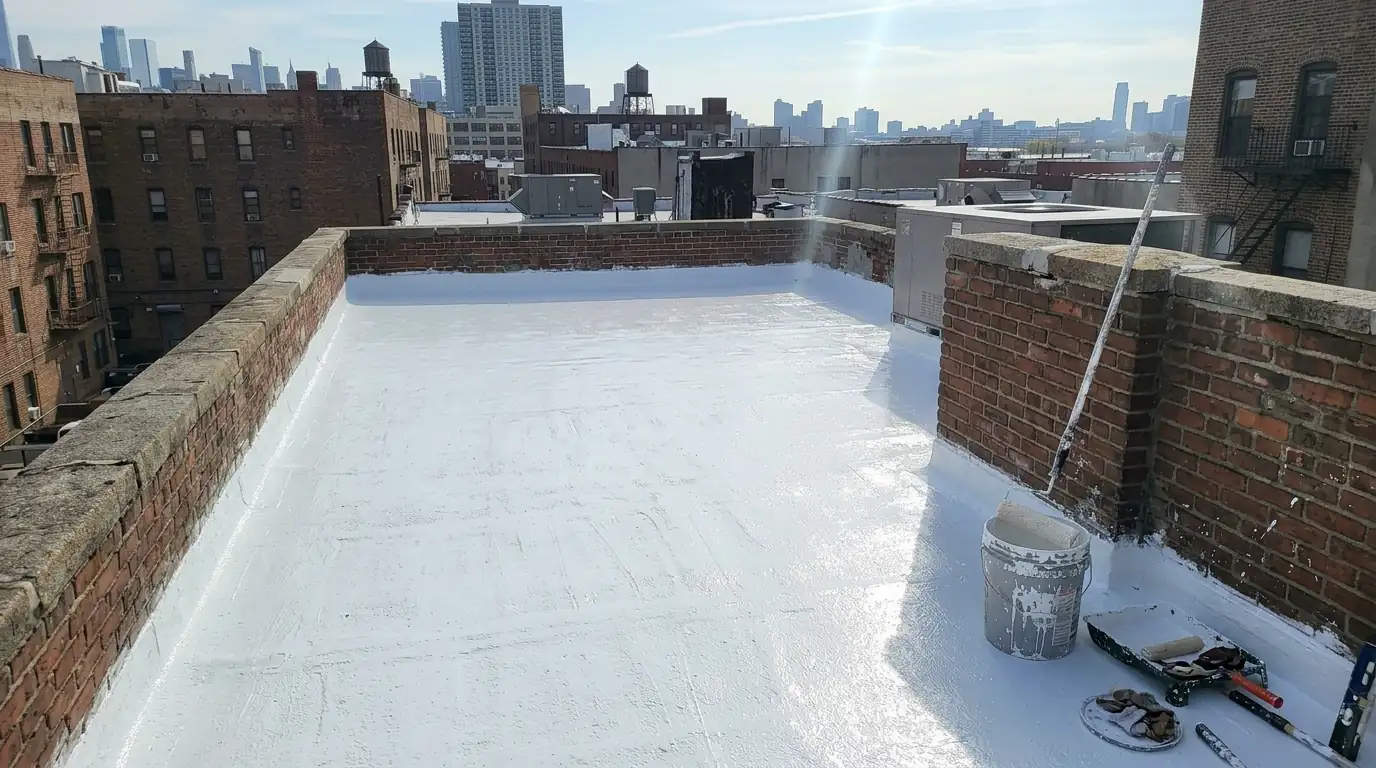
EPDM or an old coating rubs off gray or white on your hand. The surface is weathering but may still be sound.
Modified bitumen showing black asphalt where the mineral surface has worn away in the sun.
A web of shallow cracks on an asphalt or aluminum-coated roof, with no leaks below yet.
The top-floor unit runs much warmer than the rest of the building on sunny summer days.
A built-up roof whose silver coating has gone gray and patchy and no longer reflects.
No soft spots underfoot and no ceiling stains, which is exactly when a coating pays off most.
$3.15 to $6.85
per sq ft, typical range
Most roof coating jobs land between $3.15 and $6.85 per sq ft. That is a typical range, not a quote; prep and repairs move the number more than the product does.
| Coating | Where it fits | Trade-offs |
|---|---|---|
| Silicone | Low-slope roofs that hold some water after rain; EPDM, TPO and mod bit with good prep | Collects dirt; later recoats need silicone again |
| Acrylic | Well-drained roofs where reflectivity and budget matter most | Doesn't tolerate standing water well |
| Aluminum | Older built-up and asphalt-based roofs | Reflects less than clean white; mainly a protective layer |
Not listed? See every area we serve or call (201) 578-5199.
Membranes, sealers, pumps and dehumidifiers we work with come from makers such as
Not on its own. A coating isn't designed to bridge a split seam or a failed flashing, and if water is already getting in, the insulation under that spot is probably wet. We find and repair the leak first, replace any wet material, and then coat the roof. Coating over an active leak traps moisture and usually ends with blisters and peeling.
The moisture survey tells us. If a large share of the roof has wet insulation, the deck flexes underfoot, or the seams are failing all over, the membrane has reached the end of its life and a coating won't save it. We'll show you the core samples and readings so the call is clear. A few wet spots don't rule out coating; widespread saturation does.
Usually it helps noticeably. A dark roof absorbs a lot of summer sun and passes that heat into the ceiling below. A clean white coating reflects much of it away. The effect is strongest on buildings with little insulation, which describes many older Jersey City rowhouses and walk-ups. Keeping the surface clean helps it keep working.
Because thickness is what you're paying for. Each product is designed to protect the roof at a certain dry thickness, and a thin coat wears through early, starting at the high spots. We apply in passes and check with a gauge so the coating meets that specification across the whole roof, including the edges and details.
Sometimes. It depends on what the old coating is and how firmly it still grips the roof. Loose or peeling coating has to come off. Silicone is the tricky one, because few products other than silicone stick to it. We test adhesion on a small area before committing to a system, and we tell you the result.
Call (201) 578-5199 to set up a visit. We'll photograph what we find and tell you what can wait and what can't.