Water after 48 hours
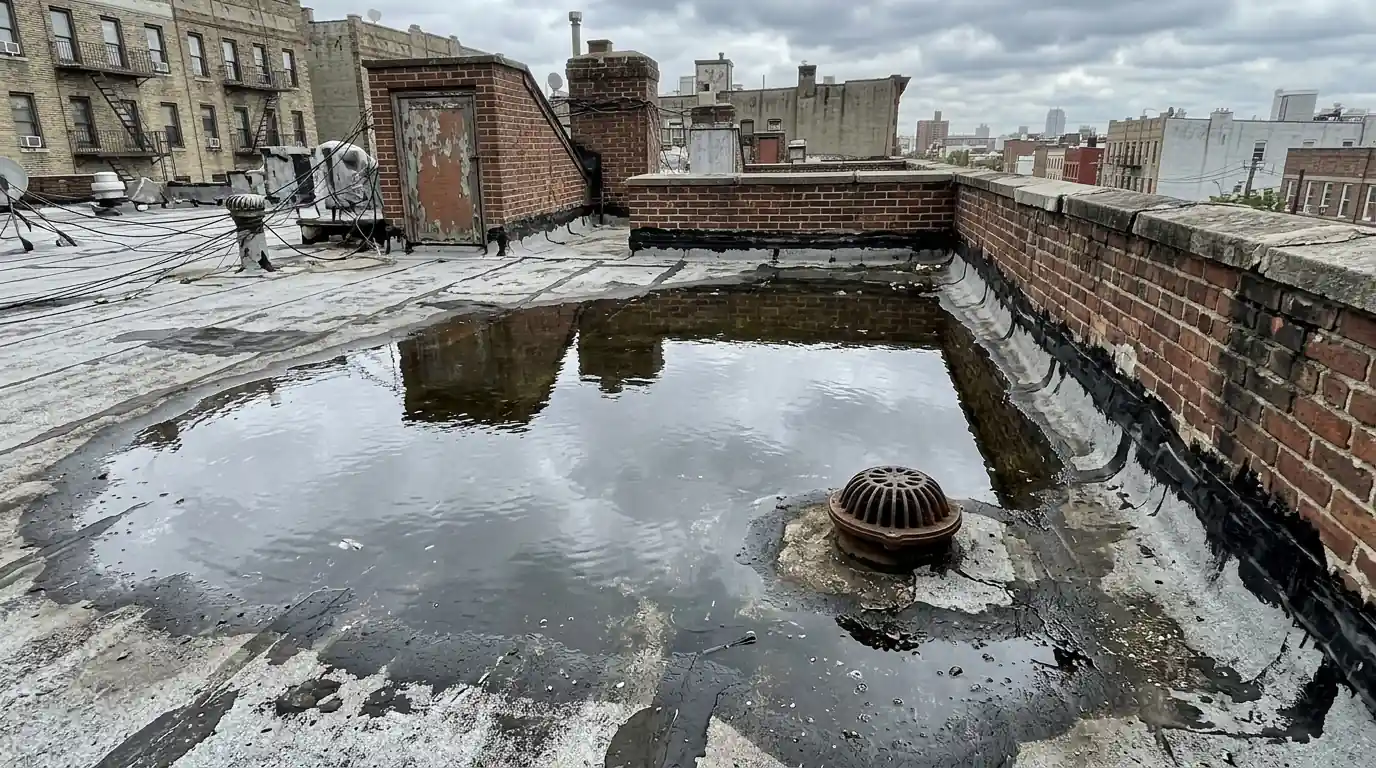
Puddles still on the roof two full days after rain in normal drying weather.
Roof waterproofing · Jersey City, NJ
Two days after the rain stopped, there's still a puddle on your flat roof. That standing water is wearing out the membrane and loading the structure, and we fix the reason it can't drain.
If water is still standing on your Jersey City flat roof 48 hours after rain, call (201) 578-5199. Our crew finds out why it won't drain, whether that's a clogged or high drain, crushed insulation, a sagging deck or no slope at all. Then we fix it with crickets, tapered insulation under new waterproofing, a lowered or added drain, or a scupper, so the roof empties on its own.
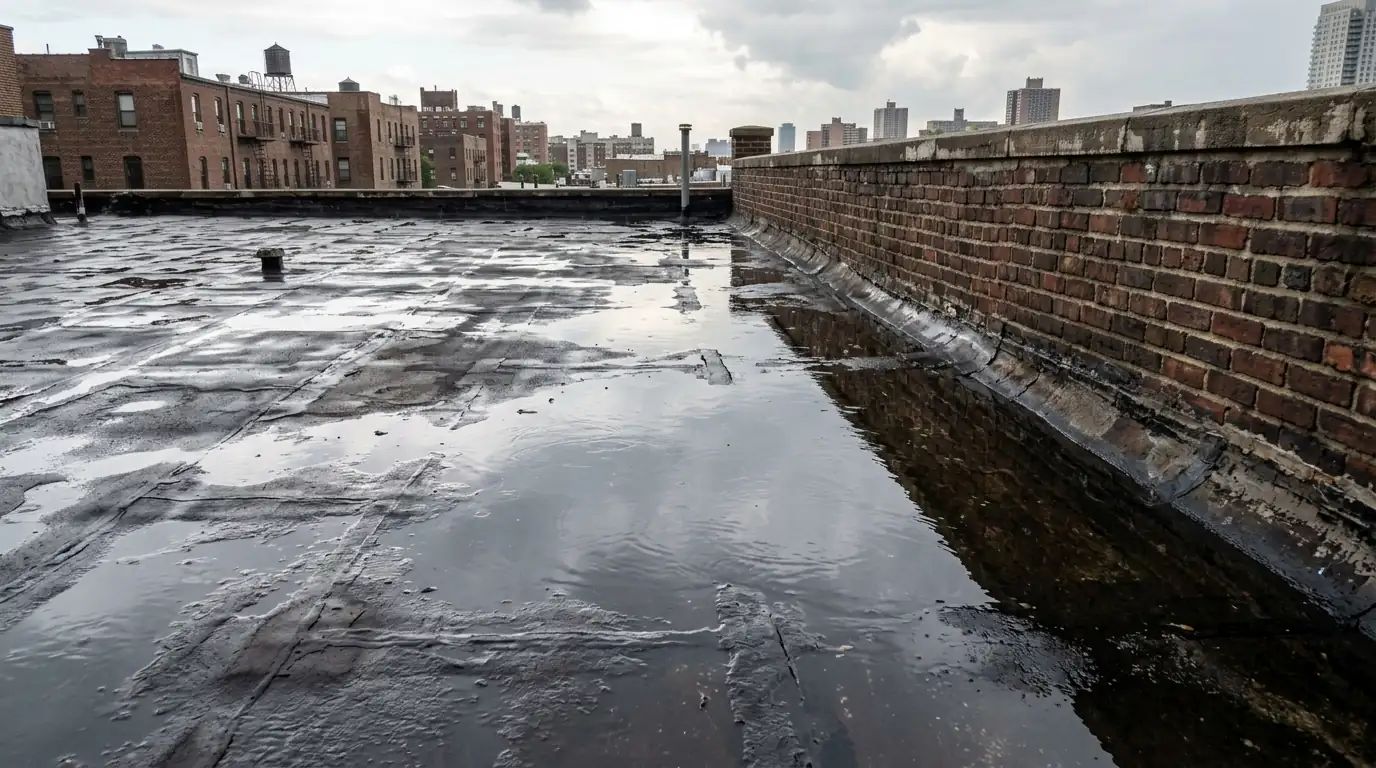
A flat roof is never perfectly flat; it's supposed to have a gentle slope that moves water to drains or scuppers. Small puddles that dry within a day or two after rain are normal on many older roofs. The common rule is that water still sitting 48 hours after the rain stopped, in normal drying weather, is ponding, and it needs attention. On a dark roof in summer that drying happens fast, so water lingering past two days in July usually means a real low spot rather than slow evaporation.
Ponding matters for two reasons. First, weight: one inch of standing water weighs about 5.2 lb per sq ft. A pond a few inches deep across a large area adds real load to old joists, and as the deck deflects, it holds even more water the next time. Second, wear: standing water speeds up surface breakdown, finds every weak lap, grows algae, and in winter freezes and expands at seams. Our guide on how much ponding is too much covers the warning thresholds in more depth.
Puddles still on the roof two full days after rain in normal drying weather.
Rings of dried silt or algae that outline where water sits and evaporates.
A roof drain that stays dry while water pools somewhere else on the roof.
A noticeable dip in the roof surface, often between joists or in the middle of the span.
Top-floor ceilings cracking or bowing under the low area of the roof.
Sheets of ice on the roof long after snow has melted elsewhere.
On Jersey City buildings, we see the same handful of causes over and over. Older rowhouse roofs were often framed with almost no pitch, and over a century the joists have sagged in the middle. Pre-war walk-ups around Journal Square and McGinley Square rely on internal drains that sometimes sit higher than the roof around them after extra layers were added over the years. And on many roofs, insulation has compressed under foot traffic or equipment, leaving low spots.
Blocked drains are the simplest cause and the first thing we check. Leaves, gravel, debris and tennis balls clog strainers and drain bowls, and the water backs up across the roof. After the remnants of Ida overwhelmed drains across north Jersey, a lot of owners learned how fast a clogged roof drain becomes a ceiling problem. Here's what we usually find when a roof won't empty:
We visit after rain, or flood test lightly, to map where water sits and how deep. Photos and measurements show the problem areas.
Drains, strainers, scuppers and leaders are cleared and tested. We note where each leader discharges at ground level.
We check deck deflection, drain heights and insulation condition. Structural concerns get flagged for a carpenter or engineer.
We lay out crickets, tapered insulation, new drains or scuppers. You see the plan and the reasoning before any work starts.
Tapered boards or crickets are installed and waterproofed into the surrounding roof. Drains are reset or added at the true low points.
We check the roof after the next rainfall to confirm it drains. Any small leftover puddles get addressed.
The fix matches the cause. A clogged drain needs clearing, a proper strainer and a check of the leader below it. Water trapped behind a chimney, hatch or rooftop unit is fixed with a cricket or saddle, a small built-up ridge that splits the flow and sends it around the obstruction toward the drains. Where the water first got in through a split seam in the pond, we close that with flat roof leak repair at the same visit.
Where a broad section is flat or sagging, tapered insulation is the most common lasting fix. Tapered boards are cut with a built-in slope, laid in a pattern that pushes water toward drains or scuppers, and sealed over with new membrane tied into the surrounding roof. On cluttered roofs we usually finish that section with liquid-applied waterproofing so the new slope and the old roof meet without a lap that can open.
Sometimes the drainage itself needs to change. We can lower a drain that sits too high by resetting the bowl, add a drain at the actual low point, or cut a scupper through a parapet to let water off the edge into a leader. Then we follow that water down. A leader that empties against the foundation just moves the problem to the basement, so where it fits we carry it away with underground leader drains.
If the roof deck has visibly sagged, the joists underneath may be overloaded, rotted or undersized, especially on older frame buildings in the Heights and Greenville. Tapered insulation can fill a modest dip, but it can't make up for a structural problem. When we see deep deflection, soft decking or signs of rot, we tell you plainly that a carpenter or engineer should look before we build up the surface.
In many cases the answer is a sequence: the framing is reinforced and rotted deck boards replaced by the right trade, then we add tapered insulation and new waterproofing over the corrected surface. Doing it in that order means the roof drains as designed and doesn't slowly sag back into a pond. It also protects the new membrane, because a roof that ponds again will wear out at the same low spot within a few seasons.
Snow adds to the picture. A ponded area that freezes, then collects drifting snow behind a parapet, carries far more weight than the same roof after a summer storm. On older frame buildings, that's one more reason to fix ponding before winter rather than after the first heavy snowfall. We're glad to look at a low spot in the fall and tell you whether it can wait or should be handled now.
| Fix | Best for | Notes |
|---|---|---|
| Cricket or saddle | Water trapped behind a chimney, hatch or unit | Small built-up ridge, quick to add |
| Tapered insulation | Broad flat or sagging sections | Sealed over with new membrane |
| Lower or add a drain | Drain sitting high or not at the low point | Ties into the building's leaders |
| Scupper through parapet | Roofs with no outlet near the low area | Needs a leader below to carry water down |
$690 to $4,280
per roof, typical range
Most ponding water repairs land between $690 and $4,280. That's a typical range, not a quote; the size of the low area and the fix it needs set the price.
Not listed? See every area we serve or call (201) 578-5199.
Membranes, sealers, pumps and dehumidifiers we work with come from makers such as
The common rule is 48 hours after the rain stops, in normal drying weather. Puddles that disappear within that window are usually fine. Water that stays longer is ponding and is wearing on the membrane, loading the structure and freezing in winter. If you're seeing water hang around past two days, it's worth having the cause checked.
One inch of standing water weighs about 5.2 lb per sq ft. A few inches across a large section adds a lot of load to older framing, and as the deck bends under it, the low spot gets deeper and holds more next time. That cycle is why ponding should be fixed before it turns into a structural problem.
Usually, yes. Water often gets trapped on the uphill side of a chimney, hatch or rooftop unit. A cricket, a small sloped ridge built up behind the obstruction, splits the water and sends it around to the drains. It's covered with membrane tied into the surrounding roof and flashing, so it becomes part of the roof surface.
It can level out a modest dip and give the roof real slope to its drains. It can't fix framing that's overloaded or rotted. If the deck has sagged significantly, we'll recommend a carpenter or engineer check the joists first. Once the structure is sound, tapered insulation sealed under new waterproofing gives the roof a lasting drainage pattern.
Call (201) 578-5199 and tell us what you're seeing. We'll set up a visit and give you a typical range before any work starts.