Lawn soggy for days
Grass stays spongy and wet several days after a storm while the rest of the yard dries out.
Sump pumps & drainage · Jersey City, NJ
If part of your yard stays soggy for days after rain, or water runs down a narrow side yard toward your foundation, an exterior French drain intercepts it underground and carries it somewhere it can actually leave.
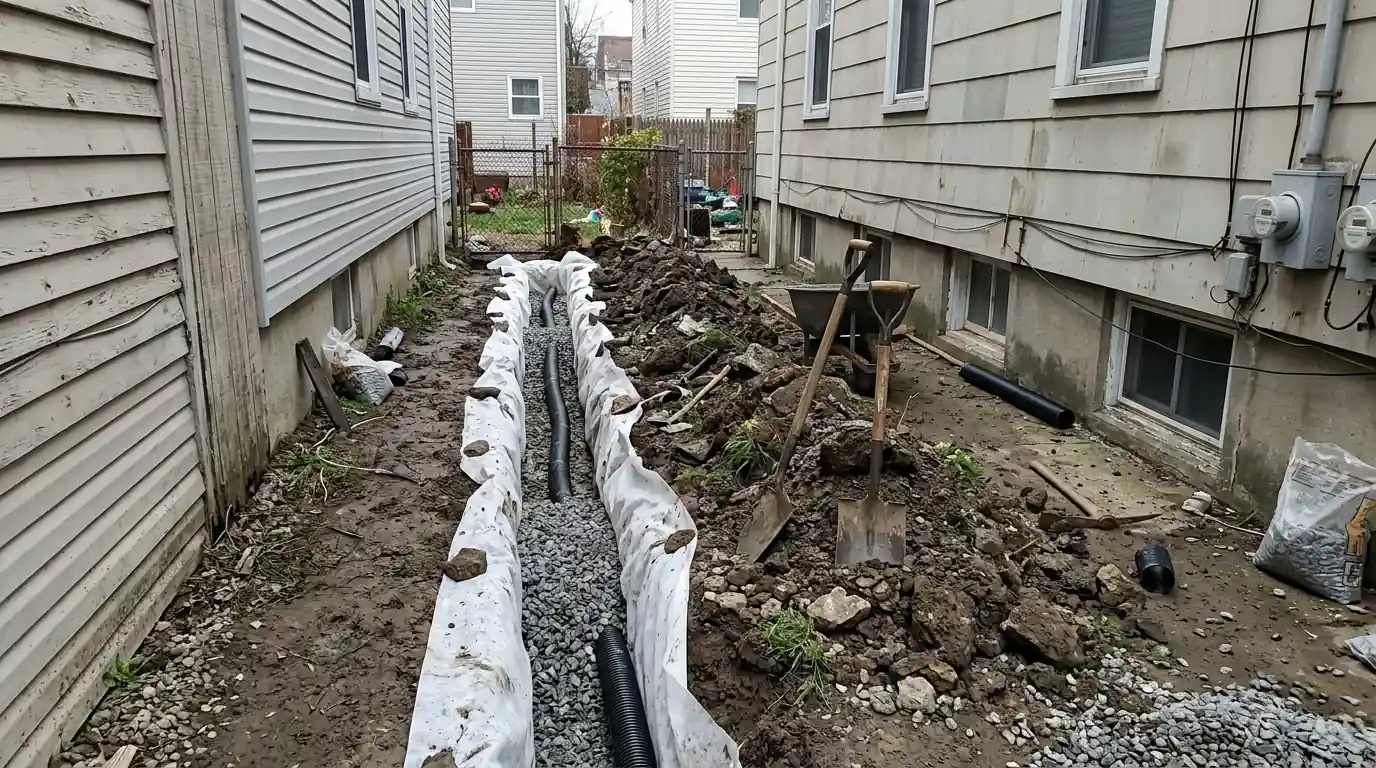
For Jersey City yards that hold water, we dig a trench, line it with filter fabric, lay perforated pipe in clean gravel and run it to an outlet: daylight, a dry well or a sump. The drain catches groundwater and runoff before it reaches the foundation. Call (201) 578-5199 and we'll look at the slope, the soil and where the water can go.
A French drain is a gravel-filled trench with a perforated pipe at the bottom. Water in the soil follows the path of least resistance, and loose gravel is far easier to move through than packed clay or old fill. It seeps into the trench, drops into the pipe through its holes and runs by gravity to an outlet. The trench intercepts water before it reaches the place you don't want it, usually a foundation wall or a low patch of lawn.
This is outdoor work, and it's different from an interior drain system, which sits under the basement slab along the inside of the walls and feeds a sump. An exterior drain stops water out in the yard; an interior drain manages water that has already reached the foundation. Many wet basements need only one of them, and some need both. Our interior versus exterior guide lays out how we decide.
The two drains also behave differently in our soils. On the Palisades ridge, where rock sits close to the surface, water moves sideways along the rock and through the soil toward a foundation, so a trench on the uphill side of the house can catch much of it before it arrives. On low, filled ground near the Hudson, the water table itself is often the problem, and an exterior trench can only lower it so far. When that's the case, we tell you an interior system is probably the better spend.
Grass stays spongy and wet several days after a storm while the rest of the yard dries out.
Puddles collect along the foundation or at the low end of a side yard walk.
Moisture or white efflorescence shows up on the basement wall nearest the wet part of the yard.
Soil washes across a walk or patio and leaves silt lines after rain.
Moss on pavers or slime on concrete marks the spots where water sits.
A low corner that holds water for days breeds mosquitoes through the warm months.
Jersey City lots are small. A side yard between a frame house and its neighbor in the Heights or Greenville can be barely wider than the concrete walk that runs its length, with roof water pouring off both buildings into it. That narrow strip is often where a basement wall takes its worst soaking. A shallow French drain along the walk, or beneath it, catches that water and moves it to the front or rear instead of letting it pool against the house.
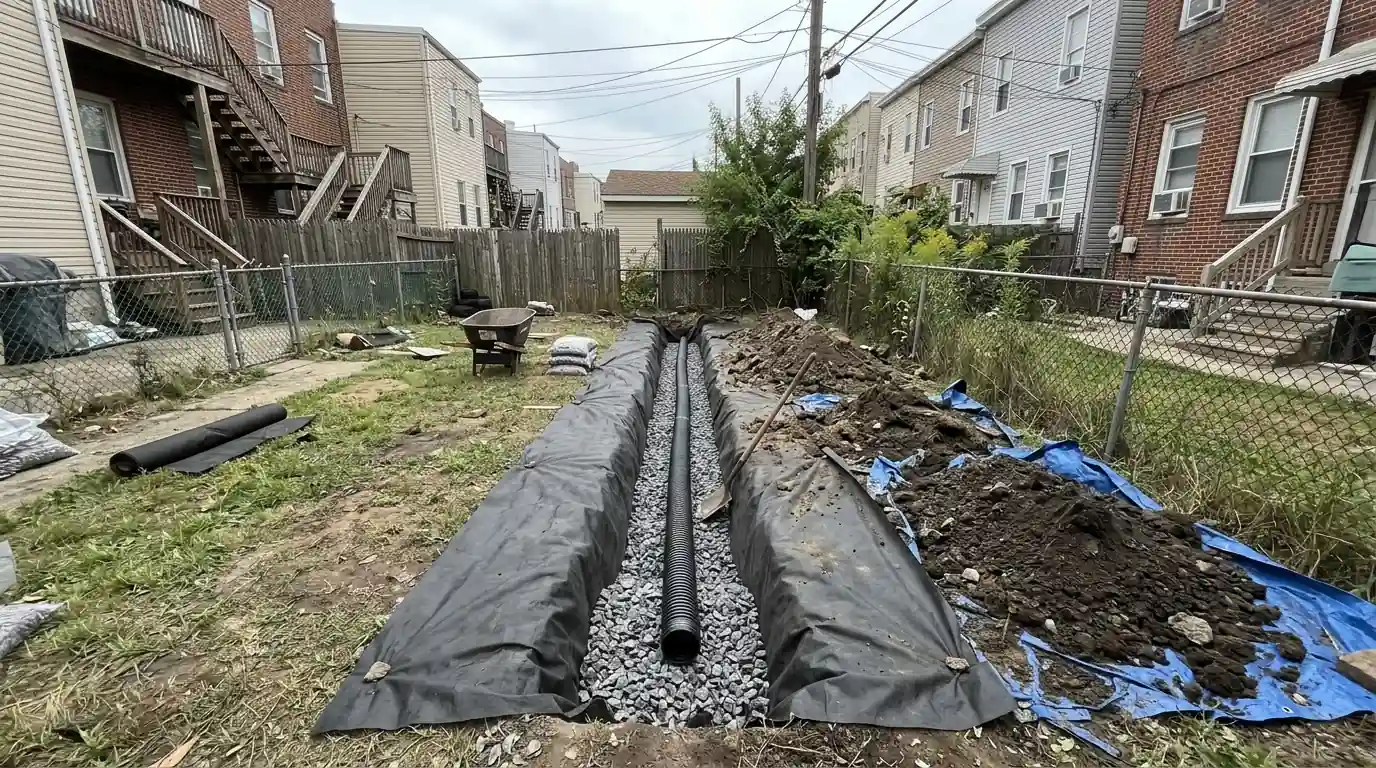
Rear yards behind rowhouses bring their own puzzles: fences, sheds, patios, old trees and almost no slope at all. We work by hand where machines won't fit, carry soil out through the side gate or the house, and protect floors along the way. In Bergen-Lafayette and other neighborhoods with rowhouses and two-family homes, a well-placed drain, sometimes paired with regrading the yard, turns a muddy yard into one you can use the week after a storm.
We watch where water goes, check the slope with a level and look for an outlet. Underground utility lines are marked before any digging.
We map the trench path, depth and fall from the high end to the outlet. You see exactly where it runs before we start.
We dig by machine where it fits and by hand along walls, fences and walks. Soil is staged on tarps or hauled away.
We line the trench with fabric, bed the perforated pipe in washed gravel and wrap the fabric over the top. A cleanout goes in at the high end.
The pipe ties into daylight, a dry well or a sump basin. We run water from end to end to confirm the fall.
We backfill with soil, sod or decorative stone, or relay the pavers we lifted. The yard is left clean and level.
We cut the trench to a depth and slope set by where the water is and where the outlet sits, usually somewhere between knee and waist deep. The trench is lined with a non-woven filter fabric that lets water through but keeps fine soil out of the stone. Clean, washed gravel goes in the bottom, then the perforated pipe with its holes facing down, then more gravel, and finally the fabric is folded over the top before soil or stone goes back on.
That fabric wrap is what keeps a French drain working for many years. Without it, silt slowly fills the gaps between the stones and clogs the pipe, and the drain quietly stops draining. We also pitch the pipe evenly, with no dips where water and sediment can sit, and add a cleanout at the high end so the line can be flushed with a hose later on.
A French drain is only as good as the place it empties. Water collected along the trench has to leave the property or go somewhere the ground can absorb it. On a sloped lot, the pipe can run out to daylight at a lower spot in the yard. On flat lots, which describes most of Jersey City, that's rarely possible, so we send the water to a dry well, a buried chamber that lets it soak into the ground slowly, or to a sump with a pump that lifts it out.
We won't build a drain that empties against a neighbor's wall or back toward your own foundation. Where the soil already holds water near the Hudson and Newark Bay, a dry well may fill and stay full, and a pumped outlet makes more sense there. We walk the yard with you, look at where your leader drains already run, and settle the outlet before any digging starts.
| Question | Exterior French drain | Interior drain system |
|---|---|---|
| Where it sits | In the yard or along the outside of the foundation | Under the basement slab along the inside walls |
| What it catches | Groundwater and runoff before it reaches the house | Water already seeping in at the walls and cove joint |
| Where water goes | Daylight, a dry well or a sump | An interior sump pit and pump |
| Disruption | Yard, walk or patio dug up | Basement floor cut and patched along the walls |
| Best for | Soggy yards and side yards draining toward the house | Basements with seepage that yard work can't reach |
$42 to $96
per linear ft, typical range
Most jobs land between $42 and $96 per linear foot, with the outlet planned into the price. Your route and your yard decide where in that range you fall.
Not listed? See every area we serve or call (201) 578-5199.
Membranes, sealers, pumps and dehumidifiers we work with come from makers such as
It depends on what it's catching. A drain meant to stop surface runoff in a side yard can be fairly shallow, while one meant to lower groundwater near a foundation runs deeper. The depth also has to work with the outlet, since the pipe must fall toward it the whole way. We set the depth after looking at the slope, the soil and where the water needs to go.
Yes, with care. We keep the trench on your property, avoid undermining fence posts or a neighbor's footing, and never point the outlet toward their wall. In tight rowhouse yards that sometimes means a shallower trench or a different route. We talk through the layout before digging so there are no surprises on either side of the fence.
The French drain is the trench and perforated pipe that collect the water. A dry well is one possible destination for it: a buried chamber surrounded by stone where collected water slowly soaks into the ground. Many drains in flat Jersey City yards end in a dry well because there's no lower spot to run the pipe out to daylight.
Filter fabric around the gravel keeps fine soil out, and fine soil is the main cause of clogging. Roots can find their way in near large trees, so we route around them where we can. A cleanout at the high end lets you flush the line with a hose, and we can clear it with a jetter if it slows down years later.
Call (201) 578-5199 and tell us what you're seeing. We'll set up a visit and give you a typical range before any work starts.