Parking Garage Waterproofing
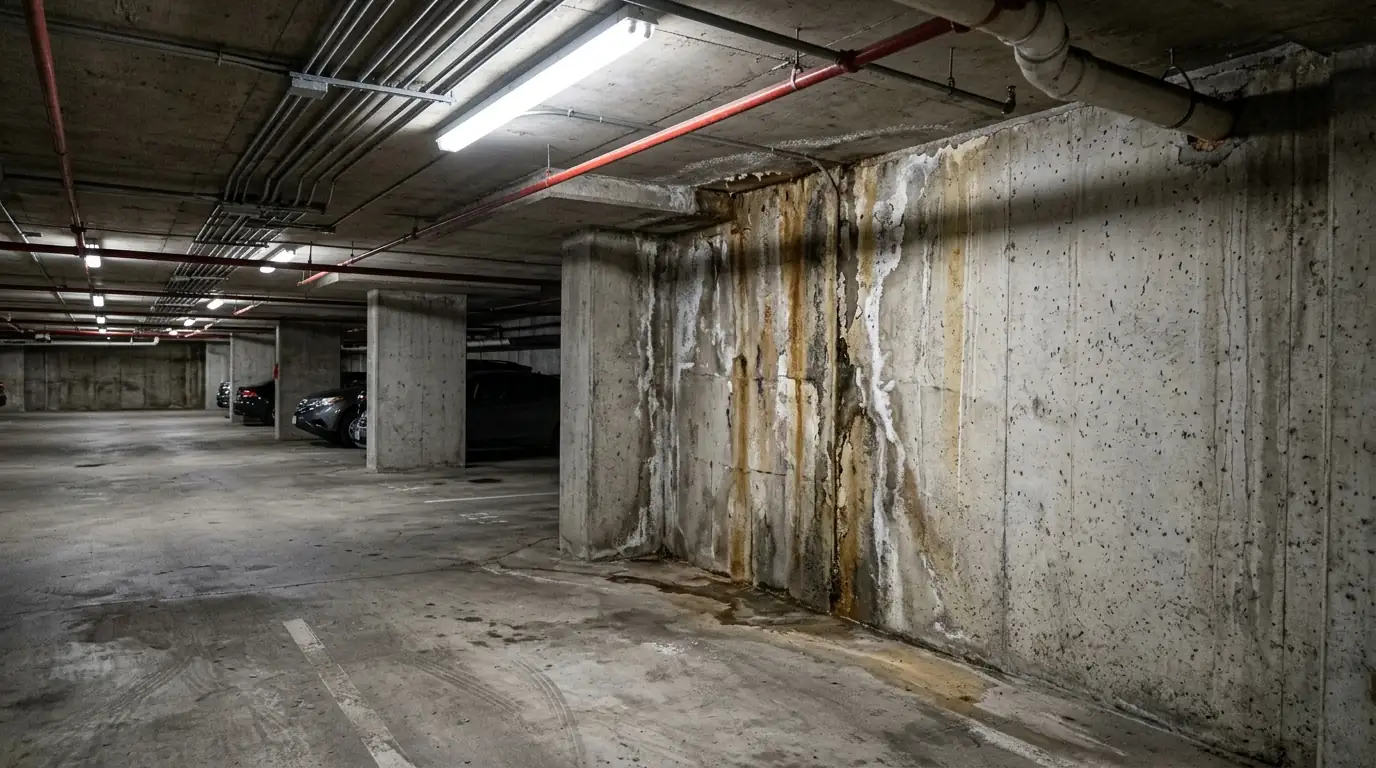
Drips onto parked cars, rust stains on the ceiling and water reaching the storage rooms or shops below a garage deck all mean water is getting.
DetailsHudson County town
Weehawken splits between Port Imperial condos on the waterfront and older rowhouses uptown near the Boulevard East cliffs. Down by the river, garages and elevator pits take groundwater; up top, foundations take seepage off the rock.
Building managers and owners in Weehawken with water in a garage, an elevator pit or a basement can call (201) 578-5199 whenever water shows up. We handle both sides of town: crack sealing, joint repair and traffic coatings for Port Imperial garages, crystalline or injection treatment for wet elevator pits, and crack or drain repairs for uptown rowhouse cellars.
The condo buildings at Port Imperial stand on the flat land between the Hudson and the foot of the cliffs, and their lowest levels sit close to river groundwater. That puts constant hydrostatic pressure on garage walls, slabs and elevator pits. Poured concrete handles the load, but every construction joint, tie-rod hole left from the formwork and pipe sleeve is a possible path in. Owners first notice white mineral trails down a garage wall, a damp strip where wall meets slab, or standing water in the pit beneath an elevator car. Left alone, that water corrodes steel and trips pit alarms.
Garage decks carry their own load. Cars track in rain and winter road salt, and that brine sinks into cracks and joints in the deck slab. Once it reaches the reinforcing steel, rust expands and breaks the concrete loose from inside. A garage waterproofing program usually combines routing and sealing cracks, replacing failed expansion joints and applying a traffic coating to exposed decks and ramps. On the lowest level we look at the walls too, since groundwater seepage and deck leaks often show up side by side and need separate fixes.
An elevator pit is the deepest hole in most Weehawken condo buildings, and it fills first. We start by cleaning the pit, finding where water enters (the floor-wall joint, a crack, a sleeve) and confirming what the elevator contractor needs for safe access. Active leaks get polyurethane injection to stop flow, then the concrete gets a crystalline treatment that grows into its pores and blocks water from within. Our elevator pit waterproofing is scheduled with management so the car is out of service for as short a stretch as possible.
Coordination is most of the job on a tower. We set dates with the property manager, book freight elevators or service entrances, and keep resident parking open by working in sections. For buildings that also see leaks at amenity decks or terraces higher up, we can trace those during the same visits. Weehawken calls are picked up at our downtown Jersey City office on Newark Avenue, 24/7, so a pit alarm on a Sunday night reaches a person who can judge whether it needs a crew that night or can wait for morning.
Based on the buildings here, these are the calls we expect from Weehawken. Every other service on our list is available too.
Drips onto parked cars, rust stains on the ceiling and water reaching the storage rooms or shops below a garage deck all mean water is getting.
DetailsWater in an elevator pit is more than a nuisance: it rusts equipment, can take a car out of service and tends to show up on inspection reports.
DetailsA leak in a commercial building costs more than the repair: damaged stock, closed storefronts, unhappy tenants and an anxious board.
DetailsA single crack running down a poured basement wall can soak a corner of the floor every time it rains.
DetailsRain driven sideways by a nor'easter finds every open mortar joint on a brick wall, then shows up as stained plaster, peeling paint or a damp closet.
DetailsWater is reaching the top-floor walls, or even a floor or two lower, while the roof surface looks fine.
DetailsUp the cliff from the waterfront, Weehawken changes completely. Uptown blocks near Boulevard East are lined with rowhouses whose basements sit on or against Palisades rock. Here the water doesn't rise from the river; it trickles along the rock after rain, crosses the foundation and seeps out at cracks and the base of the wall. Older houses add brick or stone foundations with tired mortar, so we often pair repointing of washed-out joints with a short interior drain along the wettest wall, carried to a small sump with a check valve.
These houses also take strong wind near the cliff edge, and their flat roofs, parapets and rear walls see wind-driven rain that sheltered houses never feel. A parapet with open coping joints can feed water down inside the wall for a full story before it shows. We check coping, counterflashing and the parapet's inner face along with the basement, because owners rarely want to pay for a cellar repair only to learn the stain was coming from above. Our guide to parapet leaks explains the warning signs to look for between visits.

The pit is the lowest point in the building, and near the river it sits in groundwater that presses up and in. Water enters at the joint between floor and walls, at cracks and around sleeves. Pumping it out treats the symptom. We seal active leaks with injection and treat the concrete with a crystalline product so the pit stays dry between inspections.
Yes. Cars carry salty slush in all winter, and that brine soaks into deck cracks and joints. When chlorides reach the steel inside the slab, the steel rusts and swells, cracking the concrete above it. A traffic coating and well-kept joints keep salt water out of the slab. A spring washdown helps too, and we can show maintenance staff what to watch for.
Usually from inside. Basements against the rock seep along cracks and the base of the wall rather than from a rising water table. We repoint failed mortar on older walls, inject cracks in concrete, and run a short interior drain to a sump when one wall stays wet. Digging outside is rarely practical on these tight lots, so the interior route is the usual answer.
Call (201) 578-5199 any time. Tell us the address and what you're seeing, and we'll take it from there.