Hollow, drum-like sound
Tapping the parging gives a hollow sound instead of a solid knock, which means it has let go of the wall.
Walls, terraces & decks · Jersey City, NJ
Parging that has cracked, gone hollow or fallen off in sheets leaves the foundation face open to rain, splash and frost. We remove the failed coat and apply a new one matched to block, poured concrete or old stone.
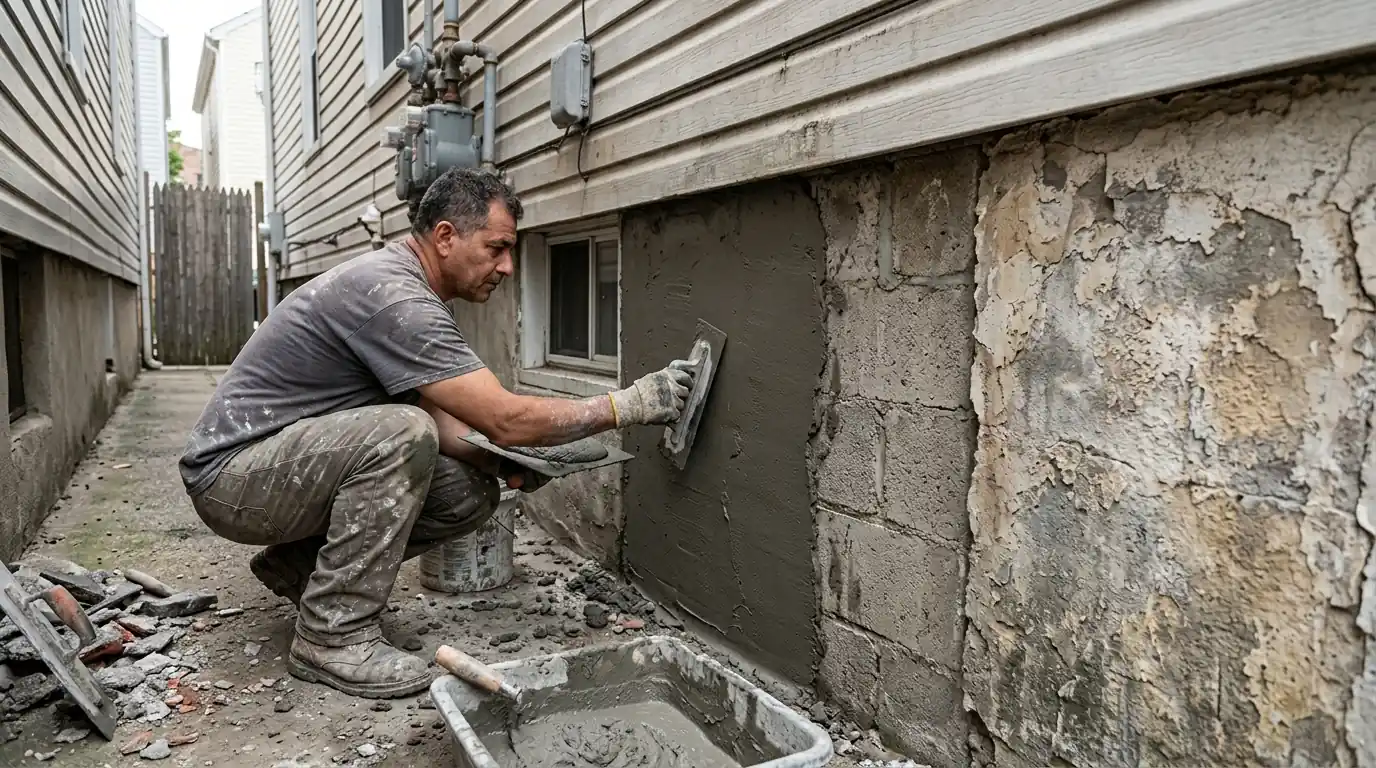
For foundation parging in Jersey City, call (201) 578-5199. We sound the existing coat for hollow spots, cut failed parging back to a solid edge and repair the wall behind it. Block and poured concrete get a cement or polymer-modified parge in two coats. Old stone and lime-mortar walls get a breathable lime parge, so moisture can still leave the wall instead of getting trapped behind the finish.
Parging is the thin coat of mortar troweled over the part of a foundation wall that shows above the ground. On a block wall it covers the joints and gives the face a smooth, even surface that sheds rain. On a poured wall it hides tie holes and rough casting marks. On older stone it evens out an irregular face. Its job is protecting that exposed band of masonry from splash, sun and frost, and giving the base of the house a finished look.
Parging fails mostly because water gets behind it. Rain splashing off a walkway, a downspout dumping at the corner, or soil and mulch piled against the wall keep the bottom edge wet. Water wicks into the masonry and freezes through the winter, pushing the coat off the wall from behind. It goes hollow first, sounding like a drum when you tap it, then it cracks, then it drops off in sheets.
Poor bond is the other cause. Parging troweled onto a dusty, painted or bone-dry wall never grips properly, and a coat laid on too thick in one pass cracks as it shrinks. Across the Heights and Greenville, two- and three-family frame houses often sit on block or poured foundations with a strip of parging that has been patched over the years. Each patch is a different mix, and the edges between them are where the cracks begin.
Tapping the parging gives a hollow sound instead of a solid knock, which means it has let go of the wall.
A map pattern of fine cracks across the coat, usually from a mix that dried too fast or went on too thick.
Pieces of parging have dropped away, leaving bare block, concrete or stone exposed to the weather.
The bottom few inches are soft, flaking or missing where soil, mulch or splash keeps them wet.
Efflorescence bleeding through the coat or pushing it off, a sign moisture is trapped behind it.
Block faces broken or crumbling where the parging used to be.
Several patches of different color and texture, with cracks running along their edges.
We start by tapping the whole parged band with a hammer to find every hollow spot, and we mark each one. Loose and hollow parging is cut back with a saw and chisel to a clean, solid edge, so the new coat butts against parging that still grips the wall. Where the coat is failing along most of a wall, stripping the band completely and starting fresh usually costs less over time than patching dozens of separate spots.
Then the wall gets prepared. Cracks in the block or concrete behind are opened and filled, spalled block faces are rebuilt, and the surface is cleaned and dampened so the new mix won't dry too fast. On poured or block walls we apply a bonding agent, then a scratch coat, then a finish coat once the first has firmed up. The new parge is damp-cured for several days, because cement-based mortar that dries quickly cracks.
The top and bottom edges matter as much as the coat itself. At grade we carry the parge a little below the soil line with a clean edge and pull the soil back so the wall can dry. At the top, where the foundation meets the sill or siding, we shape a small wash so rain runs off rather than into the joint. Where downspouts empty against the wall, underground leader drains remove the splash that started the damage.
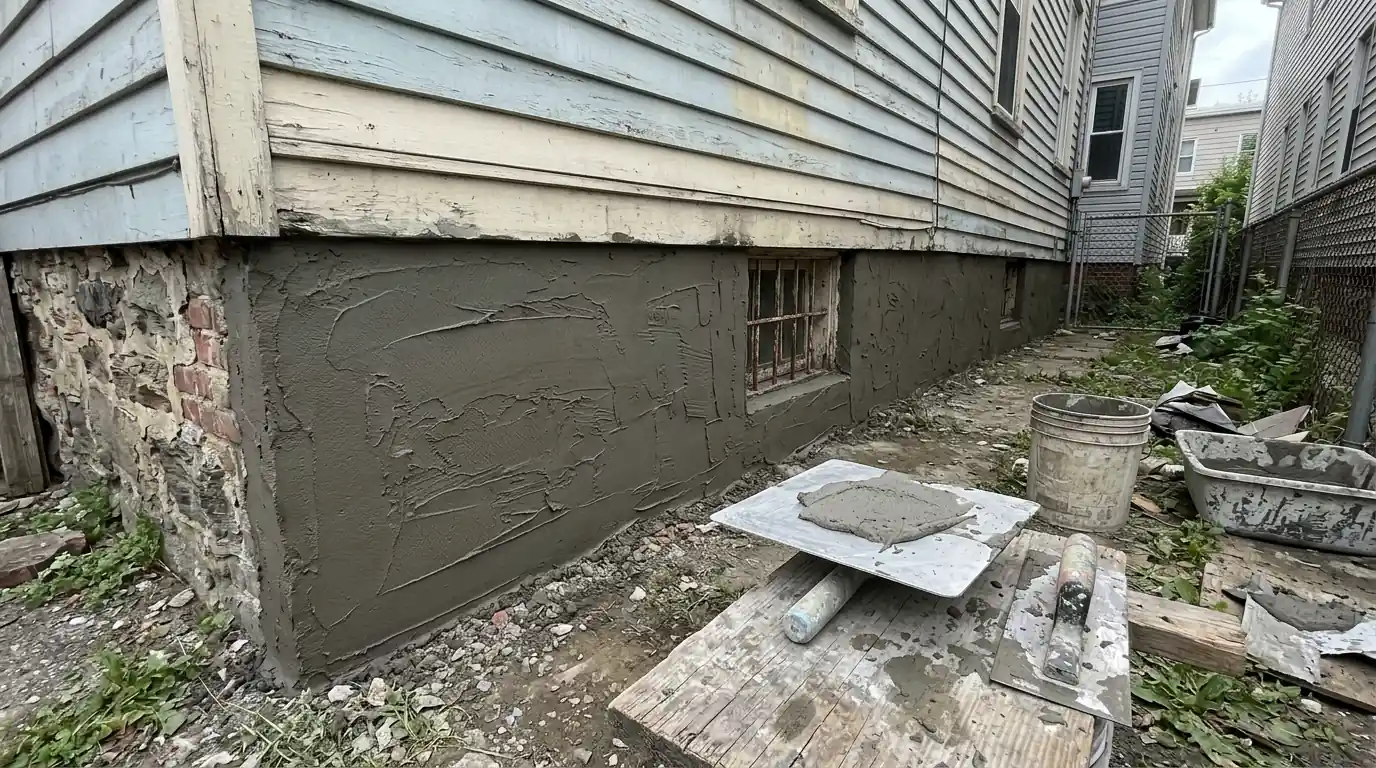
We tap the full parged band and mark every hollow or cracked area. That tells us whether patching or a full strip makes more sense.
Loose parging is cut back to a clean edge that is firmly attached. We protect plantings, walkways and siding while we work.
Cracks, spalled block and washed-out joints behind the coat are repaired. A new finish over a damaged wall would only fail again.
Block and poured walls get a cement or polymer-modified parge. Stone and lime-mortar walls get a breathable lime parge.
We dampen the wall and apply a scratch coat, then a finish coat. Edges at grade and at the sill are shaped to shed water.
The new parge is kept damp while it cures so it stays crack-free. We then apply a breathable coating or sealer where the wall calls for one.
Foundations under older rowhouses and brownstones, and under many frame houses built a century ago, are brick or rubble stone laid in lime mortar. Those walls move moisture out through the joints and let it evaporate from the face. A hard cement parge sealed over them traps that moisture. Salts collect behind the coat, the coat pops off, and it often pulls the face of the stone or brick away with it. Much of the flaking parging on old walls failed exactly this way.
On those walls we use a lime-based parge, mixed softer and more vapor-open than the masonry, applied in thin coats and finished with a breathable mineral paint or left natural. Before it goes on, washed-out joints are repointed, the same way our stone foundation work treats the wall from inside. The finish lets the wall keep drying outward, which is how it has stayed sound since it was built.
Parging is a finish for the exposed face, and it works alongside the below-grade side rather than replacing it. If your basement is wet along the same wall, the part under the soil needs drainage or a membrane, which our exterior foundation waterproofing page explains. On designated historic blocks the foundation face is part of the facade, and we tell you when a job will likely need Historic Preservation Commission review.
Most foundations in the city show on only one or two sides. On attached rowhouses the exposed band is often just the front wall under the stoop and the rear wall facing the yard, while the side walls of detached frame houses can sit a few feet from a fence or the house next door. We work those narrow strips by hand, stage mixing on the sidewalk or in the yard, and protect the stoop, areaway and plantings as we go.
Timing matters too. Cement and lime parge both need temperatures above freezing while they cure, and lime sets slowly, so we schedule exterior parging from spring through fall and cover fresh work against hard sun, wind-driven rain and early frost. On blocks facing the bays, such as much of Bayonne, salt air and steady wind dry a fresh coat quickly, so we mist it and keep it covered for longer there.
| Mix | Best for | Notes |
|---|---|---|
| Cement parge | Poured concrete and concrete block walls | Hard and durable; needs a damp cure to avoid shrinkage cracks |
| Polymer-modified parge | Block and poured walls with slight movement, thin repairs | Stronger bond and some flexibility; good over a well-prepared older surface |
| Lime parge | Brick, rubble stone and lime-mortar walls | Softer and breathable; lets old masonry keep drying outward |
$11.50 to $24.80
per sq ft, typical range
Most parging jobs land between $11.50 and $24.80 per square foot of wall face. That's a typical range, not a quote; we measure the wall and check how much of the old coat has failed before giving you a number.
Not listed? See every area we serve or call (201) 578-5199.
Membranes, sealers, pumps and dehumidifiers we work with come from makers such as
Only where the old coat is still stuck tight to the wall. Hollow or loose parging under a new layer keeps letting go and takes the new coat with it. We tap the whole band, cut back anything that sounds hollow to a solid edge, and patch or re-parge from there. When most of the coat is loose, a full strip is the better value.
The bottom edge stays wetter than the rest of the wall. Splash off a walkway, a downspout emptying at the corner, or mulch and soil packed against the foundation feed water into the masonry, and winter freezing pushes the coat off from behind. A new coat lasts longer when the soil is pulled back, the edge is finished cleanly and roof water is carried away.
A lime-based parge that is softer and more vapor-open than the brick or stone. Old lime-mortar walls need to release moisture through their face, and a hard cement coat traps it, which leads to salt buildup, popping and crumbling masonry. We repoint washed-out joints first, then apply the lime parge in thin coats and leave it natural or finish it with a breathable mineral paint.
Yes, with the right paint. On cement or polymer-modified parge, a breathable masonry coating works once the coat has fully cured. On lime parge over old stone, use a mineral or lime-based paint that lets moisture pass. Skip thick oil-based paints and heavy film coatings on the foundation band, because they trap water behind them and restart the same peeling cycle that ruined the last coat.
A sound coat helps the exposed face shed rain, which matters at the soil line. Most basement water, though, comes from below grade: through cracks, the cove joint, or a wall under soil pressure. That side calls for drainage, crack repair or an exterior membrane. We look at both when we come out, since a wet basement and failing parging often share the same cause, usually roof water landing at the wall.
Call (201) 578-5199 and tell us what you're seeing. We'll set up a visit and give you a typical range before any work starts.