Basement Waterproofing
Water on the basement floor after every hard rain usually means pressure from outside the wall, not a plumbing leak.
DetailsJersey City, NJ
Jersey City buildings take on water in very different ways, from century-old rowhouse foundations downtown to frame houses on the Heights ridge and garages under waterfront towers. We find the path the water takes and close it.
Our crews handle basement seepage, sewer backups, foundation cracks, leaking terraces and flat-roof leaks in every Jersey City neighborhood, working out of our office at 218 Newark Avenue downtown. Call (201) 578-5199 at any hour. We ask where the water shows up and when, send a technician to trace it, then explain the fix and the typical cost before any work starts.
Much of downtown and the land along the Hudson, plus low blocks toward Communipaw and Newark Bay, sits on old marsh and fill. That ground holds a high water table, so after a long rain the water pushes up and sideways against the basement as hydrostatic pressure, finding the cove joint and every soft mortar joint along the way. Up on the Palisades ridge it is the opposite story. Rock sits close to the surface on the Heights, and water runs along that rock until it reaches a foundation crack, then shows up as a wet stripe on one wall.
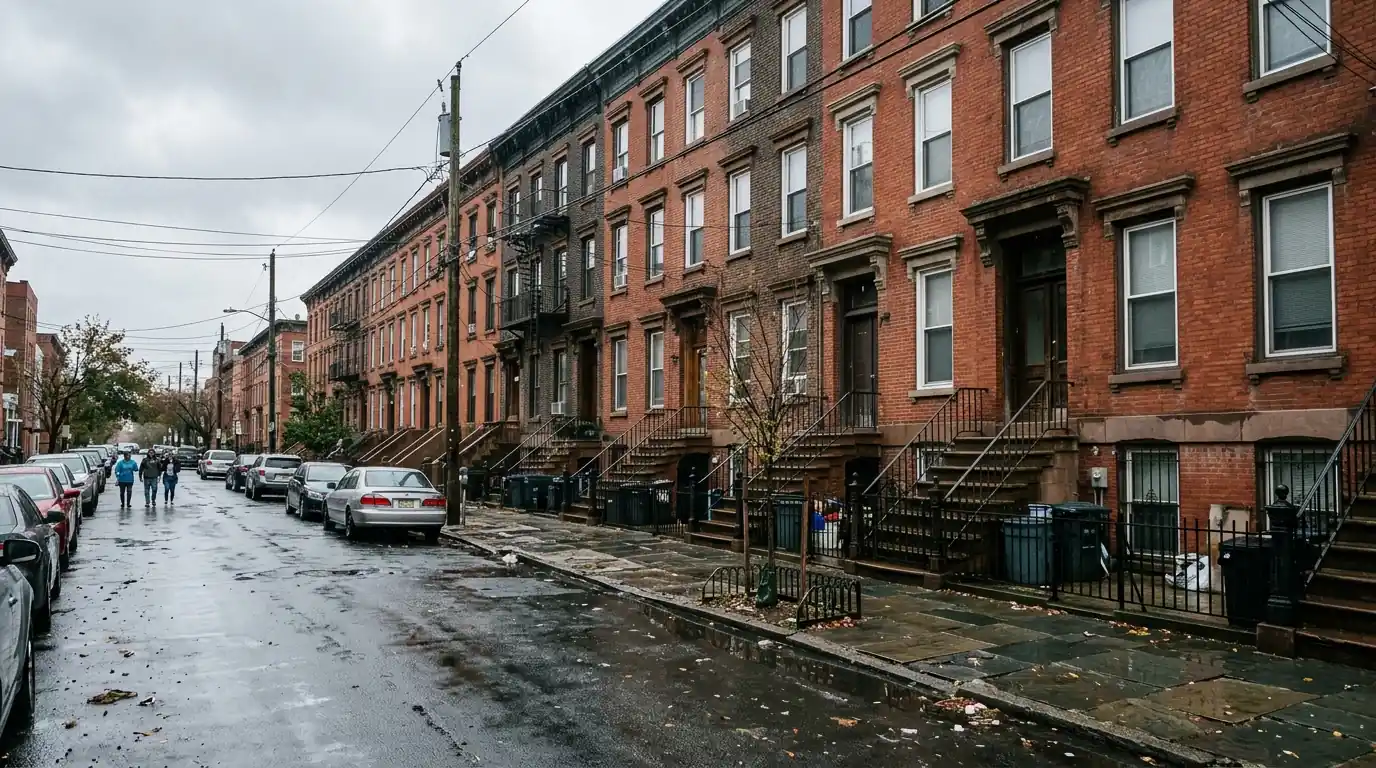
Building type matters as much as ground. Downtown rowhouses and brownstones sit on brick or rubble-stone foundations laid in lime mortar, with a front areaway under the stoop and a small drain that clogs with leaves. Frame two- and three-family houses often have a crawl space under the rear addition and leaders that dump right at the wall. Pre-war walk-ups around Journal Square have deep basements with floor drains tied to the sewer. Waterfront towers bring their own list: below-grade garages and elevator pits that sit in groundwater all year long.
Water does not only come from below. Flat roofs behind parapets, rooftop decks built over the membrane on newer condos, and terraces on the towers all leak in ways that look like a basement problem at first, such as a stain two floors down or a damp party wall. We check the roof, the parapet coping and the deck before blaming the foundation, because the cheaper fix is often up top. Our roof deck waterproofing work starts by lifting a few pavers to see the membrane underneath.
Our Jersey City office sits at 218 Newark Avenue, a short walk from the Grove Street PATH station, and the phone is answered 24/7. When water is coming in at two in the morning, you talk to a person who can send an emergency crew the same night when one is free, with pumps, wet vacs and drying equipment on the truck. For slower leaks we set a visit, trace the source with moisture meters and a look at the outside drainage, and walk you through what we found before anything gets opened up.
Attached buildings take planning. Many rowhouse basements are reached only through a narrow interior stair or a front areaway, and a shared party wall means the water you see may start next door. We bring compact excavation tools, run hoses and pump lines through the areaway rather than the living space, and protect floors on the way down. On blocks with permit or alternate-side parking we plan where the truck stages, keep sidewalks clear and protected, and haul spoil out in bags so the street is left the way we found it.
Based on the buildings here, these are the calls we expect from Jersey City. Every other service on our list is available too.
Water on the basement floor after every hard rain usually means pressure from outside the wall, not a plumbing leak.
DetailsThe rubble-stone and brick walls under 19th-century rowhouses weep differently from poured concrete.
DetailsWhen a heavy storm sends dark, foul water up through your basement floor drain, the problem is the sewer, not groundwater.
DetailsIf water keeps showing up in the same corner of your basement after every heavy rain, a properly placed sump pump gives it somewhere to go.
DetailsA single crack running down a poured basement wall can soak a corner of the floor every time it rains.
DetailsWater is coming through the ceiling under your rooftop deck, and nobody can see the membrane because the deck sits on top of it.
DetailsSuperstorm Sandy in 2012 pushed storm surge into low downtown streets, and basements there filled from the outside in. The remnants of Ida in 2021 were different: extreme rain fell across north Jersey in a few hours, and basements flooded through floor drains, window wells and walls even on blocks that had never seen water. If your building took water in either storm, the way it came in tells us what to fix, whether that is a sump pump with a battery backup, sealed window wells or a new drain line.
Most of Jersey City runs on a combined sewer, where storm water and sewage share the same pipes. In a heavy downpour those pipes fill, and sewer water can come back up through the lowest floor drain or toilet in the building. A backwater valve lets water leave but blocks it from returning. Sewer-side work falls under the local sewer utility and plumbing code, so we tell you when a permit or a plumber is required and coordinate it. Our guide to sewer backups covers the basics in plain terms.

Each page below covers the buildings, roofs and common problems in that part of the city.
Type your ZIP to see whether it sits in our regular coverage. Any ZIP not listed, call and ask.
Low, filled ground near the Hudson, the old marsh around Paulus Hook, and blocks toward Newark Bay tend to have a high water table, so basements there feel water pressure after long rains. On the Heights, rock sits near the surface and water usually arrives through cracks instead. The fix differs, which is why we trace the source before recommending anything.
Not exactly. FEMA flood zones cover parts of downtown Jersey City and describe surface flooding, which matters for flood insurance, a question for your agent. A basement outside a flood zone can still take water from groundwater, sewer backups or leaders dumping at the wall. We deal with the water getting in, whichever way it travels.
Yes. Alongside one- to three-family houses and rowhouses, we waterproof garages, elevator pits, terraces and roof decks on condo and rental buildings. On those jobs we coordinate with the property manager or condo board on access, scheduling and notices to residents, and we put the scope in writing so the board can see exactly what is being done.
Call (201) 578-5199 any time. Tell us the address and what you're seeing, and we'll take it from there.