Key points
- Combined sewers carry storm water and sewage together, so heavy rain can overload them.
- A backwater valve lets water leave the building but blocks it from coming back.
- Valves need regular cleaning and inspection, or they jam open or shut.
- Sewage in a basement is a health hazard: stay out of the water and keep clear of electrical gear.
What a combined sewer means for your basement
Much of Jersey City and Hoboken is served by combined sewer systems, where the rain running off streets and roofs travels in the same pipes as the sewage from every building on the block. On a normal day there's plenty of room in those pipes. In heavy rain, storm water fills them fast, and once a main runs full, the water inside has to go somewhere. It pushes back up the lateral pipes that connect each building to the street.
Every drain in your building ultimately feeds that lateral. If the lowest drain sits below the level the sewer water reaches during a storm, water will flow backward into it. That's why the basement floor drain, a basement toilet or a laundry sink is where backups show up first. Low-lying blocks downtown and much of Hoboken, built on old marsh and fill, tend to see it before buildings on higher ground, though no basement fixture on a combined system is completely out of reach.
The age of the pipe adds to the risk. Many older buildings still drain through cast iron or clay laterals laid generations ago, and roots, cracks and settled joints narrow them over the years. A partly blocked lateral backs up sooner because it can't drain the building's own water fast enough while the street sewer is surging. If your basement drain is slow on dry days too, the lateral itself may be part of the problem, and a camera inspection by a plumber can show what's inside.
How a backup unfolds during a heavy rain
Backups follow a recognizable pattern. The heaviest rain arrives, often in a summer thunderstorm or the wind-driven bands of a nor'easter, and before long the floor drain gurgles, then starts to fill. Water rises out of it, sometimes with a sewage smell, sometimes looking almost clear at first because so much of it is rain. It spreads across the slab and may come up through a basement shower or toilet too. When the storm eases and the sewer drains down, the water often recedes the same way it came.
That timing is the clue that separates a sewer backup from a foundation leak. Groundwater seepage tends to build over hours or days and comes from the walls or the cove joint. Sewer water arrives fast, at the peak of the storm, and comes from fixtures and drains. Both can happen in the same storm, as many north Jersey owners found when the remnants of Ida came through in 2021. If you're not sure which you're dealing with, our guide on why Jersey City basements leak walks through how to tell them apart.
What a backwater valve does, and where it goes
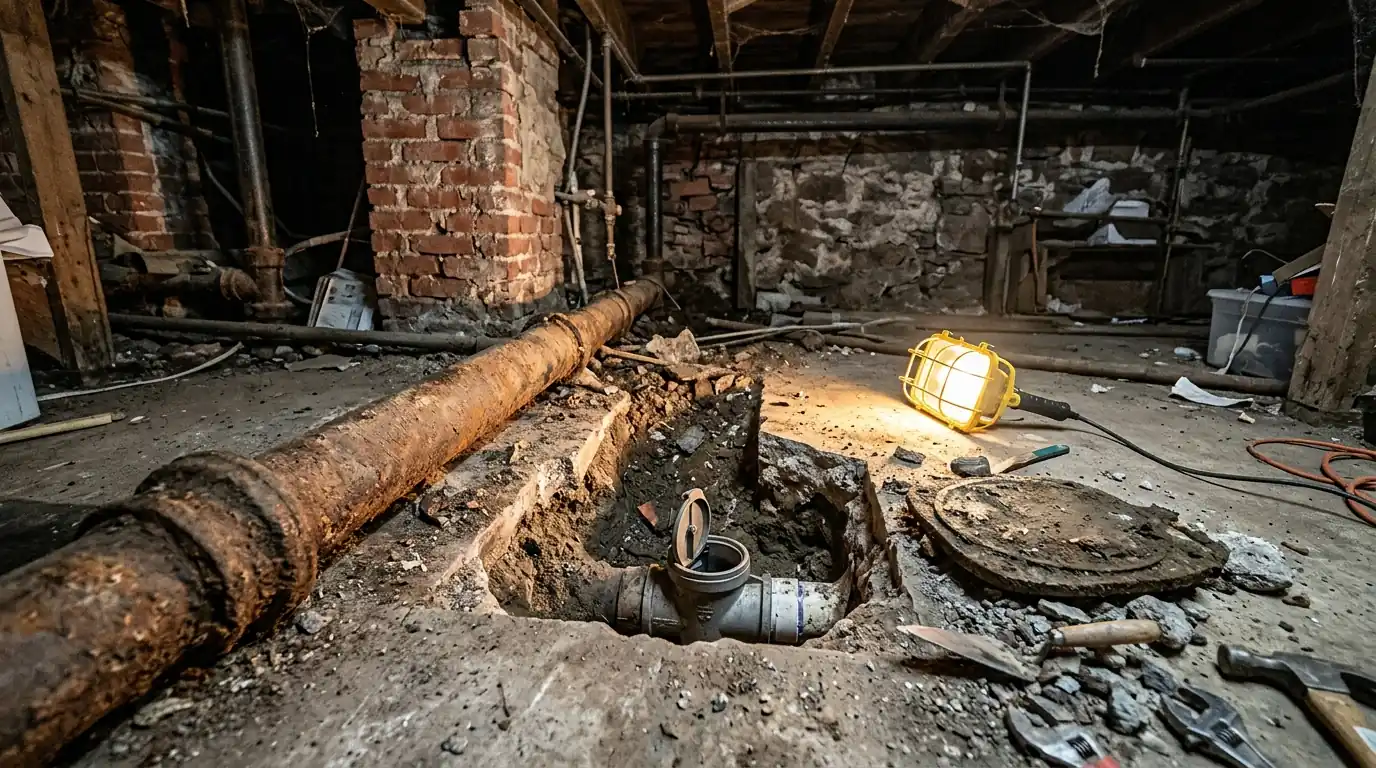
A backwater valve is a one-way gate on the building sewer. Under normal flow, wastewater pushes a flap open and passes out toward the street. When sewer water starts flowing back toward the building, it presses the flap closed against a seat and the line seals. Valves for houses and small buildings are usually installed in the main building drain, inside the basement or just outside the foundation, with an access cover so the flap can be reached for cleaning.
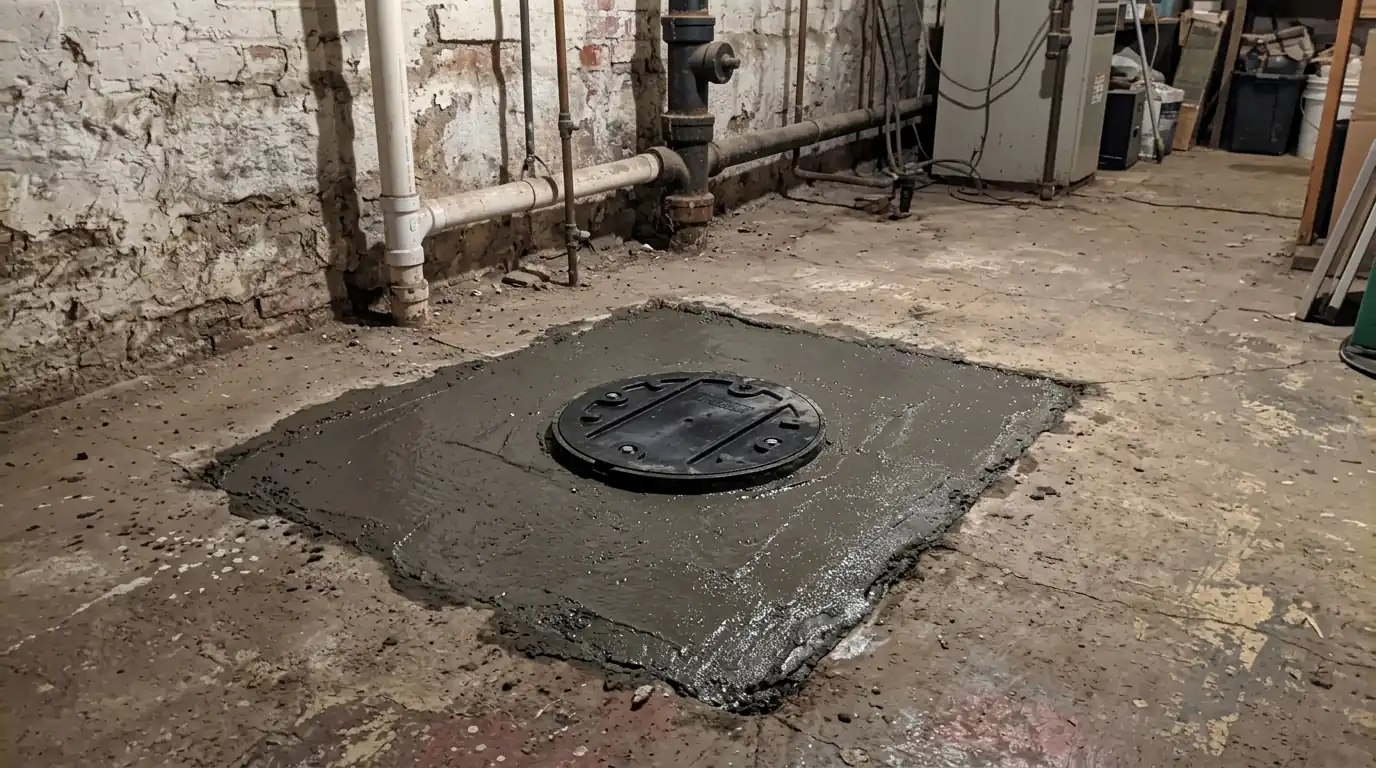
Placement matters. A valve protects only the drains it sits downstream of, so it has to be located where it covers every basement fixture, which in many buildings means cutting the slab to reach the main line and patching the floor afterward. Owners should also know the catch: while the valve is closed, water from inside the building can't leave either. Typical installs land between $1,640 and $4,350, driven by depth, slab work, access and the condition of the old pipe.
There are a few types. A normally open valve keeps the flap hanging open so the line vents and drains freely, closing only when water flows backward. A normally closed valve rests shut and opens with outgoing flow. Some designs add a second gate that can be closed by hand before a big storm. Which type suits a building depends on the pipe size, how deep the line is and what the local plumbing code allows, so it's chosen with the job rather than off a shelf.
Keeping a backwater valve working
A backwater valve lives in a line that carries sewage, so grease, paper and debris settle on the flap and the seat over time. A valve jammed open gives no protection, and one jammed shut backs up the building's own drains. Neither problem shows itself until the worst possible moment. That's why a valve needs to be opened, looked at and cleaned on a regular schedule rather than installed and forgotten under a basement rug.
If you'd rather not open a sewer fitting yourself, have it done as part of a routine visit. We check the valve whenever we're in a basement for sump work or a waterproofing inspection, and we'll tell you if the flap, the seat or the cover gasket is worn. A few minutes of cleaning once or twice a year is the difference between a valve that closes on cue and one that doesn't.
- Open the access cover once or twice a year and check that the flap swings freely.
- Clear grease, wipes and debris from the flap and the seat.
- Check the cover gasket so sewer gas can't escape into the basement.
- Look at the valve after any storm where it was likely to close.
- Keep the cover reachable; don't build flooring or shelving over it.
Permits and plumber coordination on sewer-side work
Work on the building sewer is different from sealing a wall. The local sewer utility and the plumbing code decide what permits a backwater valve needs, and parts of the work may have to be done by a plumber who meets the code's requirements. The steps vary by town and by building, so we don't guess. We tell you at the start when a permit or a plumber is required for your job, and what that means for the schedule.
When one is required, we coordinate it so you aren't managing two separate contractors. Our crew handles the slab cutting, excavation and concrete restoration, and the plumbing work and inspections are lined up around that sequence. For condo and rental buildings, we work through the property manager or board, since the building sewer is usually shared and a valve on it affects every unit that drains through that line.
A backwater valve also works best as part of a plan rather than on its own. If the same basement takes groundwater through the walls, a sump and drainage handle that side, and the two systems shouldn't be tied together where a sewer surge could push back through the sump. Floor drains that aren't needed can sometimes be capped, and a basement fixture that rarely gets used may be better served by a dedicated plug. We look at every drain in the basement before recommending anything.
If sewage is already in your basement
Sewer water carries bacteria and other contaminants, so treat a backup as a safety problem first and a cleanup second. Don't wade in to rescue belongings, and keep children and pets upstairs. If water is near outlets, appliances or the electrical panel, don't touch anything while standing in it, and if you can't reach the main shutoff from a dry spot, call the electric utility. Stop using every drain in the building, because anything you send down will come out in the basement.
Once the water stops rising, it has to be pumped out, and porous materials it touched, such as carpet, drywall and cardboard, usually have to go. Flooded basement pump-out is the first step, followed by cleaning, disinfecting and drying. Questions about what your policy covers belong with your own insurance agent. We answer (201) 578-5199 day and night, and when a crew is free we can come out the same night.
- Shut off basement power only if you can do it from a dry spot.
- Stay out of the water; wear rubber boots and gloves if you must go in.
- Open windows for ventilation if it's safe to reach them.
- Photograph and video the damage before anything is moved, for your own insurance claim.
- Don't run fans, heaters or a shop vacuum near standing sewage and live outlets.
Owner Guides Editor at Waterproofing Services Carteret. Writes the owner guides from the questions our crews hear in Jersey City basements and on its roofs every week.