Key points
- Low, filled ground near the rivers pushes groundwater up; the Heights sends water sideways along rock.
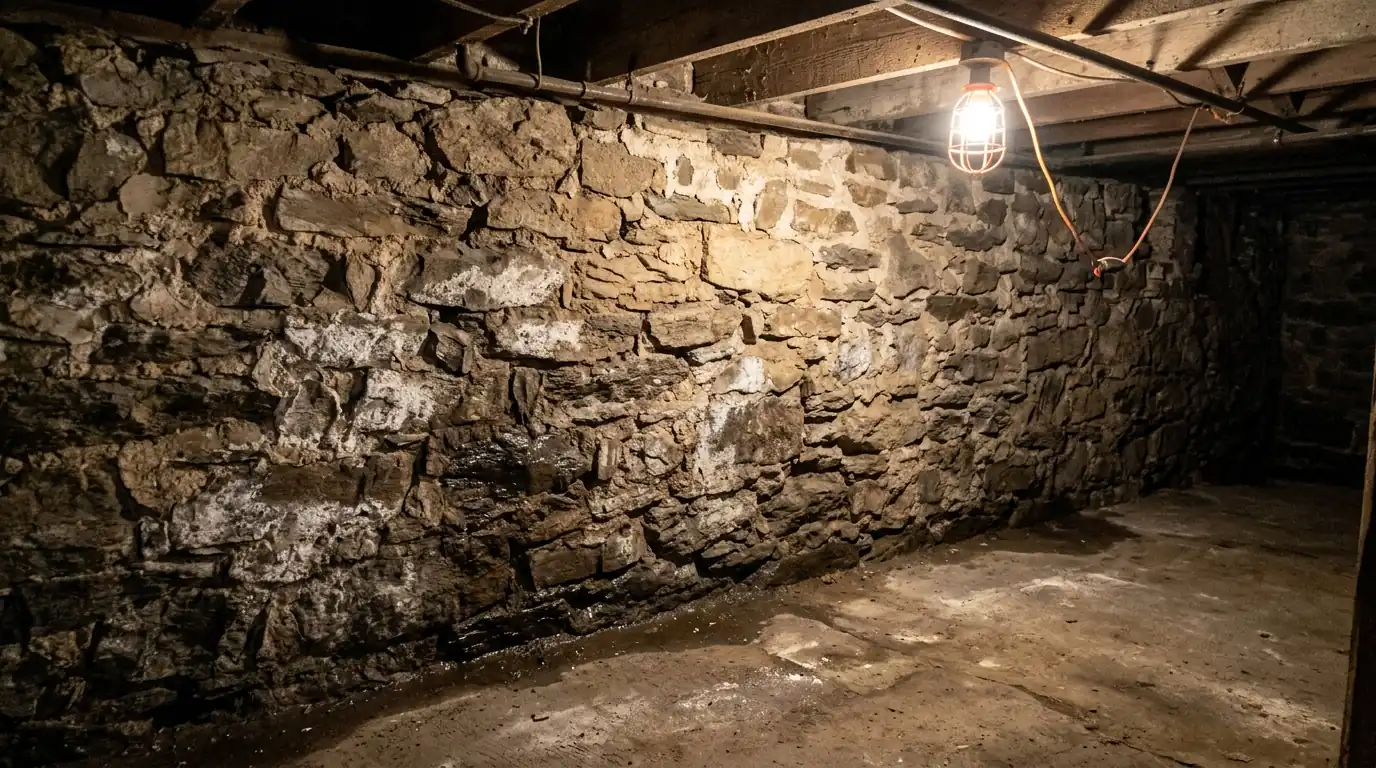
- Century-old brick and stone foundations seep as their lime mortar washes out.
- In poured concrete, the cove joint and tie-rod holes are the usual entry points.
- Water rising from a floor drain in a downpour usually points to the sewer, not the walls.
Start with the ground under your block
Jersey City is not one kind of ground. Much of downtown and nearly all of Hoboken sit on old marsh and fill along the Hudson, and Paulus Hook was once ringed by marsh. Filled ground like that holds a high water table, so after a few days of steady rain the groundwater rises around the foundation and presses against the walls and the floor slab. That push is hydrostatic pressure, and it finds every weak joint. Owners on these blocks often see water appear from the floor itself, or a damp band that creeps up the wall from the bottom.
Climb up to the Heights and the story changes. The ridge is the Palisades, with rock close to the surface, so water there rarely rises from below. Instead it runs downhill along the rock, collects against the uphill side of the foundation and pushes through cracks and open mortar joints. A basement in the Heights may stay dry through weeks of drizzle and then leak at one corner during a hard storm. Knowing which kind of ground you're on tells you if you're dealing with a rising table or a sideways flow, and that shapes every repair that follows.
Old brick and stone foundations wear out from the inside
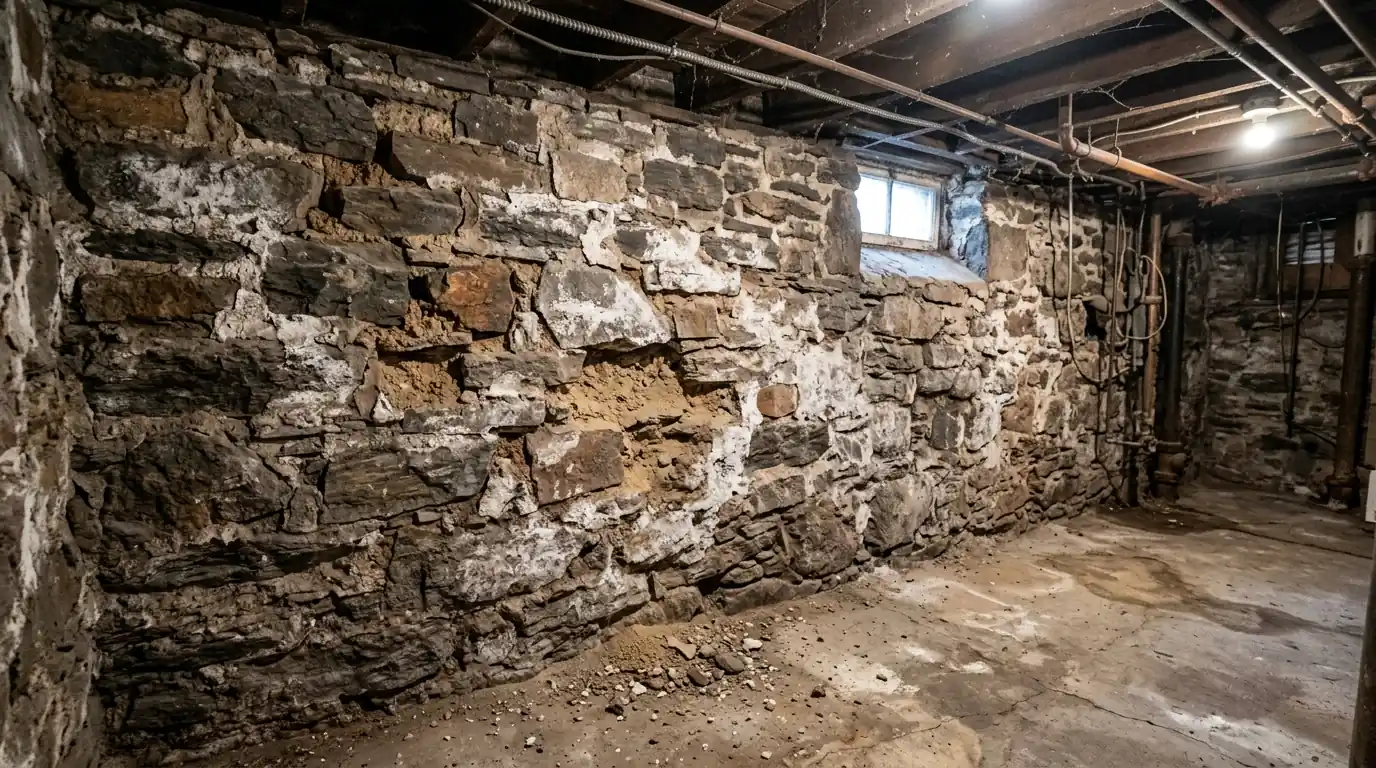
The brick rowhouses and brownstones around Hamilton Park, Van Vorst Park and Harsimus Cove usually stand on brick or rubble-stone foundations laid in lime mortar. Lime mortar was the right choice in the 1800s because it flexes, but it's soft, and a century of damp soil slowly washes it out of the joints. As the mortar goes, the wall becomes a stack of stones with gaps between them, and water follows those gaps inward. You'll see sandy grit on the floor, white efflorescence on the stone and damp patches that never fully dry out.
These buildings add entry points of their own. Front areaways, the sunken entries below the stoop, have small drains that clog with leaves and then overflow against the front wall. Some houses also have vaults under the stoop or sidewalk, and those vault walls are often the wettest masonry in the building. When we look at an older rowhouse, we check the areaway drain and any vault before blaming the whole foundation, because a cleared drain sometimes solves what looked like a failing wall.
Poured concrete has two predictable weak spots
Newer houses and infill buildings have poured concrete foundations, which are tighter than stone but not watertight. The first weak spot is the cove joint, the seam where the wall meets the floor slab. The two are poured at different times, so they never fully bond, and groundwater pressure pushes water up through that seam. A thin ring of water around the edge of the floor after rain is the classic sign of cove joint seepage, and it often shows up along several walls at once.
The second weak spot is the tie-rod holes. When the walls were poured, metal rods held the formwork together, and the ends were snapped off and patched afterward. Those patches shrink and loosen with age, leaving small round leaks in a neat grid across the wall, often with a rust streak under each one. Shrinkage cracks, vertical or diagonal, are the third common path. Each of these is a point leak, so they're usually sealed one at a time with polyurethane or epoxy injection rather than with a whole-wall system.
Cracks deserve a closer look than leaks at the joints. A thin vertical crack that weeps a little after rain is usually shrinkage and is sealed from inside. A crack that's wider at one end, runs on a diagonal, or has a step pattern through a block wall can mean the wall is moving, and that changes the repair. Mark the ends of any crack with a pencil and the date. If it grows past your marks over a few months, foundation crack repair may need to include reinforcement, not just a seal.
Roof water that ends up in the basement
A surprising share of basement leaks start on the roof. The rain math explains it: one inch of rain on 1,000 square feet of roof is about 623 gallons, and the leaders (downspouts) deliver all of it to the ground. When a leader dumps right next to the foundation, it soaks a narrow strip of soil exactly where the basement wall is weakest. On a rowhouse with a single rear leader, that can mean hundreds of gallons concentrated against one corner of the foundation in a single storm.
Walk the building and look at where each leader ends. If it stops at a splash block, empties into a cracked clay pipe or disappears into the ground with no known outlet, treat it as a suspect. Old buried leader lines often collapse or clog, and then they fill up and leak into the soil beside the wall. Moving the discharge away from the house, or replacing broken lines with underground leader drains that carry water to a proper outlet, can dry out a corner that owners have been patching for years.
Window wells work the same way on a smaller scale. A well without a working drain at the bottom fills like a bucket in a heavy storm, and the water pushes in around the basement window frame or through the wall below it. Leaves and soil bury those drains within a season or two. If a damp patch sits directly under a basement window, check the well first: clear the bottom, pour in a bucket of water and see whether it drains away in a few minutes or just sits there.
When the water comes up through the floor drain
Water that rises out of a floor drain, a basement toilet or a laundry tub during heavy rain usually isn't a foundation leak at all. Jersey City and Hoboken are served largely by combined sewers, where storm water and sewage share the same pipes. In a downpour those pipes can run full, and the overflow looks for the lowest opening it can find, which is often your basement drain. That water is contaminated, and it calls for different handling than groundwater seeping through a wall.
The signs are distinct. The water appears suddenly during the heaviest rain, it comes from fixtures and drains rather than walls, it may smell of sewage, and it often drains away once the storm passes. The usual fix is a backwater valve on the building sewer, which lets water leave but blocks it from coming back. Our guide to sewer backups and backwater valves explains how those valves work and what permit coordination looks like for that kind of job.
An owner's checklist for finding the entry point
You can narrow down most leaks before anyone opens a wall or cuts a floor. Do it during or right after a real rain, not on a dry afternoon, and take time-stamped photos so you can compare one storm with the next. Note the weather too: a leak after one hard thunderstorm points to surface water and leaders, while a leak after days of steady rain points to groundwater rising from below.
If the pattern still isn't clear, or water shows up in more than one place, a waterproofing inspection puts a technician in the basement with a moisture meter to map where the wall is wet and why. That map is what any repair should be built on. We answer (201) 578-5199 day and night, including during the storm that finally shows you where the water is getting in.
- Note whether water first appears on a wall, at the floor edge, in the middle of the slab or at a drain.
- Look for a grid of small wet spots with rust streaks; that pattern means tie-rod holes.
- Find every leader outlet and mark the ones that end within a few feet of the wall.
- Clear the areaway and window well drains, then see whether the front wall still leaks.
- Tape a square of plastic to a damp wall overnight: moisture underneath means water from outside, beads on top mean condensation.
- Smell the water. A sewage odor points to the combined sewer, not the foundation.
Owner Guides Editor at Waterproofing Services Carteret. Writes the owner guides from the questions our crews hear in Jersey City basements and on its roofs every week.