Leaks that move around
A patch stops one drip and another shows up a few feet away a month later. That points to a roof failing at many details, not one.
Roof waterproofing · Jersey City, NJ
Your flat roof keeps leaking in a new spot after every patch, because the field, the edges and the penetrations were never sealed together. We waterproof them as one continuous layer so water has no gap left.
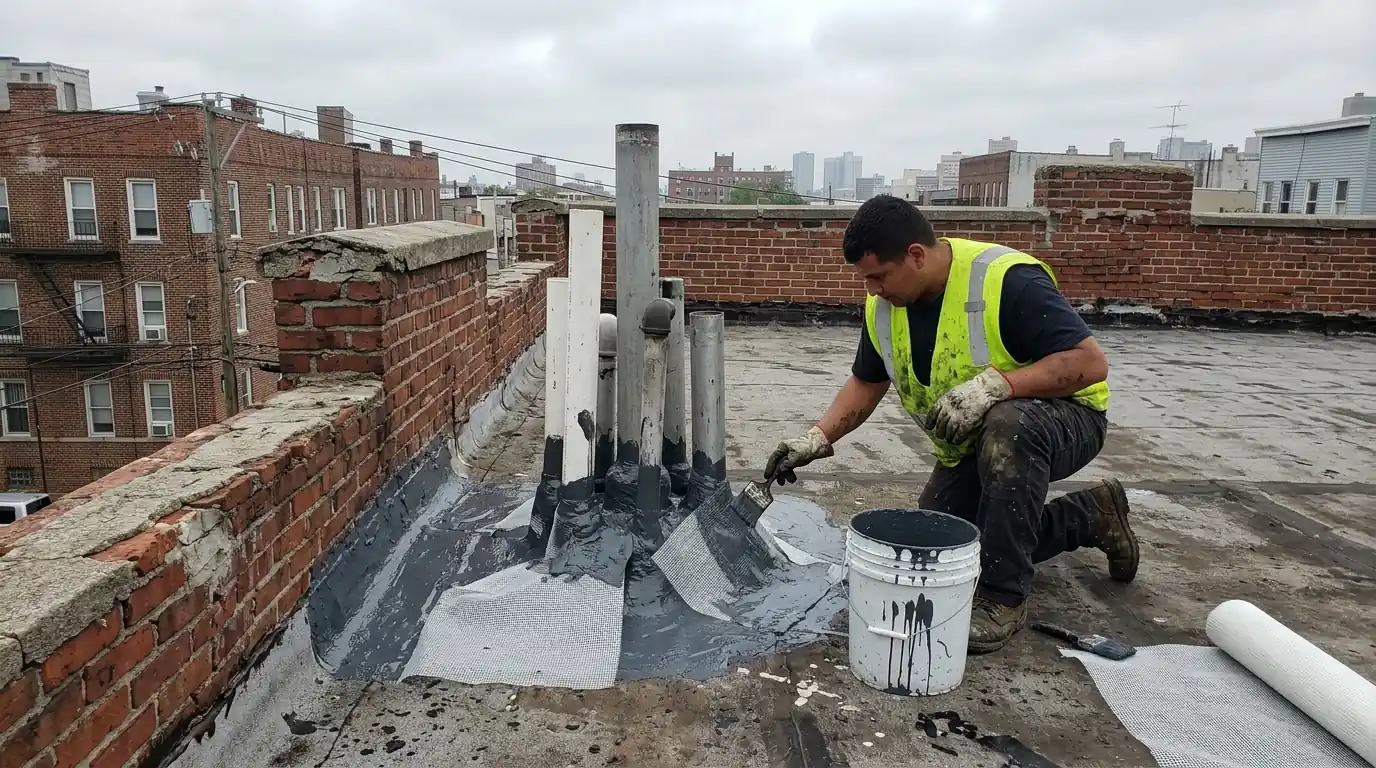
Roof waterproofing in Jersey City starts with a survey of every pipe, curb, drain and parapet base on the roof. Call (201) 578-5199 and our crew maps those details, cuts out any wet insulation, reinforces the corners with fabric and builds a liquid-applied membrane that ties into all of them. We flood test a section before we leave, so you know the roof holds water out.
Most leaks we trace on Jersey City flat roofs don't start in the open field of the membrane. They start where something interrupts it: a vent stack, a hatch curb, a parapet base, an old antenna mount, the joint where a rear extension meets the main roof. Patch one of those and the water simply moves to the next weak spot a few feet away. Roof waterproofing treats the field, every edge and every penetration as a single continuous layer, so there is no seam between the repair and the roof around it.
On a pre-war walk-up near Journal Square that can mean a long list of interruptions: plumbing vents, exhaust fans, a bulkhead door, internal drains and a parapet running the full perimeter. A brick rowhouse downtown may have fewer penetrations but a long run of party-wall parapet shared with the neighbors. The approach is the same either way. Our technicians map every detail first, decide how each one will be sealed, and only then choose the liquid-applied system that handles that particular mix of details.
Roof water doesn't stop being your problem at the roof edge, either. Every gallon the membrane sheds goes down the leaders, and on many older buildings those leaders empty right beside the foundation or into a buried pipe that collapsed years ago. One inch of rain on a 1,000 sq ft roof is about 623 gallons. If the basement turns damp after storms, we check where that water lands and, where it fits, carry it away from the walls with underground leader drains.
A patch stops one drip and another shows up a few feet away a month later. That points to a roof failing at many details, not one.
Clusters of vents, conduit and old mounts with layers of mastic piled around each one.
Dark lines or blisters where the membrane turns up the parapet, often worse after wind-driven rain.
Stains inside that line up with a vent stack or exhaust fan on the roof above.
A rear extension or bulkhead roof tied into the main roof with a lap that keeps reopening.
Years of black tar patching that has cracked in the sun and now holds water against the roof.
Sheet goods like EPDM, TPO and modified bitumen cover open roof area well, but every pipe and curb needs a cut, a boot or a field-made patch, and each of those is a lap that can open later. A liquid-applied membrane goes on wet and cures into one skin with no laps at all. That makes it the stronger choice on cluttered roofs: dozens of pipes, conduit supports, odd-shaped curbs, or the corner where three generations of old repairs meet.
We use two main families. Polyurethane membranes are flexible and tough, and they suit larger areas where foot traffic is light. Reinforced PMMA systems cure fast, even in cool weather, and carry a polyester fleece embedded between coats, which gives them strength at details that move with the building. Both need a clean, dry, primed surface. Neither one is paint: a properly built membrane goes on at a measured thickness and is reinforced wherever the roof flexes.
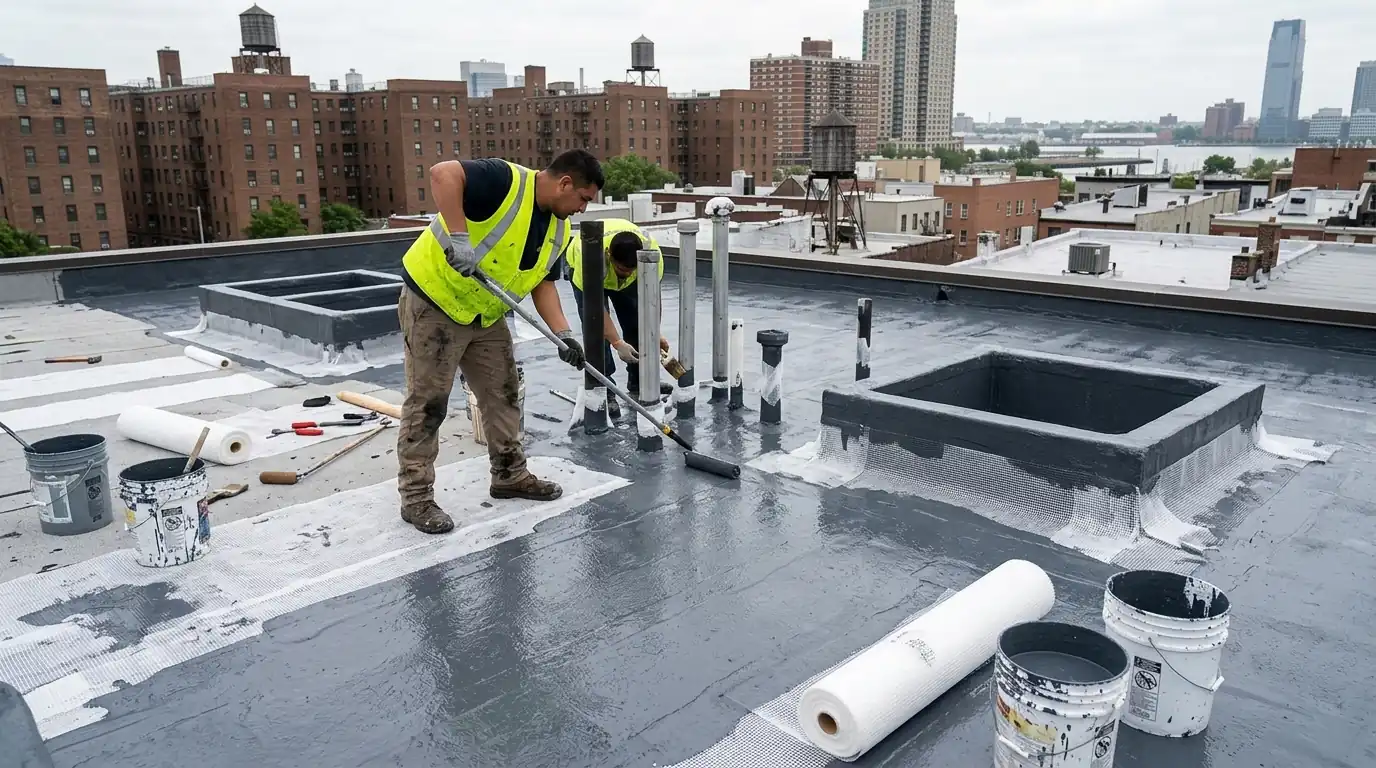
We walk the roof and log each penetration, edge, curb, drain and transition. Photos and measurements go into a plan that says how each one will be sealed.
We probe and core suspect areas to find wet insulation. Wet sections are cut out and replaced, because no membrane works over trapped water.
Loose mastic, gravel and failed patches come off, and the surface is cleaned and dried. The right primer for the substrate goes down so the membrane bonds.
Fabric and detail coats go on every corner, pipe, curb and drain first. Parapet upturns are run to the correct height and terminated.
Liquid coats are applied across the roof at a measured thickness and tied into the finished details. We gauge thickness as we go.
A section is plugged and held under water while we watch the ceiling below. You get photos of every detail before it was covered.
Owners often ask whether a silver or white coating is the same thing. It isn't. A roof coating is a maintenance layer that restores UV protection on a membrane that is already sound and dry. Waterproofing is the water-stopping layer itself, built and reinforced to keep water out without help from what lies underneath. If the existing roof is wet across most of its area, neither one is the answer: that membrane has reached the end of its life and needs replacing, and the parapets and details around it get waterproofed into the new surface.
The difference shows at the details. On a waterproofing job, flashing heights are checked, base flashings are wrapped or rebuilt, termination bars are set at the top of every upturn, and fabric goes into every inside and outside corner before the full coats. That work is slow and unglamorous, and it is where most of the labor goes. It overlaps heavily with flashing repair, and the details we always cover include:
On roofs with internal drains or scuppers, we flood test a section once the membrane has cured. Drains in that area are plugged, an inch or two of water is held against the new work, and someone checks the ceiling below for any sign of moisture. One inch of standing water weighs about 5.2 lb per sq ft, so we test in sections the structure can comfortably carry, never the whole roof at once.
We also photograph each detail before it is covered, so you have a record of how the parapet bases, drains and penetrations were built. If you manage a condo or co-op building, that record helps when the board weighs this work against other repairs, because it shows what condition the deck and insulation were in when the membrane went on. Owners planning a rooftop deck should read how a deck treats the roof underneath before any framing goes down.
| Factor | Polyurethane membrane | Reinforced PMMA membrane |
|---|---|---|
| Cure time | Needs dry hours between coats | Cures fast, even on cool days |
| Reinforcement | Fabric at corners and details | Polyester fleece built into the full system |
| Foot traffic | Light traffic areas | Handles more traffic and moving details |
| Large open areas | Efficient across broad roofs | Higher material cost over big fields |
| Typical fit | Walk-up roofs with a mix of open area and pipes | Decks, hatches and detail-heavy corners |
$4.30 to $11.20
per sq ft, typical range
Most roof waterproofing jobs land between $4.30 and $11.20 per sq ft. That is a typical range, not a quote, and the roof itself decides where yours falls.
Not listed? See every area we serve or call (201) 578-5199.
Membranes, sealers, pumps and dehumidifiers we work with come from makers such as
A coating is a protective topcoat over a membrane that is already dry and sound. Roof waterproofing is the water-stopping layer itself: we rebuild flashings, reinforce every penetration and build a liquid-applied membrane that keeps water out without relying on what's underneath. If your roof is wet or failing at the seams, a coating won't fix it, and waterproofing is the right scope.
Often, yes, as long as the existing roof is dry, firmly attached and compatible with the primer. We run a moisture survey first and cut out any wet insulation or loose membrane. Gravel, heavy mastic and failing coatings come off. Over a sound, primed surface, a polyurethane or PMMA system bonds well and spares you the cost and disruption of stripping the roof.
Because it proves the work instead of assuming it. We plug the drains in one area, hold water on the new membrane and check the ceiling below. If a detail is going to fail, we'd rather find it that day than after the next nor'easter. We test in sections so the weight stays within what the roof can carry.
Roofs crowded with penetrations: pre-war walk-ups with many vents and fans, condo roofs with mechanical units and conduit, and rowhouse roofs where years of patches meet at awkward corners. On those, a membrane that cures without laps outperforms sheet goods cut around every obstacle. A plain open roof that is still sound may only need a coating.
The base of the parapet always is, because that's where the membrane turns up and terminates. We raise and reinforce that upturn as part of the job. If the parapet itself is letting water in through the coping or mortar joints, we'll show you, and that work can be added so the roof and walls are sealed together.
Call (201) 578-5199 and tell us what you're seeing. We'll set up a visit and give you a typical range before any work starts.