Cracked mastic at walls
Black tar troweled along the base of walls that has dried, split or pulled away.
Roof waterproofing · Jersey City, NJ
The membrane looks intact, yet water keeps getting in. Most of the time we trace that kind of leak to flashing: the metal and membrane pieces that seal every edge, wall and penetration on the roof.
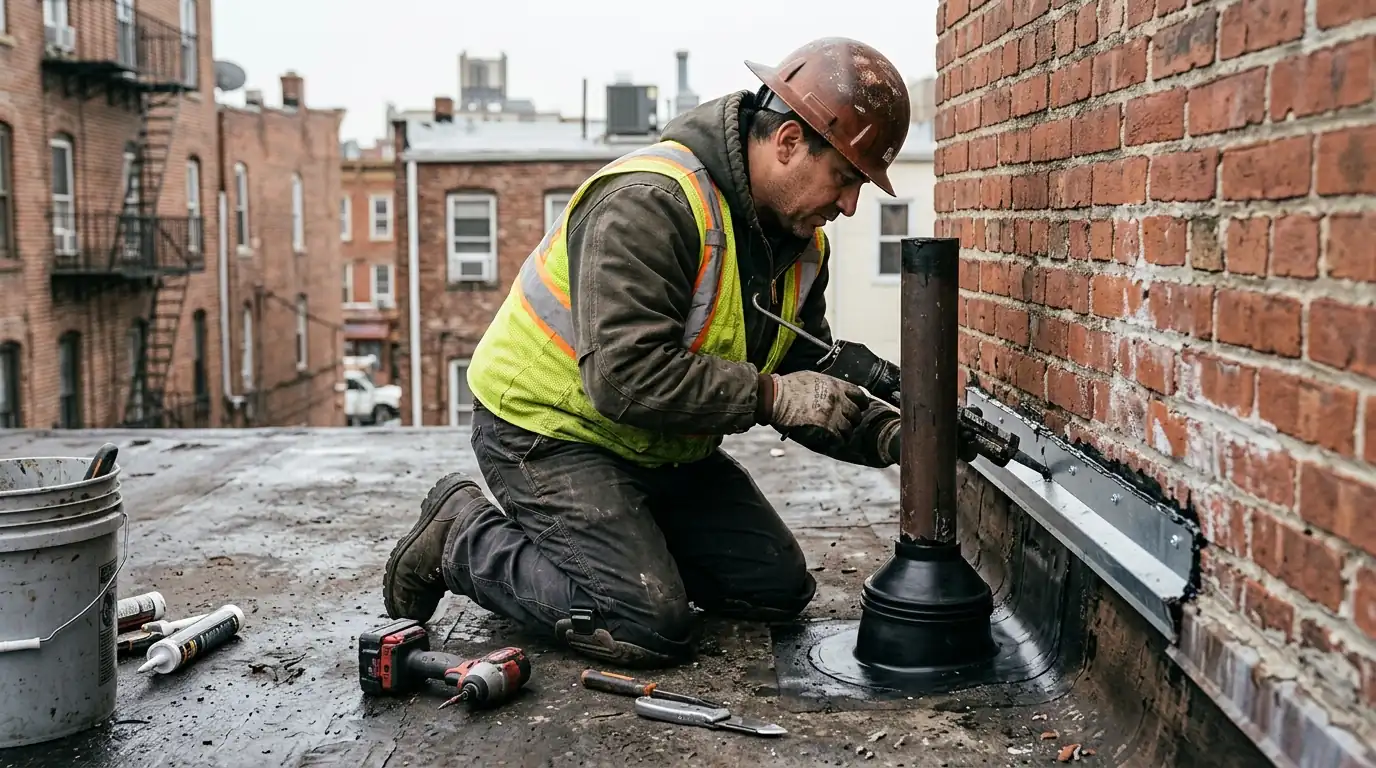
Most roof leaks in Jersey City begin at flashing, not in the open field of the roof. Call (201) 578-5199 and our technicians inspect base flashing, counterflashing, reglets, pipe boots, pitch pockets and curbs, find the detail that failed and rebuild it with materials that match your membrane. Most repairs take a single visit, and we photograph the failed flashing and the finished work for your records.
The open area of a roof, the field, is one continuous sheet. It sits flat, gets the same sun everywhere and moves very little. Flashing is different. It's wherever the roof meets something else: a wall, a parapet, a pipe, a chimney, a hatch, a skylight, a rooftop unit. Those spots move at a different rate than the roof, get hit by splash and ponding, and are built from several pieces lapped together by hand. That makes them the weak link.
On older Jersey City roofs, flashing is often the most patched part of the system. Layers of mastic get troweled over cracked base flashing every few years until the original detail is buried. Mastic dries in the sun, cracks and holds water against the wall. When we take a leak call, the flashing is where our crew looks first, because that's where the answer usually is. And the water doesn't always appear right below: a failed wall flashing can run inside the masonry and show up a floor or two down.
Black tar troweled along the base of walls that has dried, split or pulled away.
Metal bent away from the wall, missing screws, or a reglet with no sealant left.
Rubber collars around vent pipes that are cracked or gapped at the top.
Filler shrunk below the rim of the pocket, leaving a cup that holds water.
Ceiling stains below a rooftop unit, fan or hatch, often after equipment work.
Wall flashing only a few inches high, below where water or snow sits.
On a flat roof, base flashing is the membrane turned up a wall or parapet. Counterflashing is the metal that covers the top of it, set into a reglet (a slot cut into the mortar) or fastened to the wall and sealed. A termination bar holds the top edge of the base flashing tight. Curbs around hatches, skylights and rooftop units are flashed the same way, with membrane wrapped up the sides and capped.
Pipes get pipe boots or flashing collars. Odd-shaped penetrations like structural steel or clusters of conduit sometimes get a pitch pocket, a small box filled with sealant. Pitch pockets need regular topping off as the filler shrinks, and they're a frequent leak source on older roofs, especially where satellite dish or antenna mounts were left behind after the equipment came down.
Skylights and chimneys combine several of these details at once, and each has its own page: skylight leak repair for curbs and domes, and chimney leak repair for crowns, caps and the brick itself. Here is the full list of flashing details we inspect on a leak call:
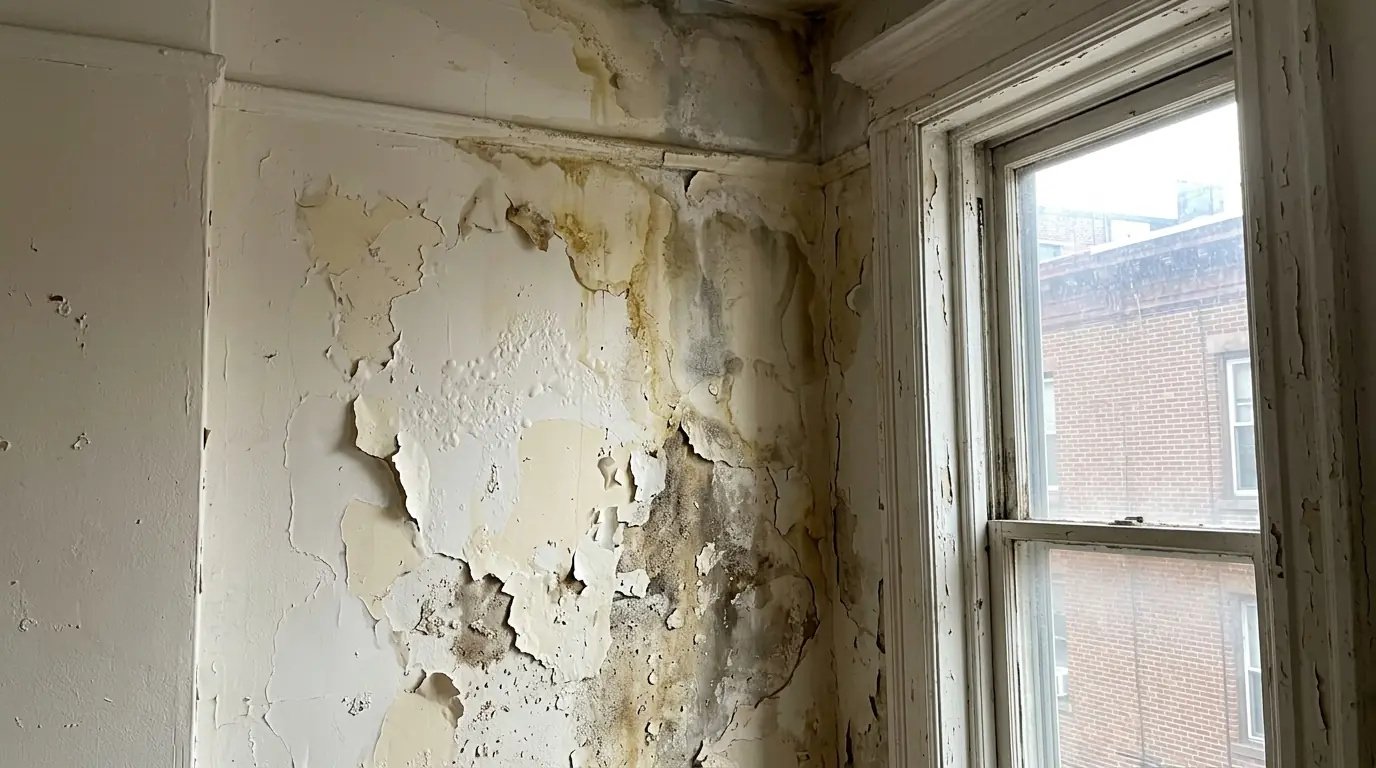
We match the inside stain to roof details above. Every flashing within range gets inspected.
If needed, we water test one flashing at a time. That confirms the source before we start cutting.
Old flashing and buried mastic come off down to a clean, dry surface. Any wet insulation underneath is replaced.
New base flashing goes up to a proper height and is terminated under a bar. Boots, curbs and pockets are rebuilt to match.
Metal counterflashing is set into a reglet or sealed to the wall. Laps and corners get a final check.
You get photos of the failed and finished detail. We note any other flashings that are close to failing.
Freeze-thaw is hard on flashing. Water gets into a small gap at the top of a base flashing, freezes, and pries it a little wider every winter. Sun bakes rubber pipe boots until they crack around the collar. Wind lifts loose counterflashing and bends it away from the wall, and nor'easters drive rain right into the opening. Near the waterfront, salt air speeds corrosion on older metal flashings and fasteners.
Rooftop units are a special case. On condo and walk-up roofs, air conditioning condensers and exhaust fans get replaced, moved or added over the years, and the curb flashing is often disturbed in the process and never properly rebuilt. If a leak started after equipment work, the curb is the first thing we check.
Another common failure is base flashing that simply stops too low. If it's only a few inches tall, ponding water or packed snow can rise over it. On these roofs, raising the flashing is part of a lasting repair, and it often goes hand in hand with parapet waterproofing when the wall above is also taking water.
A real flashing repair means removing the failed piece and the mastic buried around it, down to a clean surface. We then install new base flashing at the correct height, fasten it under a termination bar, and seal the top with counterflashing let into a reglet or mounted and sealed to the wall. Pipe boots are replaced with new boots sized for the pipe, and pitch pockets are rebuilt or replaced with a prefabricated cover where possible.
We match materials to the roof. A modified bitumen roof gets compatible modified flashing; an EPDM or TPO roof gets compatible membrane and accessories; on cluttered details a reinforced liquid flashing often wraps better than any sheet. Mixing incompatible products is a common cause of early failure. If flashings are failing all around the roof, we'll talk with you about full roof waterproofing instead of one repair at a time. Either way, you get photos of the failed detail and the finished repair.
$285 to $1,140
per repair, typical range
Most roof flashing repairs land between $285 and $1,140. That's a typical range, not a quote; the type and length of flashing set where yours falls.
Not listed? See every area we serve or call (201) 578-5199.
Membranes, sealers, pumps and dehumidifiers we work with come from makers such as
Base flashing is the roof membrane turned up a wall, parapet or curb, sealed to the roof. Counterflashing is the metal piece above it that covers the top edge and sheds water over it, set into a reglet in the mortar or sealed to the wall. Base flashing keeps water out at the joint; counterflashing protects the base flashing from water running down the wall.
Usually because the curb flashing was disturbed when the unit was installed, moved or replaced. Equipment installers focus on the unit, and the membrane around the curb gets cut, patched or left open. Condensate lines and electrical penetrations add more holes. We rebuild the curb flashing and seal each penetration so the unit sits on a watertight base.
Only briefly. Mastic over cracked flashing dries, shrinks and cracks again, often within a season. Layers build up and trap water against the wall. A lasting repair removes the failed flashing and old mastic and installs new base flashing, a termination bar and counterflashing. It costs more than a bucket of tar, but it holds.
More often than most other details. The filler in a pitch pocket shrinks and pulls away from the penetration over time, leaving a cup that holds water. We check them on every visit and top them off. Where we can, we replace pitch pockets with a prefabricated cover or a properly flashed curb, which needs less upkeep.
Yes, especially on brick buildings. Water that gets behind a base flashing or through a loose counterflashing can run down inside the wall and surface at a window head or ceiling corner well below the roof. If the stain isn't directly under the roof, we still check the flashing above that wall line before blaming the facade.
Call (201) 578-5199 and tell us what you're seeing. We'll set up a visit and give you a typical range before any work starts.