Stain on the ceiling below
A water mark in the unit below that lines up with the terrace above, often near the door wall.
Walls, terraces & decks · Jersey City, NJ
Water from a terrace or balcony is showing up in the unit below, at the door frame, or as rust stains on the concrete. We trace it to the threshold, the slope, the posts or the membrane and fix the source.
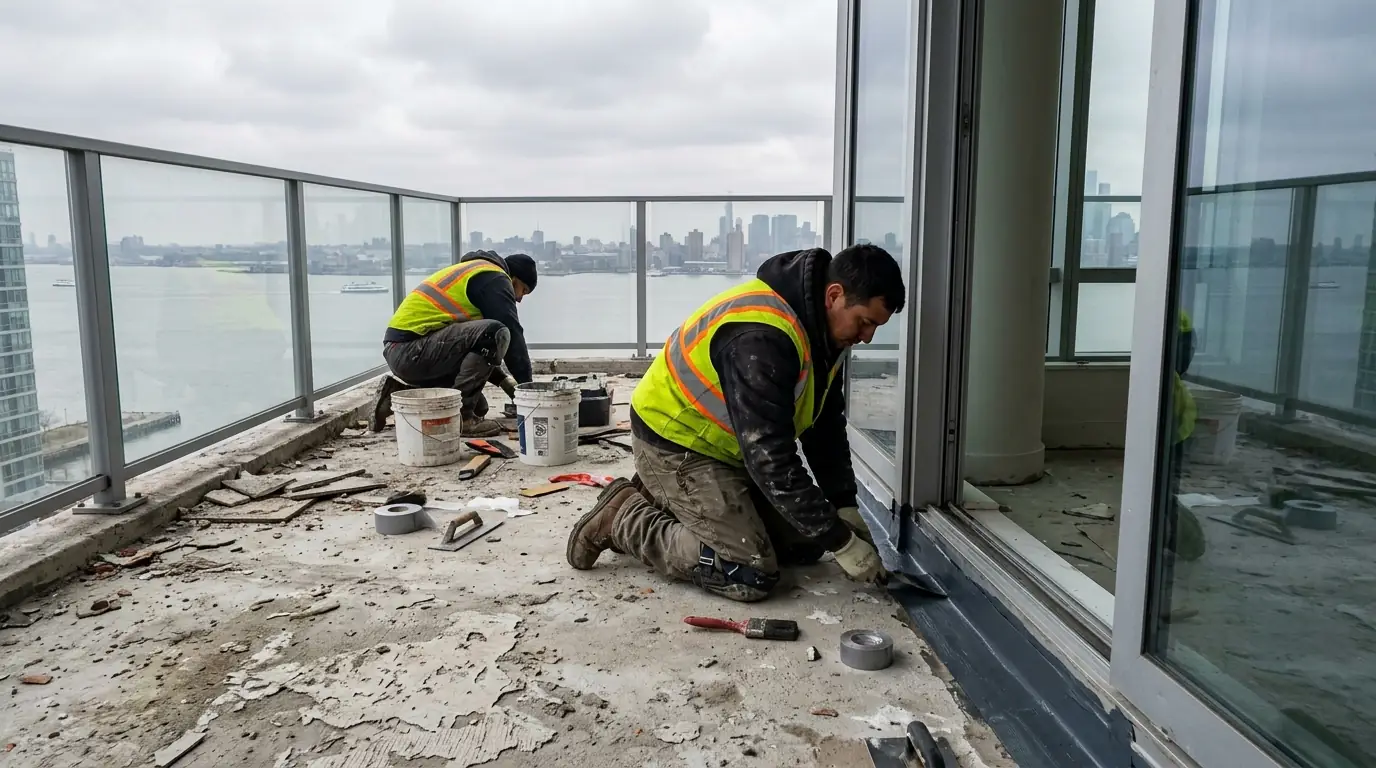
Balcony and terrace leaks in Jersey City usually start at the door threshold, railing posts, poor slope or a failed membrane under tile. Call (201) 578-5199 and our crew tests those points one by one, opens only what needs opening and rebuilds the waterproofing so water runs away from the building. On waterfront towers we coordinate access and documentation with the property manager and condo board.
A terrace built over a living room or bedroom is really a small roof with furniture on it. Rain lands on it, sits until it drains, and has to be kept out of the space below by a membrane, flashing and slope. Newer condos around Jersey City use this design constantly, especially in towers along the Newport waterfront, where setback terraces step back from the floor below. When one fails, the leak shows up in the neighbor's ceiling, not on the terrace itself.
Cantilevered balconies are a little different. There's no living space directly underneath, but water still gets into the slab through cracks and railing post holes, freezes in winter and spalls the concrete. Rust stains under the edge are a warning sign that reinforcing steel inside is corroding. Both kinds of outdoor floor need the same attention to slope, edges and penetrations, even though the damage shows up in different places. Salt air near the river speeds that corrosion along, so waterfront balconies deserve a closer look.
A water mark in the unit below that lines up with the terrace above, often near the door wall.
Damp flooring or swollen baseboard just inside the terrace door after wind-driven rain.
Tiles that click or sound hollow underfoot, a sign water is getting beneath them.
Orange streaks from the balcony edge or around railing posts, pointing to corroding steel.
Puddles that stay against the door frame long after rain stops.
Cracked sealant or concrete circling the base of the posts.
If we had to bet on one spot, it would be the sliding or swinging door that opens onto the terrace. Builders want a low step for comfort and looks, which leaves very little height between the finished terrace surface and the door sill. Wind-driven rain off the Hudson pushes water against the door, puddles collect at the threshold, and if the membrane under the sill pan was never turned up and sealed properly, water runs straight into the subfloor.
Fixing it means removing the tile or pavers along the door, exposing the membrane and the sill, and building a proper pan flashing that turns up behind the door frame and laps over the terrace waterproofing. Sometimes a small trench drain in front of the door helps carry water away. Caulk on the outside of the frame isn't a fix; it fails within a season or two and often traps water behind it. Leaks around the frame itself, above the sill, fall under window and door perimeter sealing.
We see the same pattern at the base of walls and planters along the terrace edge, where the membrane often stops short instead of running up behind the siding or masonry. The fix follows the same idea we use in flashing repair: turn the waterproofing up high, terminate it securely and lap the wall finish over it so water always runs onto the membrane, never behind it.
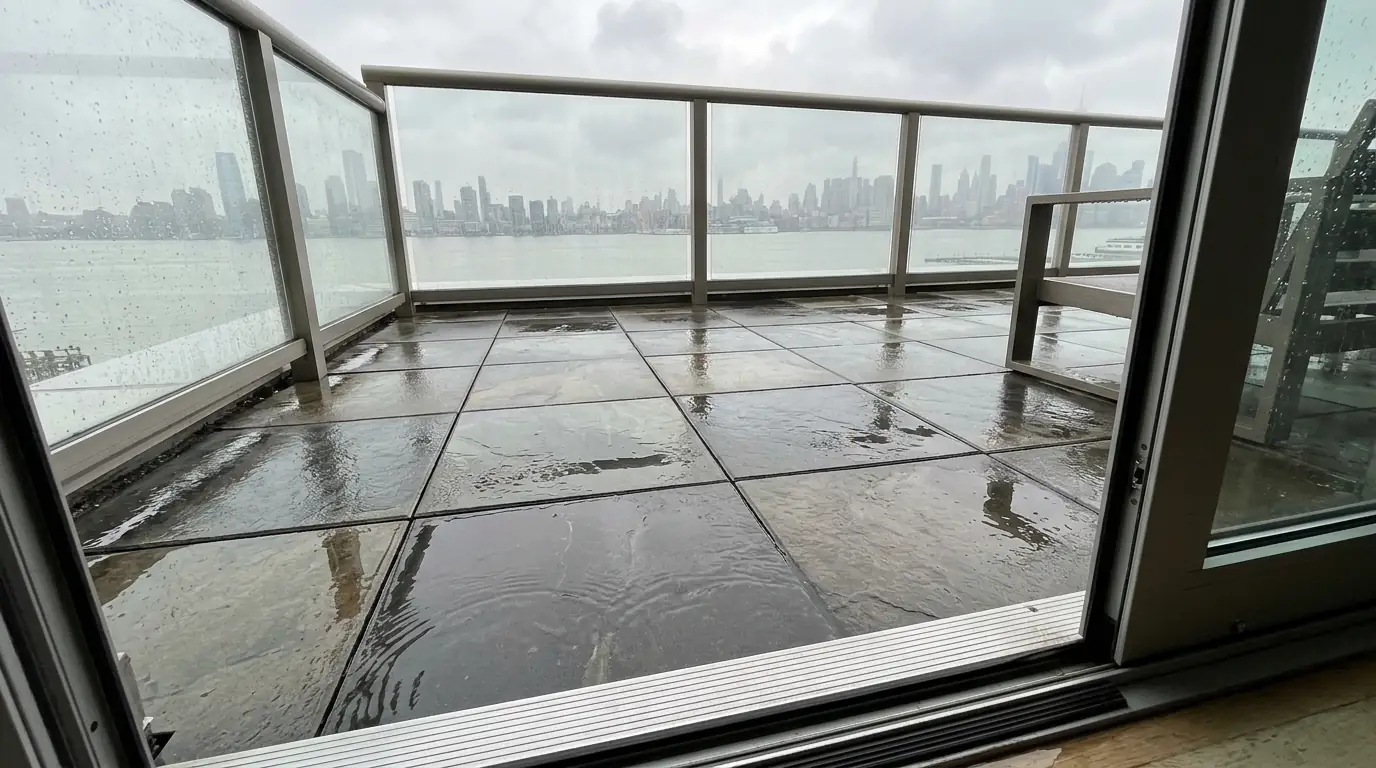
We start in the unit with the leak and map it against the terrace above. Door frames, posts and drains are checked first.
We test the threshold, posts and drain one at a time with controlled water. That narrows the cause before anything is removed.
Tile or pavers come up over the failing area. The membrane, sill and drain connection are exposed and photographed.
Low spots and back-slope are corrected, and cracks are repaired. Severe spalling gets flagged for a concrete or structural specialist.
New membrane goes down and turns up behind the door frame, walls and posts. Drains are clamped or stripped into the membrane.
Pavers or tile go back over a drained membrane. We leave the property manager photos of every step.
Tile and stone look good on a terrace, but neither is waterproof. Grout cracks, water gets under the tile, and the membrane below is what keeps it out of the building. When that membrane is missing, thin, or never tied into the drain, leaks follow. Loose tiles that sound hollow underfoot are a sign water has been getting under them for a while.
Good terrace assemblies have a sloped surface under the membrane so water moves toward a drain or edge, a fully adhered liquid or sheet membrane over that slope, and a finish layer that lets water reach the drain at membrane level as well as surface level. Pedestal pavers do this well because water drains beneath them, much like on a rooftop deck. Mortar-set tile only works when the membrane under it has a path out.
Cracked concrete balconies get crack repair, a slope check and a traffic coating on top. Where the slab slopes back toward the building, we correct that slope before sealing, because no membrane does well with water sitting against a door. Edge drips get attention too: a balcony edge without a drip lets water curl back under the slab and stain the face of the building below, so we add or restore one where it's missing.
Railings on many balconies are set in holes cored into the concrete or bolted through the membrane on base plates. Each post is a penetration. As the railing flexes in wind and the post expands and contracts, the sealant around it cracks, and water runs down the post into the slab. On steel posts, the rust that results expands and cracks the concrete further.
We wrap post bases with reinforced liquid membrane collars, regrout cored posts with a non-shrink material sloped away from the post, and reseal base plates over a sealed membrane. On terraces with many posts, a liquid-applied system is usually the cleanest way to cover everything without laps. If the slab has cracked badly or spalled around posts, we'll tell you when it needs a concrete repair contractor or an engineer before waterproofing goes on.
$1,180 to $6,900
per balcony or terrace, typical range
Most jobs land between $1,180 and $6,900 per balcony or terrace. That's a typical range, not a quote; size and what sits on top move it the most.
Not listed? See every area we serve or call (201) 578-5199.
Membranes, sealers, pumps and dehumidifiers we work with come from makers such as
Because wind pushes water sideways against the door and the wall where they meet the terrace. That's usually the threshold, where the membrane under the sill was never turned up high enough. In calm rain, water drains away before it reaches the weak spot. In a nor'easter, it's driven straight into it. We test the threshold first in cases like this.
Sometimes, if the leak is confined to one area like the door or a drain. We open the tile there, repair the membrane and reset what we removed. If the membrane has failed across the whole terrace, partial work won't hold, and the tile needs to come up. We water test first so the decision is based on evidence, not guesswork.
Water getting into the slab through cracks or around railing posts and reaching the steel reinforcement inside. As the steel rusts, it expands and cracks the concrete further, and the rust bleeds out of the edge. We seal the entry points and coat the surface, and if the concrete is spalling, we'll say plainly that a concrete repair specialist needs to see it.
Yes. On towers and condo buildings, we work through the property manager on access, elevator use, protection of common areas and notice to the neighbors below. We document the cause and the repair with photos so the board has a clear record. Who pays depends on your building's documents, and the photos help that conversation.
Enough that water never sits against the door or wall. In practice, we want the surface under the membrane to fall steadily toward a drain or the outer edge, with no low spots or back-slope toward the building. When a terrace was poured flat or settled the wrong way, we correct the slope with a sloped fill or tapered layer before the new membrane goes down.
Call (201) 578-5199 and tell us what you're seeing. We'll set up a visit and give you a typical range before any work starts.