White crust on inside walls
Efflorescence, a white salty deposit on the inside face or top-floor walls, means water is moving through the brick.
Walls, terraces & decks · Jersey City, NJ
Water is reaching the top-floor walls, or even a floor or two lower, while the roof surface looks fine. On brick buildings the parapet is often the culprit, letting rain in from the top, the face or the base.
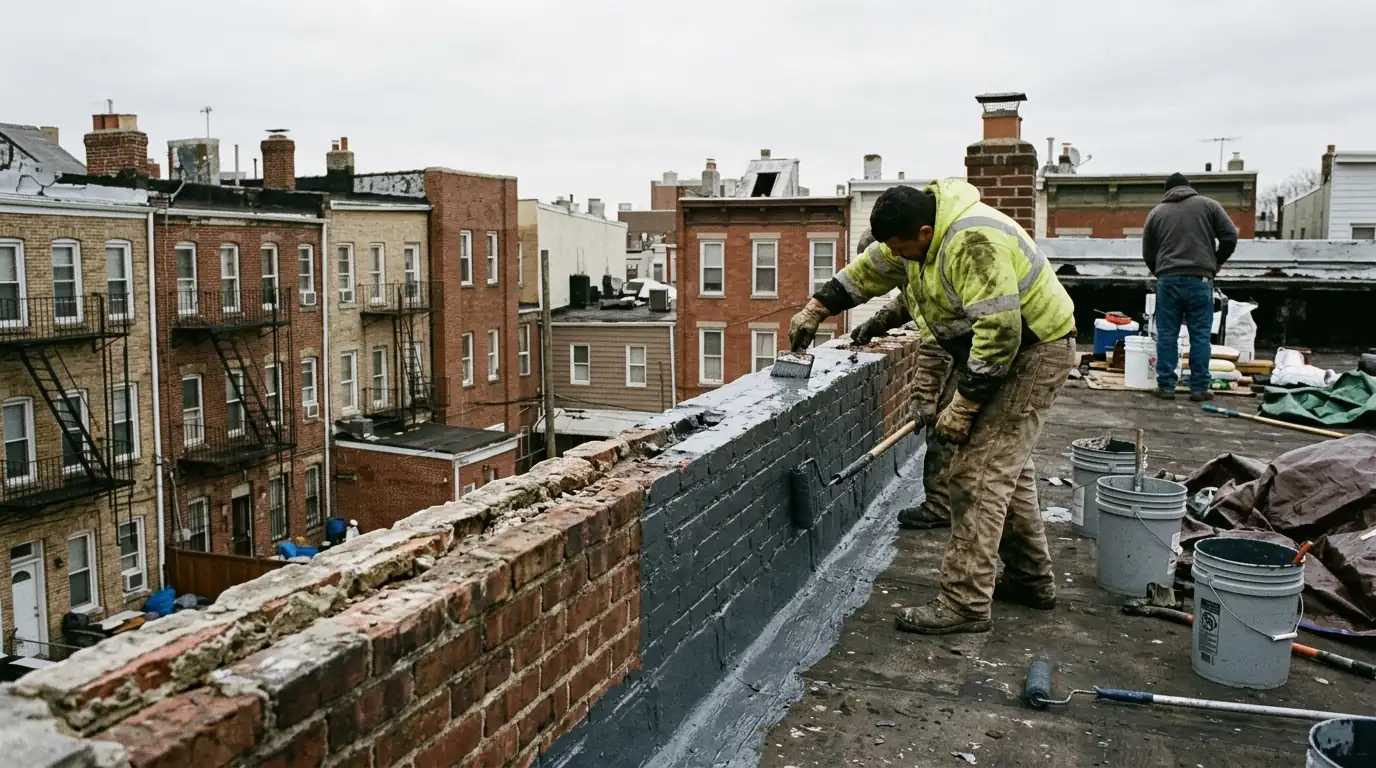
Parapet leaks in Jersey City come from three places: failed coping on top, open mortar joints in the brick, and base flashing that stops too low. Call (201) 578-5199 and our crew inspects all three, then seals the wall by repointing, wrapping membrane up and over it, or setting through-wall flashing under the coping, depending on what the masonry needs and how visible it is from the street.
The low brick wall around the edge of a flat roof takes more weather than almost any other part of the building. It's exposed on both faces and across the top, it soaks up rain, and in winter it freezes and thaws over and over. On 19th-century rowhouses in Hamilton Park and around Van Vorst Park, and on pre-war walk-ups near Journal Square, parapets are often the oldest masonry on the building and the least maintained.
Water that gets into a parapet doesn't stay there. It runs down inside the wall, below the roof line, and can surface on the top-floor ceiling, along an upper wall, or two floors down beside a window where it finally finds a way out. Owners blame the roof and pay for membrane patches that never touch the source. Our guide on why parapet walls are a leak source explains the pattern in more detail, and it's worth reading before you pay for another patch.
Efflorescence, a white salty deposit on the inside face or top-floor walls, means water is moving through the brick.
Gaps between coping stones or loose metal caps you can see from the roof.
Joints you can poke into, or brick edges standing out where mortar has washed away.
Membrane that turns up only a few inches before stopping, often buried in old mastic.
Water marks along the top of walls on the top floor, not in the middle of the ceiling.
A parapet that tilts or bows, often from years of trapped water and freezing.
From the top. Coping stones, metal caps or terra cotta tiles sit on the parapet to shed water. When joints between stones open, mortar beds crack or a metal cap loses its fasteners, rain drops straight into the core of the wall. The top of the parapet is the most exposed surface on the building, so this is the most common entry point we find.
Through the face. Brick itself absorbs some water, but the mortar joints are the real path. Old lime mortar erodes, freeze-thaw opens hairline cracks, and wind-driven rain gets pushed deep into the wall. On the roof side, missing joints are often hidden behind old tar. Once water is inside the core of the wall, it can travel sideways and down for several feet before it shows up indoors.
At the base. The membrane on the roof should turn up the parapet and terminate high enough that splashing and ponding water can't reach the top of it. On many older roofs, base flashing stops only a few inches up, or it's been patched so many times that the termination is buried in mastic. Water gets behind it and runs down into the building.
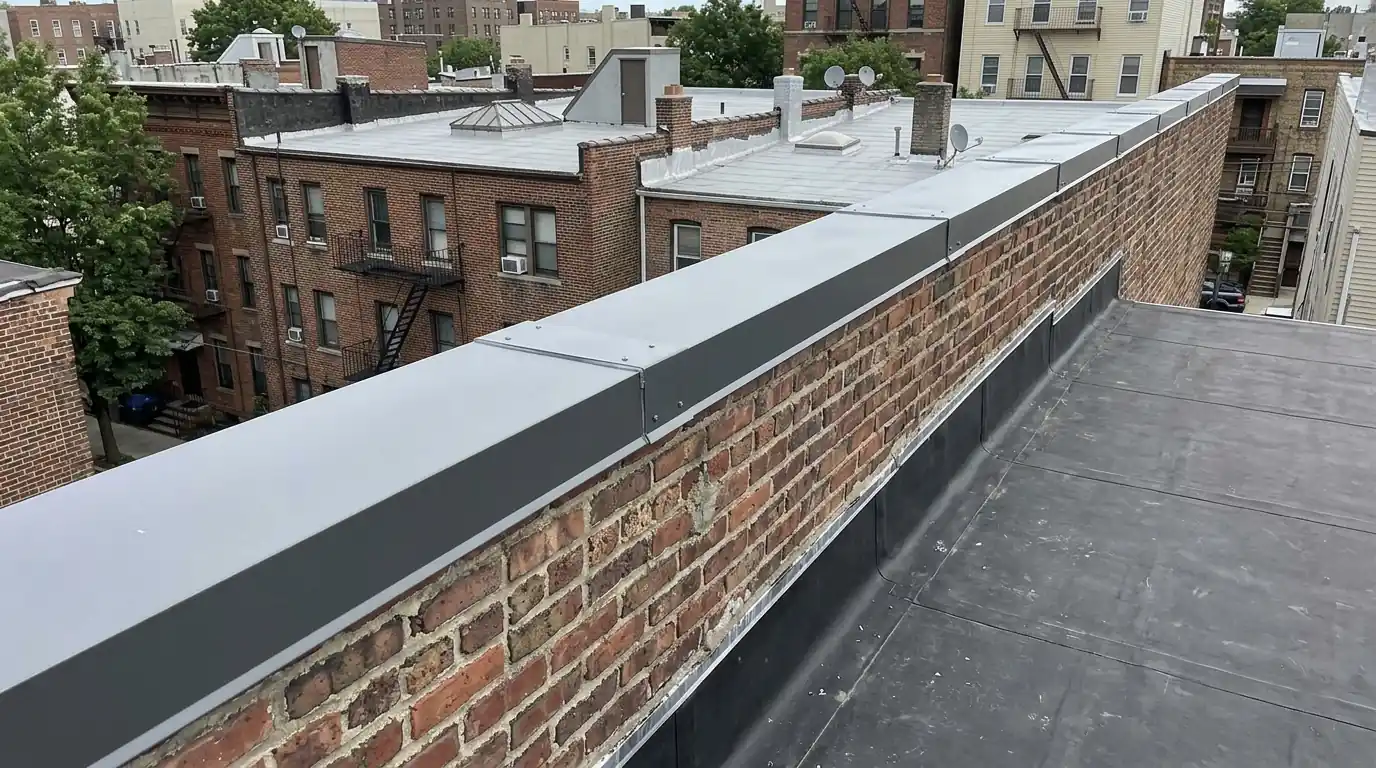
We check the coping, both brick faces and the base flashing on every run of parapet. Party walls get noted separately.
We decide between wrapping, repointing, through-wall flashing or a mix. Street-facing and historic parapets get a masonry-first approach.
Failed mortar is raked out and repointed, and broken brick is replaced. Badly leaning sections get flagged for a mason or engineer.
Membrane is run up to a proper height and terminated under a bar or in a reglet. Counterflashing seals the top edge.
Coping is reset over through-wall flashing, or the parapet is wrapped and capped with new metal. Joints are sealed to shed water outward.
We test the suspect runs and photograph the finished details. You get a record of every section we sealed.
The right fix depends on the condition of the masonry and how the parapet looks from the street. When the brick and mortar are sound and the parapet is hidden from view, the most durable approach is often to run a membrane up the inside face, over the top and down the outside a short distance, then cap it with new metal coping. Water then has no masonry to soak into from above.
Where the parapet faces the street or sits in a historic district, the brick usually has to stay visible. In that case we do brick repointing with a mortar matched to the old brick, reset or replace coping with proper joints, and install through-wall flashing under the coping so any water that gets past it is directed back out. Exterior work in Jersey City's designated historic districts goes through the city's Historic Preservation Commission review, and we tell owners up front when a parapet job will likely need it.
At the base, we raise the flashing and terminate it under a bar or into a reglet cut into the mortar, then seal it with counterflashing. Corners get reinforcing fabric, because that is where a raised upturn cracks first. That ties directly into roof flashing repair, which often happens on the same visit, and the finished base gives any future work on the roof a clean, high detail to tie into.
On Jersey City rowhouses, the parapet between two roofs is often shared, sitting right on the property line. Water getting into it can show up in either house, and fixing only your side may leave the neighbor's half still feeding the leak. We look at both faces when we can reach them, and we explain clearly which part of the wall is failing.
When the neighbor agrees, sealing the whole party-wall parapet in one job is cleaner and cheaper for both owners. When they don't, we can wrap and flash your side and the top, with a clean termination at the line. We'll be honest about how much that will help. Either way, we keep the details consistent so future work on either roof can tie into them. If staining continues down the facade below the parapet, the wall itself may need exterior wall waterproofing as well.
| Approach | What it involves | Where it fits |
|---|---|---|
| Membrane wrap and metal cap | Membrane up the inside, over the top, capped with metal coping | Parapets hidden from the street with sound brick |
| Repoint and through-wall flashing | New mortar joints, coping reset over a flashing layer | Street-facing and historic district parapets |
| Base flashing only | Raise and terminate the membrane at the base | Parapets whose top and faces are still tight |
$38 to $96
per linear ft, typical range
Most parapet waterproofing jobs land between $38 and $96 per linear ft. That's a typical range, not a quote; masonry condition drives most of the spread.
Not listed? See every area we serve or call (201) 578-5199.
Membranes, sealers, pumps and dehumidifiers we work with come from makers such as
That's efflorescence: salts carried out of the brick and mortar by water moving through the wall, left behind when the water evaporates. It means the parapet is getting wet from the top, the face or the base. Brushing it off doesn't solve anything. We find where the water enters and seal that point, and the deposits stop forming.
On many parapets, yes. Running the membrane up the inside face, over the top and capping it with metal stops water entering from above, which is the most common source. It's the right choice when the parapet isn't visible from the street. On street-facing or historic parapets, we usually keep the brick exposed and rely on repointing and through-wall flashing instead.
High enough that ponding water, snow and splash can't reach the top of it. Many old roofs in Jersey City have flashing that stops just a few inches up. We raise it to a proper height, terminate it under a bar or in a reglet cut into the mortar, and seal it with counterflashing so water can't get behind it.
We can seal your face, the base on your roof and, with care, the top up to the property line. That often helps a lot. If the neighbor's side is badly deteriorated, though, water can still enter there and travel through the wall. We'll tell you honestly how much your half alone should accomplish, and doing the whole wall together is usually the better value.
When the wall is leaning, bulging, missing large sections of brick or has cracked through. Those are structural masonry problems, and we say so plainly rather than wrapping a failing wall in membrane. Waterproofing works on a sound parapet. If yours needs rebuilding first, we'll explain what we saw so the mason starts with clear information.
Call (201) 578-5199 and tell us what you're seeing. We'll set up a visit and give you a typical range before any work starts.