Key points
- A parapet is exposed on both faces and the top, so it soaks up more weather than any other wall.
- Open coping joints and cracked mortar let water straight down into the wall.
- Base flashing that stops low on the wall lets wind-driven rain and snowmelt behind it.
- Party-wall parapets are shared, so a lasting repair often starts with a talk with the neighbor.
Why the short wall around your roof gets the worst weather
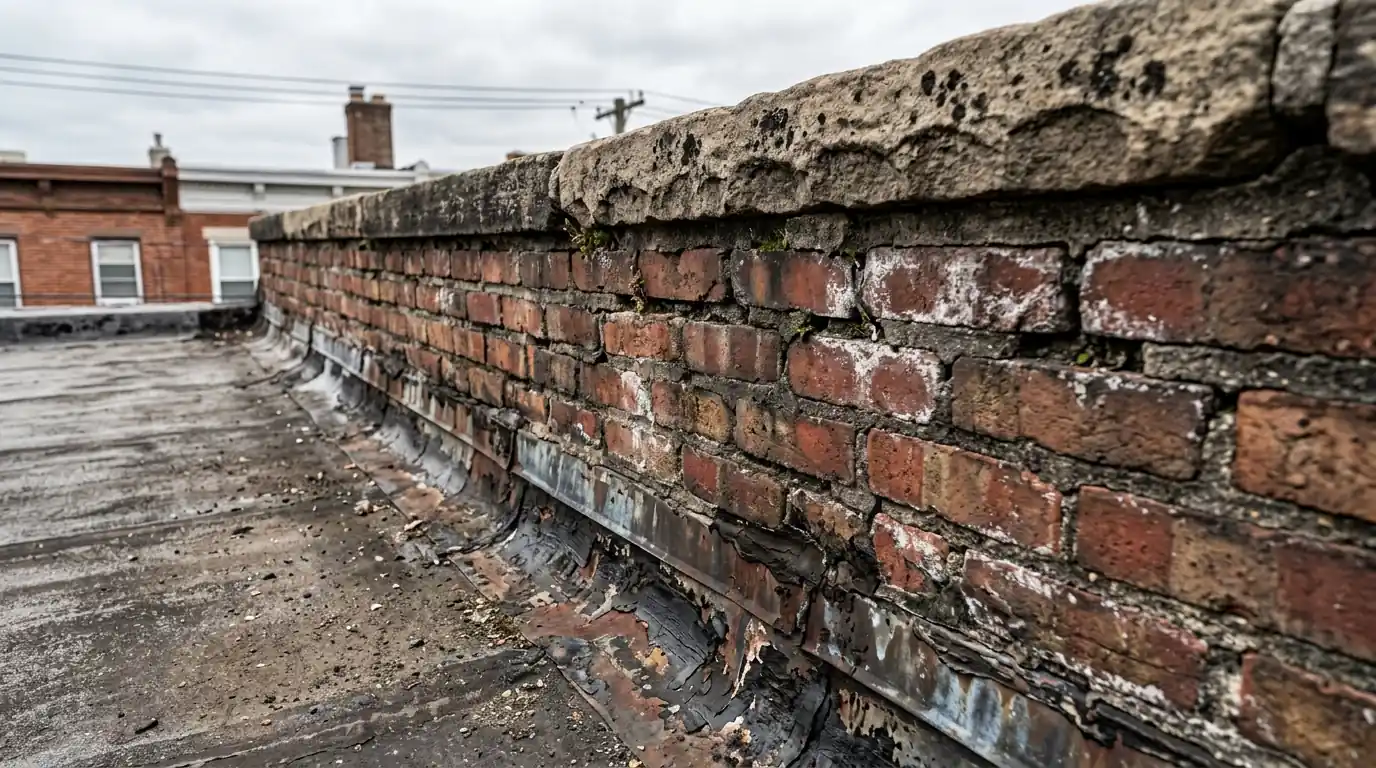
A parapet is the part of a brick wall that rises above the roof line. On downtown rowhouses in Hamilton Park, Van Vorst Park and Harsimus Cove, it may be only two or three feet tall, but it's the most exposed masonry on the building. Rain hits its outer face, its inner face and its top. Wind off the Hudson pushes water into it from the side. In winter it freezes from both directions, with no heated room behind it to slow things down. Walk-ups around Journal Square and McGinley Square have taller, longer parapets with the same weakness, just more of it, and the corners where two walls meet tend to crack first.
An ordinary wall takes weather on one face. A parapet is outside on three surfaces, so its brick and mortar absorb far more water and go through far more freeze-thaw cycles. Water that gets into a parapet doesn't stay there. Gravity pulls it down into the wall below the roof line, where it reaches ceiling joists, plaster and top-floor rooms. That's why parapet leaks are so often misread as roof leaks, and why owners sometimes pay for a new membrane that doesn't stop the drip. Our guide to ponding water on flat roofs covers the other big source of top-floor leaks.
Coping: the cap that's supposed to keep water out of the wall
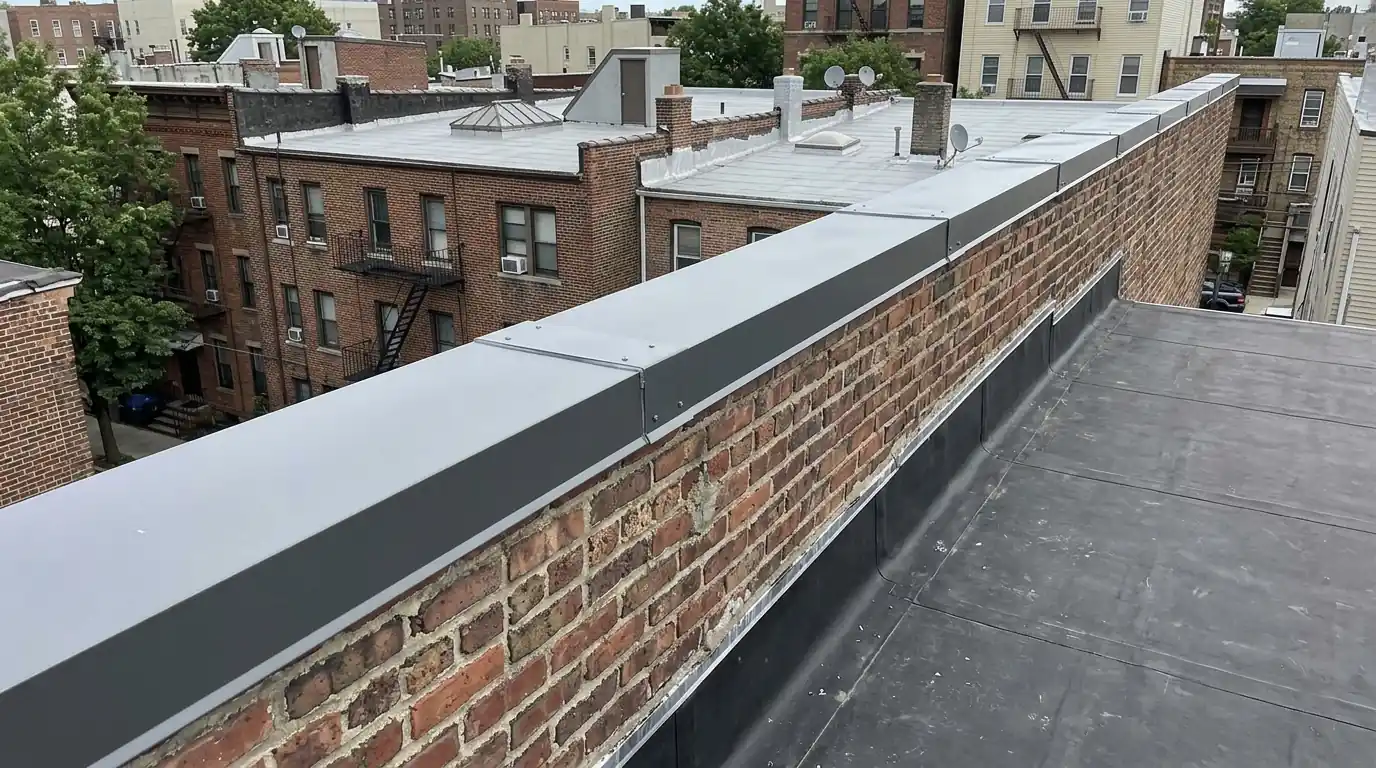
Coping is the cap on top of the parapet: stone, terra cotta, brick laid on edge or sheet metal. Its job is to shed water off the top of the wall and away from both faces, so the brick below stays as dry as an exposed wall can. When it works, you never think about it. On old rowhouses the coping joints were set in mortar that has long since cracked, and each open joint funnels water straight down into the center of the wall. Shifted stones, missing drip edges on the underside and metal coping with failed seams all do the same thing.
Metal coping fails in its own ways. Sections expand in summer sun and contract in winter, and the joint covers between them work loose. Fasteners rust, especially near the waterfront, where salt air speeds corrosion. On stone and terra cotta, our technicians look for joints that have opened, for pieces that rock when pressed, and for missing or flattened drips that let water curl back under the cap. Resetting and sealing coping is often one of the least expensive fixes along the whole roof edge, and one of the most effective.
Mortar joints and the brick face below the coping
Below the coping, the parapet is plain brick and mortar, and old lime mortar wears out. Joints erode, crack and open up, especially on the side facing the prevailing storms. Every open joint is a place where water gets in and where freeze-thaw can push the brick face apart. You'll sometimes see spalled brick, with the face popped off, or white mineral deposits where water has carried salts out through the masonry and left them behind as it dried. Loose bricks near the top of a parapet are worth noting too, because they mean water has been working inside the wall for a while.
Brick repointing is the standard fix: raking out the failed mortar and packing in new mortar that matches the strength of the old brick. On historic rowhouses that mortar has to be soft enough to protect the brick, since a hard modern mix can crack the softer old brick around it. A coating painted over the roof side of a parapet is a common shortcut that tends to trap water in the wall, so we'd rather repoint and flash it properly. In designated historic districts, work on a street-facing parapet may go through the city's Historic Preservation Commission review, and we'll tell you when that's likely.
Base flashing height and the through-wall flashing nobody sees
Where the roof meets the parapet, the membrane turns up the wall as base flashing. On many older Jersey City roofs, that flashing only runs a few inches up the brick and was held in place with a bead of mastic. When snow piles up or water ponds against the wall, it rises above the top of the flashing and runs behind it. Wind-driven rain does the same. Good practice runs base flashing well up the wall, secures it with a termination bar and covers its top edge with counterflashing set into a reglet or a mortar joint.
Through-wall flashing is the hidden layer. It's a sheet of metal or membrane built into the wall just under the coping, or near the roof line, to catch water soaking down through the brick and send it back out. Many older parapets were built without it, and on others it has corroded away. When it's missing, water that gets past the coping travels down inside the wall and behind the base flashing, so even a brand-new membrane can't stop it. Adding it means lifting the coping and sometimes rebuilding the top courses of brick.
Party-wall parapets you share with the neighbors
On attached rowhouses, the parapet between two roofs usually sits on the shared party wall. Half of it is your neighbor's, and water doesn't care where the property line runs. A cracked coping joint over the party wall can leak into your top floor, theirs, or both. Repairs done from only one side often fail, because the coping and any through-wall flashing run across the full width of the wall, and a half-sealed joint simply moves the water over a few inches.
The practical answer is to talk to the neighbor early, ideally before the leak gets worse on either side. We can look at both sides of a shared parapet, explain what each roof needs, and do the work in the same visit if both owners agree. When only one owner goes ahead, we'll still tie the repair in as well as the other side allows and tell you plainly where the limits are. On condo and co-op buildings the same issue plays out between units or with the board, and our commercial waterproofing work is planned with the property manager from the first visit.
Signs inside the top floor that point to the parapet
Parapet leaks leave a recognizable trail indoors. Because the water comes down through the wall rather than through the roof deck, it usually shows up along the edge of the ceiling where it meets an outside or party wall, or on the wall itself just below the ceiling. The pattern often lines up with a coping joint or a corner above. It also tends to follow the weather in a telling way, getting worse during long, windy storms and lingering for days afterward as the brick slowly gives up the water it absorbed. These are the signs worth watching for on the top floor:
If you see two or more of these, start with the parapet before anyone talks about redoing the whole roof. A careful look at the coping, the mortar, the base flashing and the roof side of the wall usually finds the entry point. Parapet wall waterproofing typically runs $38 to $96 per linear foot, depending on wall height, how much repointing and coping work is involved, and whether through-wall flashing is added. If water is coming in now, we answer (201) 578-5199 day and night.
- A band of staining along the ceiling edge at an outside or party wall
- Peeling or bubbling paint high on a wall, often worse after a storm
- White powdery deposits on interior plaster or exposed brick
- Damp patches that show up a day or two after rain and dry slowly
- Leaks during wind-driven rain but not during calm, steady rain
- Cracked or crumbling plaster at the top of a wall below the roof
Owner Guides Editor at Waterproofing Services Carteret. Writes the owner guides from the questions our crews hear in Jersey City basements and on its roofs every week.