Puddles against the wall
Water collects right at the foundation after rain instead of soaking in farther out.
Sump pumps & drainage · Jersey City, NJ
When your patio, driveway or lawn tilts toward the house, every storm sends water straight at the foundation. We regrade the soil and add catch basins or channel drains so rain runs away from your walls instead.
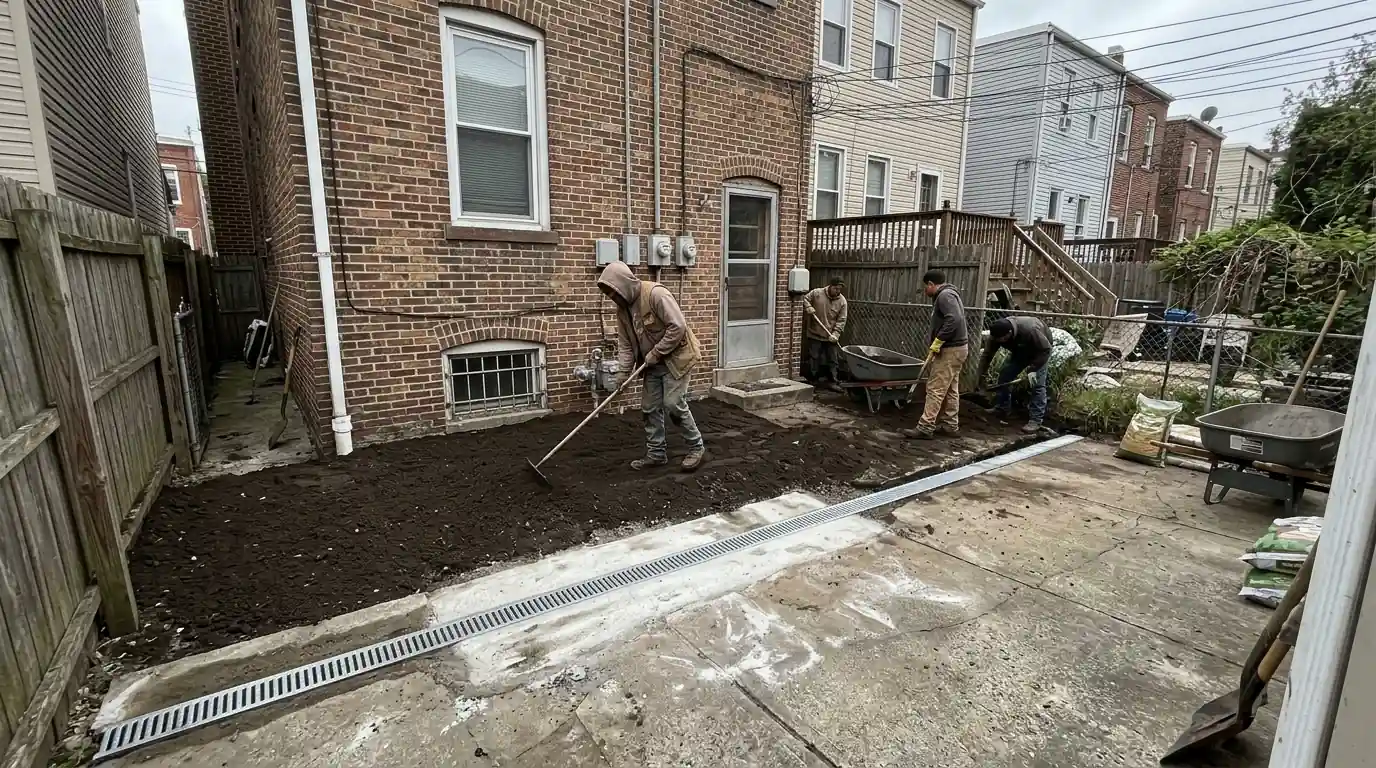
For Jersey City properties where water flows toward the house, we regrade the soil so it falls away from the foundation, and add catch basins or channel drains where patios and driveways slope the wrong way. Collected water goes to a dry well, a sump or the curb where allowed. Call (201) 578-5199 and we'll walk the yard with you.
Soil next to a foundation should slope away from the house, so rain landing near the walls runs outward instead of soaking down along them. Over decades that slope disappears. Soil settles, mulch and garden beds build up against the siding, and new patios get poured flat or tilted the wrong way. Once the ground leans toward the house, every storm pushes water against the basement wall, where it finds every crack and loose mortar joint.
Regrading means rebuilding that slope. We pull back the soil along the foundation, bring in clean fill, compact it in layers and shape it so it falls steadily away from the wall for several feet. We keep fill below the siding and below basement window sills, so we don't trade one leak for another. Where window wells sit in that zone, we check their drains too, because a window well that holds water can undo a good grade.
Water collects right at the foundation after rain instead of soaking in farther out.
A splash of water on your patio or driveway rolls toward the house, not away from it.
Garden beds or mulch have built up until they touch the siding or sit above the window sills.
Rain runs down the driveway and slips in under the garage door.
The basement leaks mostly on the side facing the yard or patio.
Thin lines of dried mud show where water flows and settles after storms.
Water crosses your property line from a higher yard or a nearby leader every storm.
Hard surfaces are the bigger problem in most Jersey City yards. A concrete patio poured tight against the rear wall of a rowhouse, or a driveway running downhill to an attached garage, gathers rain from a wide area and sends all of it to one spot. Breaking out and repouring the slab is one answer, but a drain often does the same job for far less money and far less mess.
A channel drain, sometimes called a trench drain, is a narrow grated channel set into the concrete across the low edge of a patio or at the foot of a driveway. Water running across the surface drops through the grate and travels along the channel to a pipe. A catch basin is a square box with a grate at a single low point, with a sump in the bottom that traps leaves and grit before the water moves on. We pick between them based on whether water sheets across or gathers in one spot.
Grates and basins need a little care. Leaves, mulch and grit settle in a channel drain and in the sump at the bottom of a catch basin, and a basin that's full sends water right back across the patio. We set grates where you can lift them by hand and show you how to scoop out the sump each fall. A few minutes with a trowel and a bucket after the leaves drop keeps everything flowing through the winter storms.
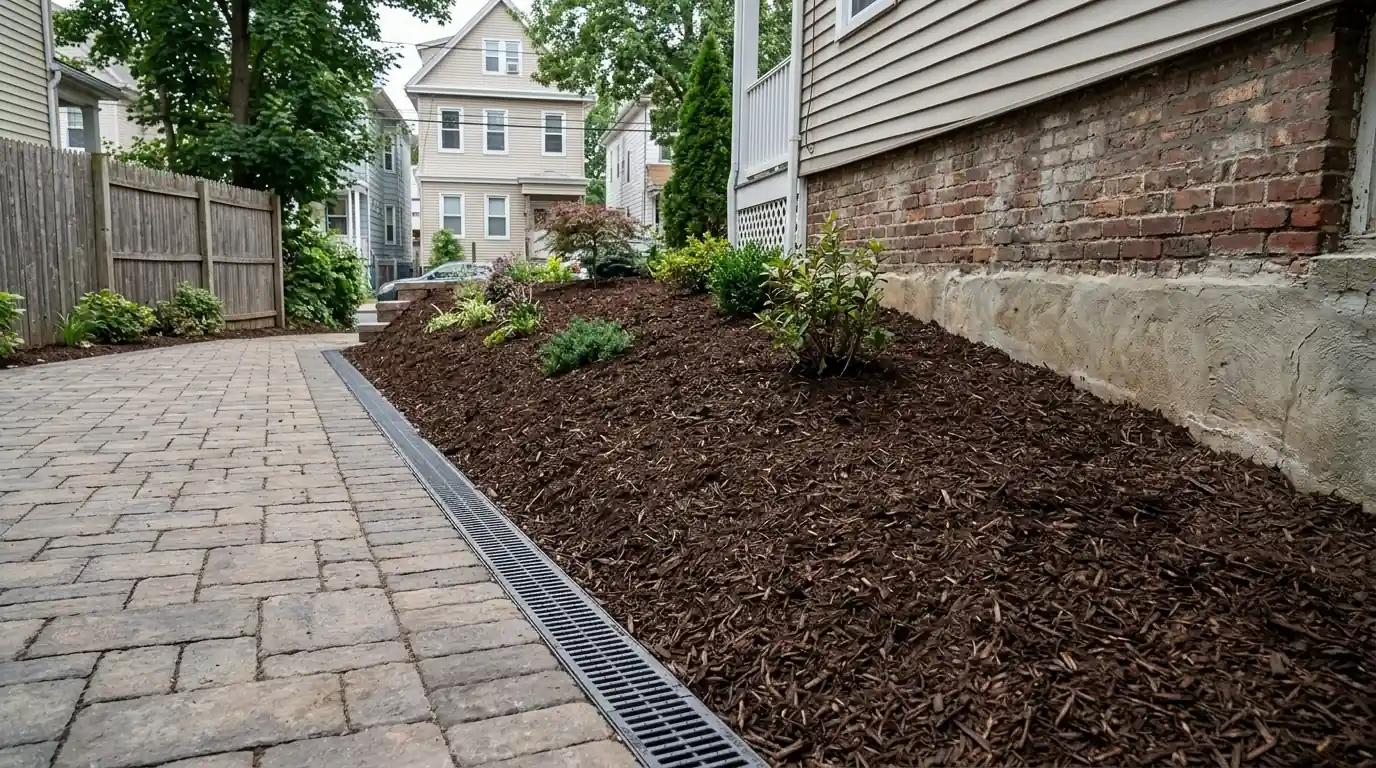
We look at the yard, ideally after rain, and check slopes with a level. We note where water enters, gathers and can leave.
We decide where regrading is enough and where a catch basin or channel drain is needed. You see the plan and the outlet before work starts.
We remove old soil and mulch from the wall, add clean fill and compact it to a steady slope. Soil stays below siding and sills.
We saw-cut concrete for channel drains or set catch basins at the low points. Pipe runs underground to the planned outlet.
Collected water goes to a dry well, a sump or an allowed curb outlet. We test each drain with a hose.
We patch concrete, reset pavers and finish the soil with seed, sod or stone. All debris leaves with us.
Behind downtown brownstones and in neighborhoods like Hamilton Park, yards are narrow, walled in on three sides and often sit lower than the street. There's no obvious place for water to go and no room for machines. We dig by hand, move soil in buckets through the basement or a side gate where there is one, and protect floors and stairs along the way. A small catch basin tied to a dry well is often the whole fix.
These yards also tend to be paved edge to edge, so rain from your roof, your patio and sometimes the yard next door all ends up at your rear wall. That's where the rear areaway and its drain take a beating, and where many rear basement leaks begin. Getting the surface water out of that corner is usually the first step before any wall repair is worth paying for.
Plenty of Jersey City drainage problems start on a neighbor's lot. A higher yard, a leader aimed at the property line or a new patio next door can send water across to you. We don't touch anyone else's property, but we can intercept water at your line with a shallow swale, a channel drain or a French drain along the fence, and carry it to an outlet on your side.
Where a neighbor's leader is clearly the source, a friendly conversation often solves more than any drain. We point out what we see in plain terms so you can share it. And we never send collected water onto someone else's lot; it goes to a dry well, a sump, a curb outlet where the town allows one, or a buried leader line that carries it away. Grading and drains together are usually what finally keep the basement dry.
| Fix | Best when | Limits |
|---|---|---|
| Regrading soil | Lawn or beds slope toward the foundation | Can't fix paved areas; needs room to slope away |
| Catch basin | Water gathers at one low point | Collects only where it sits; needs a pipe and outlet |
| Channel drain | Water sheets across a patio or driveway toward the house | Requires cutting concrete; grate needs clearing of leaves |
| Swale | Water crosses a lawn from a higher lot | Needs some width; won't fit every rowhouse yard |
$1,350 to $6,200
per yard, typical range
Most jobs land between $1,350 and $6,200, from simple regrading along one wall to a full set of drains with an outlet. Yard size and the hard surfaces involved drive the number.
Not listed? See every area we serve or call (201) 578-5199.
Membranes, sealers, pumps and dehumidifiers we work with come from makers such as
The goal is a steady fall away from the wall for several feet, enough that water visibly runs outward rather than sitting. The exact grade depends on how much room you have before a fence, walk or property line. In tight rowhouse yards we often combine a short slope with a drain, since there isn't space for a long, gentle grade.
Usually, yes. A channel drain set across the driveway just outside the garage door catches water running down the slope before it reaches the door. It needs a pipe to a proper outlet, such as a dry well or sump, and enough capacity to keep up in heavy storms. We size the channel to the area of paving that drains toward it.
We can intercept it on your side of the line with a swale, a channel drain or a shallow French drain along the fence, and carry it to an outlet on your property. We don't work on a neighbor's lot, but we can explain what's causing the flow so you can talk with them about their leaders or grading.
It often cuts leaks a lot, especially along the side where water was pooling, because less water reaches the wall. If groundwater is rising from below or the wall has cracks, grading alone won't finish the job. We look at the basement and the yard together and tell you which fixes matter most and in what order.
Call (201) 578-5199 and tell us what you're seeing. We'll set up a visit and give you a typical range before any work starts.