Water at the basement door
A wet floor or a tide line just inside the door under the stoop after rain.
Basement & foundation · Jersey City, NJ
If water pools in the sunken entry under your front stoop and slides under the basement door, the areaway drain or the stoop above it has failed. We clear the drain, seal the stoop and stop the water at the threshold.
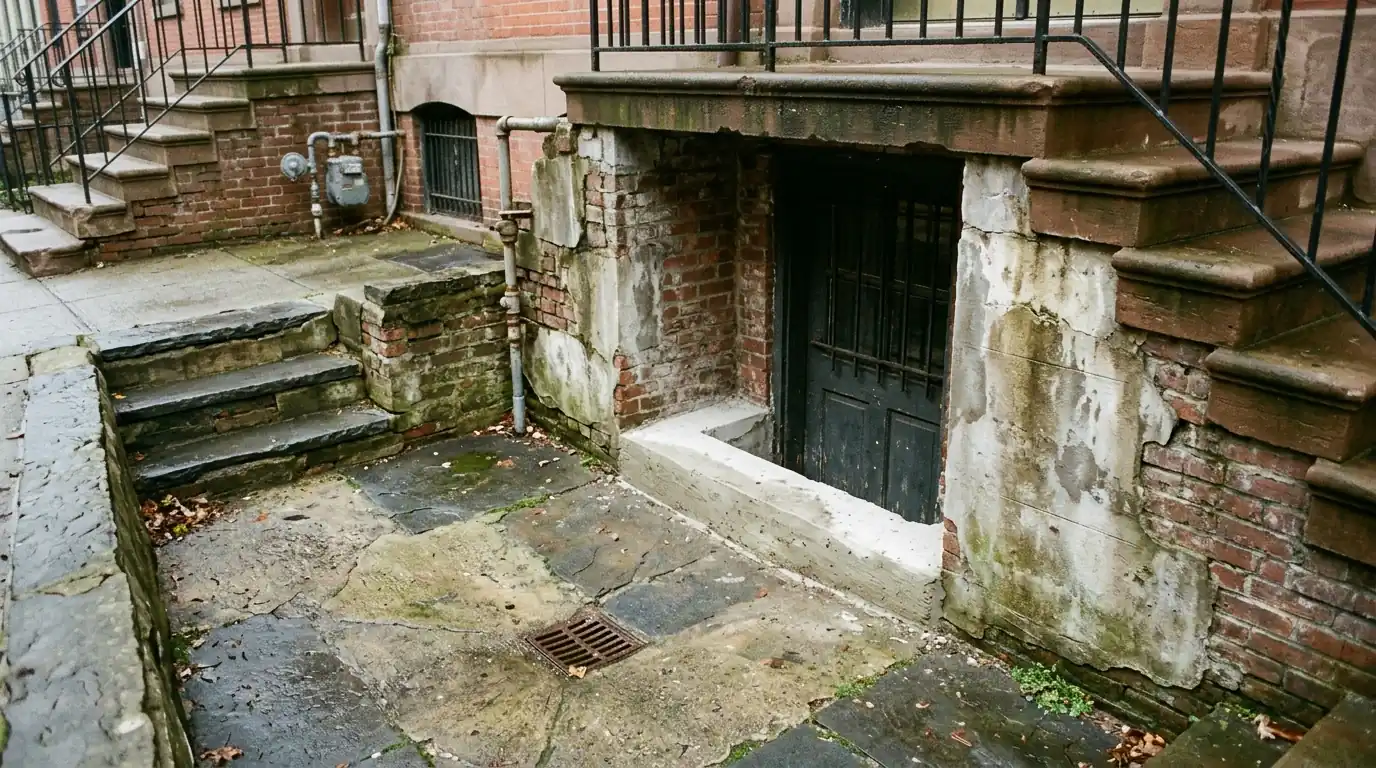
For leaking areaways and stoops on Jersey City and Hoboken rowhouses, call (201) 578-5199. We clear or rebuild the small areaway drain, raise and seal the basement door threshold, waterproof the stoop slab and its joints, and treat vaults under the stoop or sidewalk where water seeps through. Most of the work keeps the front of the house looking exactly as it did.
Brick rowhouses and brownstones in downtown Jersey City and Hoboken were built with a front areaway: a sunken space below the stoop, a few steps down from the sidewalk, with a door into the basement. It is the lowest outdoor point on the lot. Rain from the stoop, the sidewalk and sometimes the front wall all drains into it, and the only way out is one small drain in the paving.
That drain is often only a few inches across, connected to old piping under the floor, and easy to choke with leaves, grit and trash blown off the street. When it slows, water rises in the areaway until it reaches the door threshold. In a heavy storm, if the drain ties into the sewer, water can even come up out of it. Either way, it ends up under the basement door and across the floor.
Hoboken and the low blocks of downtown Jersey City sit on old marsh and fill, so the ground under many of these areaways stays wet after long rains. Groundwater can then push up through cracked areaway paving or the joint where it meets the front wall, even with the drain clear. That is why we look at the paving and wall joints as closely as the drain itself, rather than assuming one clogged grate explains every wet floor.
A wet floor or a tide line just inside the door under the stoop after rain.
Water still sitting in the areaway an hour after the rain stops.
The areaway drain gurgles or pushes water up in heavy rain, a sign it ties into an overloaded sewer.
Open cracks, loose treads or missing mortar where the stoop meets the house.
Water or white mineral deposits on the ceiling or walls of the vault under the stoop or sidewalk.
A basement door that is swollen, rotted or rusted along its bottom edge.
We start by finding out what the drain connects to. Some run to the building's sewer line, some to an old dry well, and some to pipes nobody has seen in decades. We clear them with a cable or a jetter and, where the pipe has collapsed or is packed with roots, rebuild that section. A slightly larger grate with a small basket under it keeps leaves from going straight back in.
Where the areaway drain connects to the sewer, heavy rain can push water back up through it. Jersey City and Hoboken rely largely on combined sewers, where storm water and sewage share pipes, so this happens often. A backwater valve on that line lets water leave but stops it from coming back. Sewer-side work can require a permit and a plumber, and we tell you up front when that applies and coordinate it.
The drain also needs a little help between visits. Lift the grate and scoop out the basket after leaves fall and again in spring, and keep trash cans, recycling bins and planters from sitting on top of it. If you rent out a garden-level unit that opens onto the areaway, let the tenant know where the drain is and what a slow drain looks like, so a clog gets reported before a storm rather than during one.
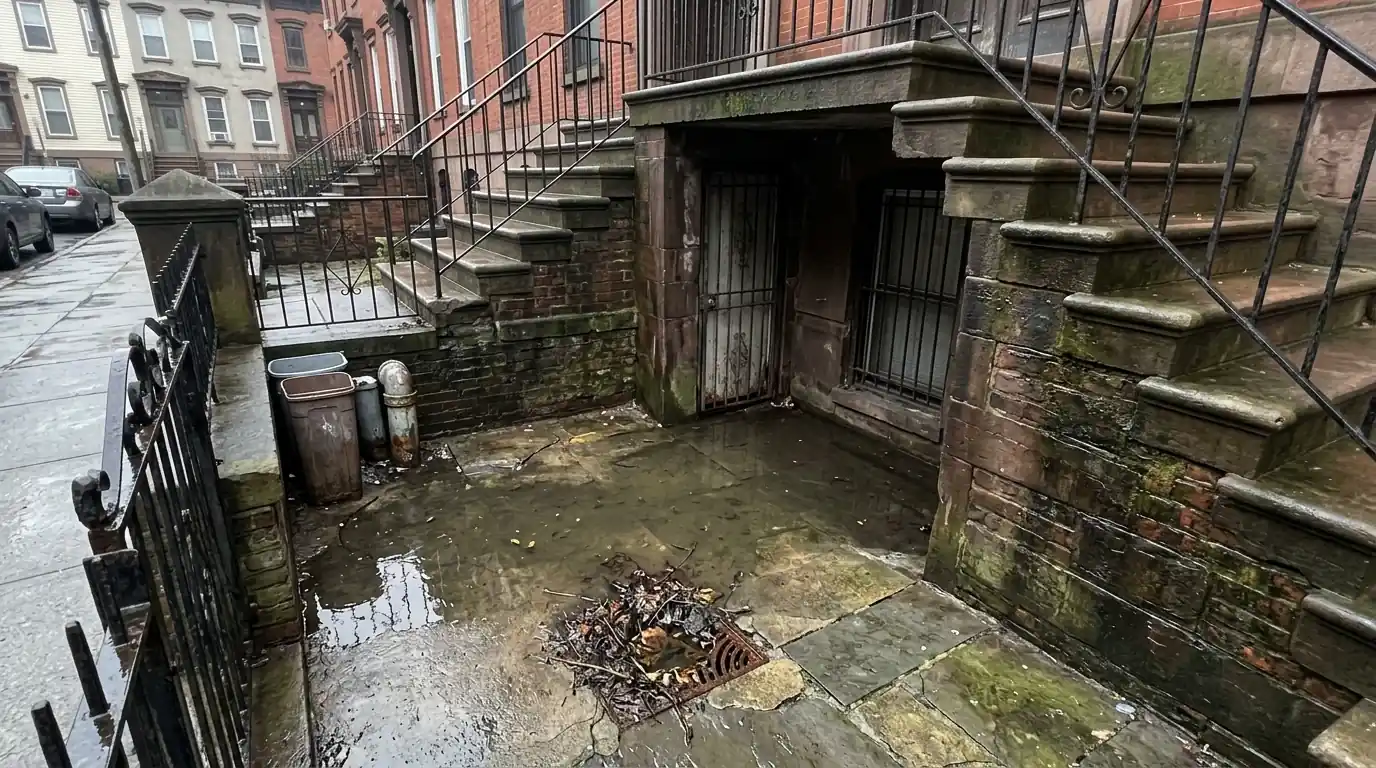
We watch where water enters and test the areaway drain with a hose. We also inspect the stoop, its joints and any vault below.
The drain is cleared and its pipe inspected. Collapsed or root-packed sections are rebuilt and a better grate goes on top.
Where the drain ties into the sewer, we look at adding a backwater valve. Permit and plumbing needs are explained and coordinated.
We set a higher sill or small curb at the door and seal the paving joints. The paving is pitched toward the drain where needed.
Cracks and joints are cleaned and sealed, and the landing gets a sealer or membrane. Materials are chosen to suit brownstone, brick or concrete.
We seal the slab above, repoint or inject the vault walls and give it a drain path. Then we water-test the whole front again.
The basement door threshold is often level with or below the areaway paving, so even an inch of water goes straight under it. We raise the threshold where the door allows, pitch the paving toward the drain, and seal the joint where the paving meets the wall. A small curb or raised sill can buy a couple of inches of margin without changing how you use the door.
The stoop overhead is the other half. Brownstone and concrete stoop slabs crack, and the joints where treads, landing and building wall meet open up. Water running through them lands in the areaway or soaks into the vault below. We clean and seal those joints, patch cracked treads with a compatible material, and apply a breathable penetrating sealer or a liquid-applied membrane on the landing, depending on the stone and how it gets used.
Iron railings set into the stoop are a common weak point. Where the posts enter the stone, rust expands and splits it, and the split lets water straight into the stoop body. We clean out those sockets, deal with loose posts, and reset or seal around them so the stone stops cracking. Treads that rock or have open joints underneath also get attention, since they funnel water right into the vault or the areaway below.
Many older rowhouses have a vault tucked under the stoop, and some have one reaching under the sidewalk. These brick or stone rooms were used for coal or storage, and they leak through the ceiling when the slab above fails and through the walls when the lime mortar washes out. We seal the slab from above where we can reach it, repoint or inject the walls from inside, and give the vault a way to drain.
Exterior work on rowhouses in Hamilton Park, Van Vorst Park, Paulus Hook and Harsimus Cove goes through the city's Historic Preservation Commission review, and the stoop is part of the facade. We tell you when a job will likely need that review and choose materials that keep the stoop looking the way it should. For the brick foundation behind the areaway, see our stone and brick foundation work.
| Problem | Usual fix | Note |
|---|---|---|
| Areaway drain slow or clogged | Clear the line, rebuild collapsed pipe, new grate | The most common single cause |
| Water rising out of the drain | Backwater valve on the sewer connection | Permit and plumbing needs vary |
| Water under the basement door | Raise the sill, seal paving joints, pitch to the drain | Works only with a working drain |
| Leaks through the stoop | Seal joints and cracks, sealer or membrane on the landing | Material matched to the stone |
| Wet vault | Seal the slab above, repoint or inject the walls | Often paired with stoop work |
$1,450 to $6,700
per areaway, typical range
Most areaway and stoop jobs land between $1,450 and $6,700. It is a typical range, not a quote, because the drain, the stoop and any vault each vary a lot from house to house.
Not listed? See every area we serve or call (201) 578-5199.
Membranes, sealers, pumps and dehumidifiers we work with come from makers such as
Usually because the drain is tied into the sewer and the sewer is full. Jersey City and Hoboken are largely served by combined sewers, so in heavy rain, storm water and sewage share the same pipes. When those pipes back up, water has nowhere to go but out through the lowest opening, which is often your areaway drain. A backwater valve on that line is the standard answer.
In most cases, yes. We favor penetrating sealers and joint sealants that do not leave a shiny film, and patch material matched to the stone color. Where a landing needs a liquid-applied membrane, we pick one suited to a walking surface and to the look of the block. On designated historic blocks we tell you when the work will likely need the Historic Preservation Commission's review.
Most vault leaks come from the slab above, either the stoop landing or the sidewalk, with some seepage through old mortar in the walls. We seal the slab from the top where it is reachable, repoint or inject the walls from inside, and make sure any water that does get in can drain away. The vault will not become a finished room, but it can stop dripping.
It helps, but only if the areaway drain works. A higher sill buys a couple of inches of margin. If the drain is clogged, water simply rises past that too. We pair the threshold change with clearing or rebuilding the drain and pitching the paving toward it, so water leaves the areaway instead of waiting at the door.
Call (201) 578-5199 and tell us what you're seeing. We'll set up a visit and give you a typical range before any work starts.