Drips in wind-driven rain
Water that appears only when rain blows from one direction usually means a curb corner or side lap has opened.
Roof waterproofing · Jersey City, NJ
Water is dripping from the skylight well, and it's rarely the glass. We trace whether it's the curb flashing, a cracked dome, a failed gasket or plain condensation, then seal the actual source.
For a leaking skylight in Jersey City, call (201) 578-5199 and tell us when the drips appear. Our technicians check the dome, the frame gasket and the flashing around the curb, water test one side at a time, then reflash the curb, reseat the unit or, when the dome or frame has failed past saving, swap the unit as part of stopping the leak. Condensation gets ruled in or out first.
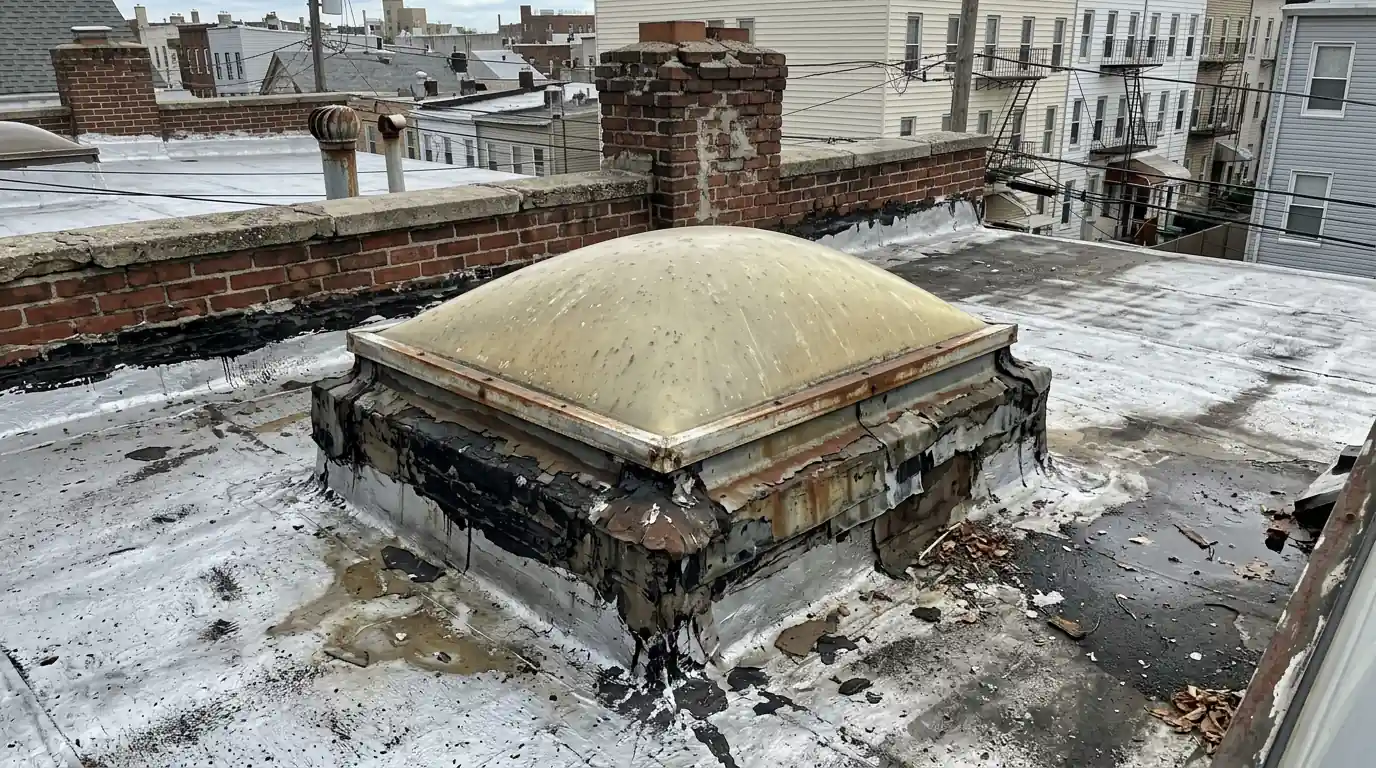
Most skylight leaks we open up on Jersey City rowhouses are not coming through the glass at all. They start at the curb, the short wood or metal box the unit sits on. On a flat roof that curb is wrapped with base flashing, and over the years the corners split, the laps shrink back, and water that sheets across the roof during a nor'easter runs in behind the flashing. From inside, the stain looks like a skylight problem, so that is what owners call it.
Condensation is the other suspect, and it fools plenty of people. In January, warm moist air from a bathroom or stairwell rises into the skylight well and meets cold glass or a thin acrylic dome. Water beads, runs down the inside of the frame, and drips onto the stair landing. If the drips show up on cold, dry mornings rather than during rain, that points to condensation. We check both, because the fixes are completely different and nobody should pay for flashing they don't need.
A quick way to tell them apart before we arrive: note when it drips. Rain plus wind from one direction usually means a curb corner or a side lap. A steady drip while snow is melting on the roof suggests the flashing sits too low for the snow line. Frost or droplets on the inside of the dome with no weather outside is moisture from the house. Tell us what you saw when you call; photos help.
Water that appears only when rain blows from one direction usually means a curb corner or side lap has opened.
Brown rings on the plaster around the skylight shaft show water traveling down behind the flashing, not through the glass.
An acrylic dome that has gone cloudy and brittle is close to cracking through, often in the first hard freeze.
Cracks that follow the wire grid mean the frame is moving or rusting and squeezing the pane.
Rust streaks at the bottom rail of a steel frame mean water has been sitting there and the gasket is gone.
Ice or droplets on the inside of the glass with no rain outside point to condensation from the rooms below.
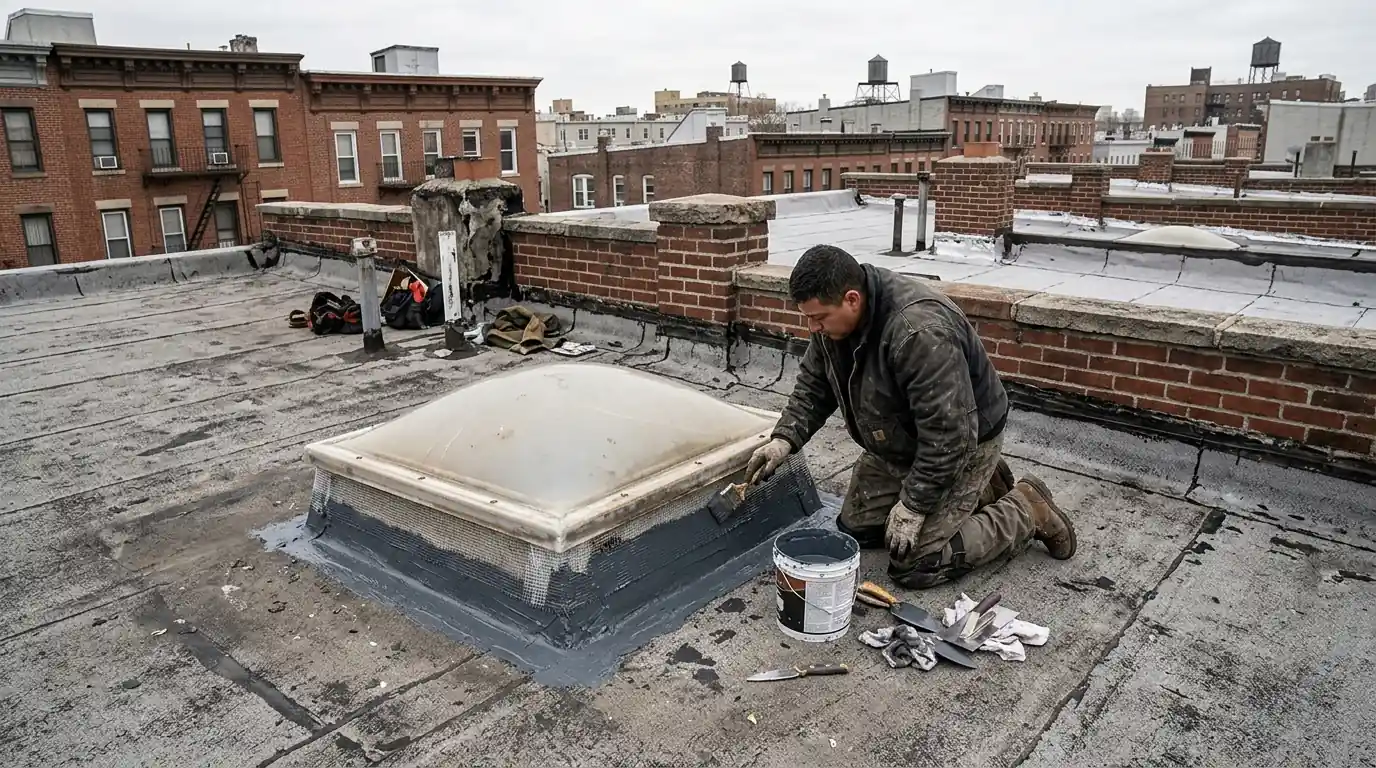
The curb is where the skylight meets the waterproofing, and it behaves like any other roof penetration. A real repair cuts back the failed flashing and dried sealant, primes the curb, and installs new base flashing with reinforced corners that ties into the field membrane with proper laps. Where the unit design allows, a metal cap or counterflashing covers the top edge. Caulk smeared over a split corner looks tidy for a few months, then sun and cold open it again, so we don't sell it as a fix.
Height matters as much as the seal. Many older curbs sit only a few inches above the finished roof, so ponding water or packed snow climbs right over the flashing. When the curb is low or soft with rot, we rebuild it to a proper height before flashing. If water collects around the skylight because the roof dishes toward it, a small cricket or ponding water repair steers water away, and that detail often separates a skylight that leaks again in two winters from one that stays dry. The same methods apply in roof flashing repair elsewhere.
We look at the stain from inside first, then inspect the dome, frame, gasket and curb flashing. A hose test on one side at a time confirms the entry point.
We compare the drip pattern with the weather and check the inside of the glazing. If it's condensation, the fix is venting or insulation, not flashing.
We test the curb wood or metal for rot and rust. That tells us whether it can be reused or needs rebuilding to a proper height.
Old membrane and sealant come off, the curb is primed, and new reinforced flashing is tied into the roof. A cap or counterflashing covers the top edge.
A sound unit gets new gaskets and fasteners. A cracked dome or rusted frame is replaced on the repaired curb so the leak is closed for good.
We run water over the finished curb and check inside for any drip. The stairwell below is cleaned before we leave.
Downtown and around Hamilton Park, many brick rowhouses still have a skylight over the top stair, sometimes an old wired-glass unit in a steel frame, sometimes a plastic dome added decades later. Wired glass cracks along the wire when the frame rusts and swells, and the putty that held the panes dries to powder. Acrylic domes yellow, turn brittle under strong summer sun, and crack from hail or a dropped tool. A single short crack can be sealed as a stopgap; once a dome is crazed across its face, patching only buys a season.
Frames matter as much as glazing. Steel frames rust from the bottom rail up, aluminum frames lose their gaskets, and wood curbs underneath rot where water has been sitting for years. We probe the curb with an awl before we commit to anything. When the dome is cracked through or the frame has rusted past resealing, swapping the unit is simply the step that stops the leak. We match the curb size where we can so the deck opening stays the same, and an insulated dome cuts condensation at the same time.
Skylights usually sit right over a stairwell, which means a hole in the roof directly above the only way in and out of the building. We stage materials before anything is opened, cover the stairs below with drop cloths, and keep a temporary cover ready in case a summer thunderstorm rolls in early. In a multi-unit building we let tenants know when the stair will be dusty and for how long.
We also look at what surrounds the skylight. If the field membrane around the curb is cracked or patched to exhaustion, sealing the curb alone just moves the leak a foot over, so we'll show you the condition and suggest flat roof leak repair or a wider waterproofing scope where it's needed. If the whole roof membrane is beyond repair, it needs replacing, and the skylight curb gets flashed into the new surface.
| Option | When it fits | What it involves |
|---|---|---|
| Reflash the curb | Dome and frame are sound, leak is at the corners or laps | New reinforced flashing tied into the roof membrane |
| Reseat the unit | Gasket has failed or fasteners have loosened | Unit lifted, new gaskets and fasteners, curb top resealed |
| Swap the unit | Dome cracked through, frame rusted, parts unavailable | Curb repaired, new unit set and flashed to close the leak |
| Treat condensation | Drips on cold dry days, frost inside the glass | Insulate the well, improve venting, consider an insulated dome |
$340 to $1,390
per skylight, typical range
Most skylight leak repairs in Jersey City land between $340 and $1,390. That's a typical range, not a quote, and we price your skylight after we've seen the curb and the glazing.
Not listed? See every area we serve or call (201) 578-5199.
Membranes, sealers, pumps and dehumidifiers we work with come from makers such as
Rain driven sideways gets pushed up under flashing laps and into curb corners that stay dry in a straight-down shower. That pattern almost always points to the flashing on one side of the curb rather than the dome itself. We water test that side to confirm, then rebuild the flashing at the corner so it laps the right way and sits high enough above the roof surface.
A single short crack can be sealed to stop water for a while, but acrylic that has cracked once is usually brittle across the whole dome. Sun on a flat roof keeps making it worse, and the next freeze often opens new cracks. We'll seal it as a stopgap if you need time, though a new dome on a freshly flashed curb is the lasting answer.
If water appears on cold, dry days and the inside of the glass is fogged or frosted, it's most likely condensation from warm, moist air inside the house. If it shows up during or right after rain, it's a leak. Sometimes it's both. We check the curb flashing and the glazing and can suggest an insulated dome or better bathroom venting.
Yes. Old wired-glass skylights in steel frames are common over the top stair in downtown rowhouses and brownstones. If the frame is sound, we reglaze seals and reflash the curb. When the frame has rusted and the glass has cracked, we set a new unit sized for the opening on the repaired curb, so the stair ceiling below needs no rework.
High enough that ponding water and packed snow can't reach the top of the flashing. Many older curbs sit only a few inches up, which is why they leak during snowmelt. When we find a low or rotted curb, we rebuild it to a proper height before flashing, and that change alone stops a lot of repeat skylight leaks.
Call (201) 578-5199 and tell us what you're seeing. We'll set up a visit and give you a typical range before any work starts.