Musty smell upstairs
A damp, earthy odor in the room above the crawl, strongest in summer or after rain.
Basement & foundation · Jersey City, NJ
If the room over your rear addition smells musty or the floor feels cold all winter, the crawl space underneath is probably damp and open to outside air. We seal it, dry it and keep it that way.
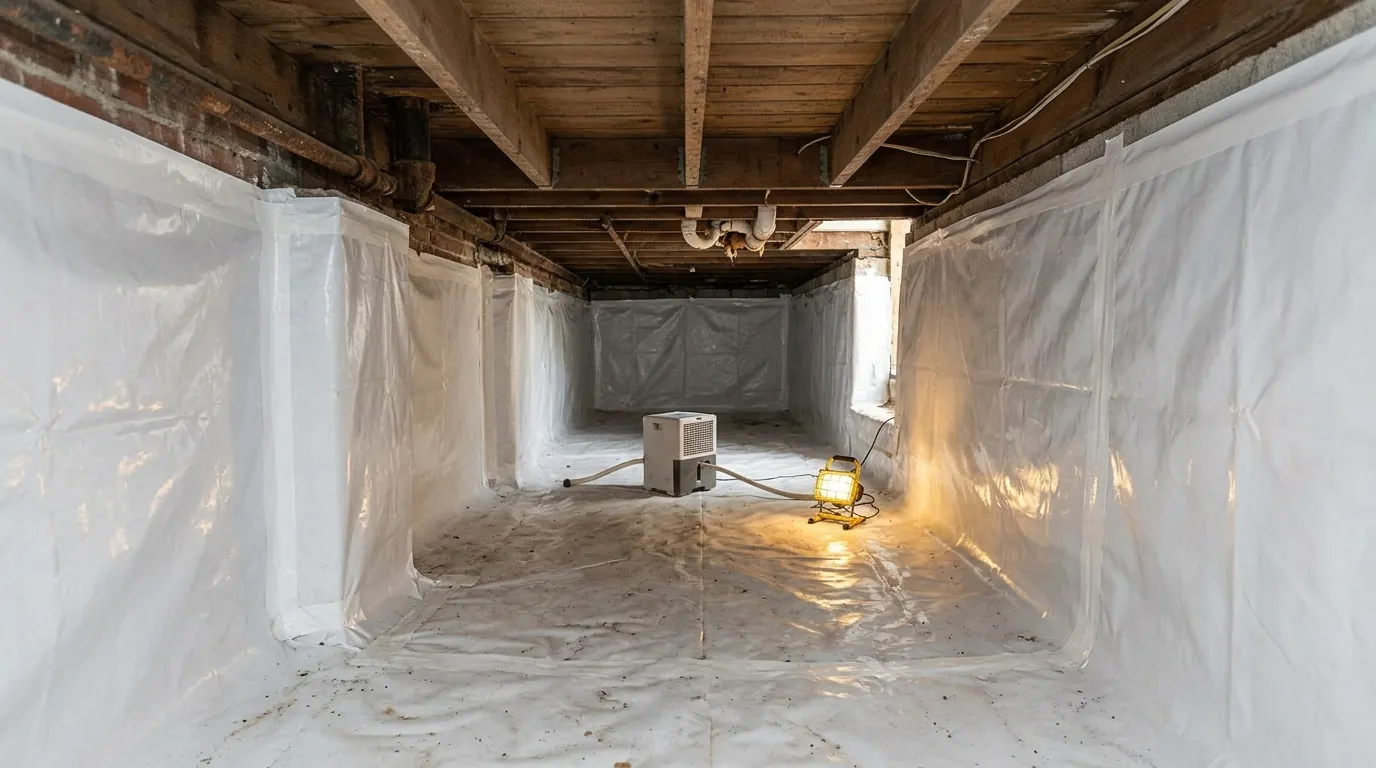
We encapsulate crawl spaces in Jersey City under rear additions and frame houses. Our crew lays a sealed vapor barrier across the floor and up the walls, closes the vents, seals the rim and installs a dehumidifier, plus a small sump if water collects. Call (201) 578-5199 and we will look at the space, its moisture and how water reaches it before pricing anything.
Plenty of Jersey City houses have a full basement under the main block and a shallow crawl space under a kitchen or rear addition that was built later. That crawl often has a dirt or thin concrete floor, a couple of vents to the yard and little real insulation. Ground moisture rises through the soil all year, and in summer warm, humid air pours in through the vents and condenses on cool joists and pipes.
Some older frame houses across the city sit partly on crawl spaces, and the problem there is the same at a larger scale. Damp wood feeds mold, insulation sags off the joists, and the air in the crawl moves up into the house through gaps around pipes and wires. That is why you smell it in the kitchen even though nobody has been down there in years.
The two kinds of ground here behave differently as well. On low, filled land closer to the Hudson and Newark Bay, the soil under a crawl stays wet longer after rain because the water table sits higher. Up on the Palisades ridge, water tends to run along the rock and seep in at the base of the crawl wall. Knowing which one you have tells us whether the crawl mostly needs a vapor barrier or also needs a way to get rid of liquid water.
A damp, earthy odor in the room above the crawl, strongest in summer or after rain.
The floor over an addition feels noticeably colder than the rest of the house.
Batts hanging down from the joists or lying on the dirt, often heavy with moisture.
White, green or black growth on the framing or subfloor, visible from the access hatch.
Standing water on the crawl floor or a wet line on the wall after heavy rain.
Water lines and ductwork dripping condensation onto the soil in humid weather.
Encapsulation turns the crawl from a ventilated, damp space into a closed, conditioned one. The core is a heavy vapor barrier that covers the whole floor, runs up the foundation walls and around the piers, and is taped at every seam and sealed along its top edge. Vents to the outside are closed off, the rim joist area is sealed, and the access door gets a tight fit so outside air stops wandering in.
Once the space is sealed, a dehumidifier holds the air in a dry range. Where water actually collects on the crawl floor after storms, we add a small sump basin and pump under the liner so it leaves before it can pool and never lifts the liner off the floor. Here is what the work usually covers:
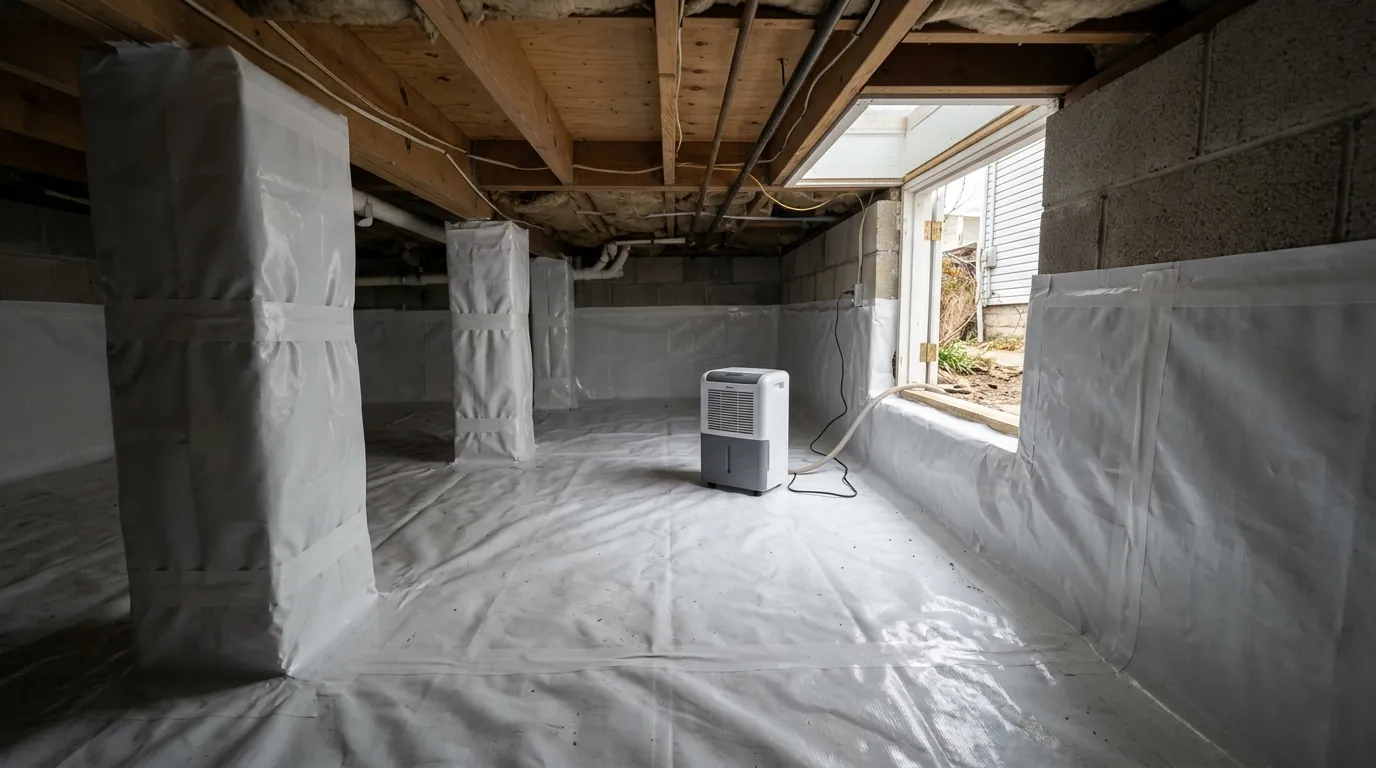
We check humidity, look for standing water and mold, and measure the floor and walls. We also note every vent, pipe and opening that needs sealing.
Leaders, grading and wall cracks get handled first. If water still collects, we set a crawl space sump.
Debris, fallen insulation and anything stored on the soil comes out. The floor is smoothed so the liner lies flat.
Vents, the rim joist area and penetrations are closed off. The access door is fitted so it shuts tight.
The liner covers the floor and runs up the walls and piers. Every seam is taped and the top edge is sealed to the wall.
We install a unit sized for the space and drain it to the sump or a condensate pump. We show you the settings and how to check it.
Most owners call us about something they notice in the living space, not the crawl itself. A kitchen that always smells a little damp, a cold floor in January, cabinets with a faint mildew odor, or a back room that feels clammy in August. Those all trace back to the same cause: moist, unconditioned air sitting under the floor and leaking up through it.
After encapsulation the floor is no longer sitting over a cold, wet box, so it usually feels warmer, and the smell fades as the wood dries out. Basement air and crawl air often mix in houses where the two spaces connect, so we look at both. If the main basement runs damp too, a whole-basement dehumidifier or a fix for wall seepage may belong in the same visit.
A vapor barrier stops ground moisture. It does not stop liquid water running in through a wall or under the footing during a nor'easter. If the crawl takes water, we deal with that before sealing, otherwise it collects under the liner and you have hidden a problem instead of fixing it. Leaders dumping beside the addition, a yard that slopes toward the back of the house and cracks in the crawl wall are the usual culprits.
That might mean redirecting a leader, regrading a strip of yard through our yard drainage and grading work, sealing a crack, or setting the crawl sump mentioned above. Our guide on whether encapsulation is worth it walks through the trade-offs if you are still deciding. Once the water path is closed, the liner and the dehumidifier do the rest.
Plan for a little upkeep afterward. The dehumidifier filter needs cleaning a few times a year, the crawl sump should be tested before storm season, and anyone who goes down there for plumbing or wiring work should leave the liner as they found it, with any cut taped back. A quick look through the access door each spring, checking for torn seams, standing water or a dehumidifier that has stopped draining, keeps a sealed crawl working the way it should for years.
| Approach | What it does | Typical result |
|---|---|---|
| Vented crawl, left as is | Lets outside air move through the space | Humid summer air condenses on cool wood; damp and musty |
| Plastic on the floor only | Slows some ground moisture | Walls and vents still let moisture in; the smell often stays |
| Full encapsulation | Seals floor, walls, vents and rim, with a dehumidifier | Dry air under the floor, warmer floors, odor fades |
$4,850 to $13,600
per crawl space, typical range
Most encapsulation jobs land between $4,850 and $13,600. Treat that as a typical range rather than a quote, since the size and condition of your crawl move it most.
Not listed? See every area we serve or call (201) 578-5199.
Membranes, sealers, pumps and dehumidifiers we work with come from makers such as
Once a crawl space is encapsulated, the vents get sealed. Open vents were meant to dry crawl spaces, but in humid summers here they bring in warm, wet air that condenses on cool joists. Closing vents only works as part of the whole system, though. Shut them on an unsealed dirt crawl with no dehumidifier and moisture rising from the ground has nowhere to go.
In most cases, yes. Sealing the space stops new moisture coming in, but the air still needs to be held in a dry range, especially in July and August. Below-grade spaces commonly sit above 60 percent humidity in summer, and holding roughly 45 to 55 percent discourages musty odors. A small dedicated unit draining to a sump or condensate pump does that without anyone emptying a bucket.
Yes, but not until the water is handled. Sealing a liner over a floor that takes water just hides the puddle. We first trace how it gets in, usually leaders, grading or a cracked wall, and fix what we can outside. Where water still shows up, a crawl space sump under the liner pumps it out so the barrier stays dry on top.
Usually it helps. A vented crawl lets cold winter air sit right under the floor. Sealing the vents, the rim and the walls turns the crawl into a closed space that stays closer to the temperature of the house. Owners often notice the difference in the first winter, though an older addition with no floor insulation at all may still need some added.
Call (201) 578-5199 and tell us what you're seeing. We'll set up a visit and give you a typical range before any work starts.