Puddles in one spot
Water returns to the same corner or along the same wall after every heavy rain, which points to groundwater collecting under the slab.
Sump pumps & drainage · Jersey City, NJ
If water keeps showing up in the same corner of your basement after every heavy rain, a properly placed sump pump gives it somewhere to go. We dig the basin, set the pump and run the discharge well clear of your foundation.
In Jersey City, we install sump pumps by cutting the slab at the lowest wet point, setting a lined basin, and fitting a pump with a check valve, a sealed lid and a discharge line that carries water away from the house. Most installs take a day. Call (201) 578-5199 any hour to talk through your basement and whether a pump, a drain or both makes sense.
A sump pump does one job: it lifts water that collects below your basement floor and sends it outside before it can rise through the slab or seep in at the cove joint. On its own, a pump drains only the soil right around its basin. Paired with an interior perimeter drain, it becomes the outlet for water collected along every wall, which is how most wet basements actually get dry. We decide which setup fits after we see where water enters and how your floor slopes.
Ground conditions change the job from block to block. Downtown streets near the Hudson sit on old marsh and fill, and the water table rises after long rains, pushing groundwater up against the slab with real hydrostatic pressure. Up in the Heights, rock sits close to the surface and water tends to travel along it and through foundation cracks instead. A basement in Paulus Hook may need a pump that cycles for days after a nor'easter, while a frame house on the ridge may only hear its pump during a downpour.
Water returns to the same corner or along the same wall after every heavy rain, which points to groundwater collecting under the slab.
The concrete floor darkens or sweats a day or two after a storm, even where you can't see a crack.
Chalky efflorescence along the base of the walls shows water passing through the masonry and drying on the surface.
An odor that never clears, even with a dehumidifier running, often means moisture is rising from below the floor.
Some older houses have a bare hole or clay crock in the floor that once held a pump and now just fills with water.
Water that appears when snow melts tells us the soil around the foundation stays saturated for days at a time.
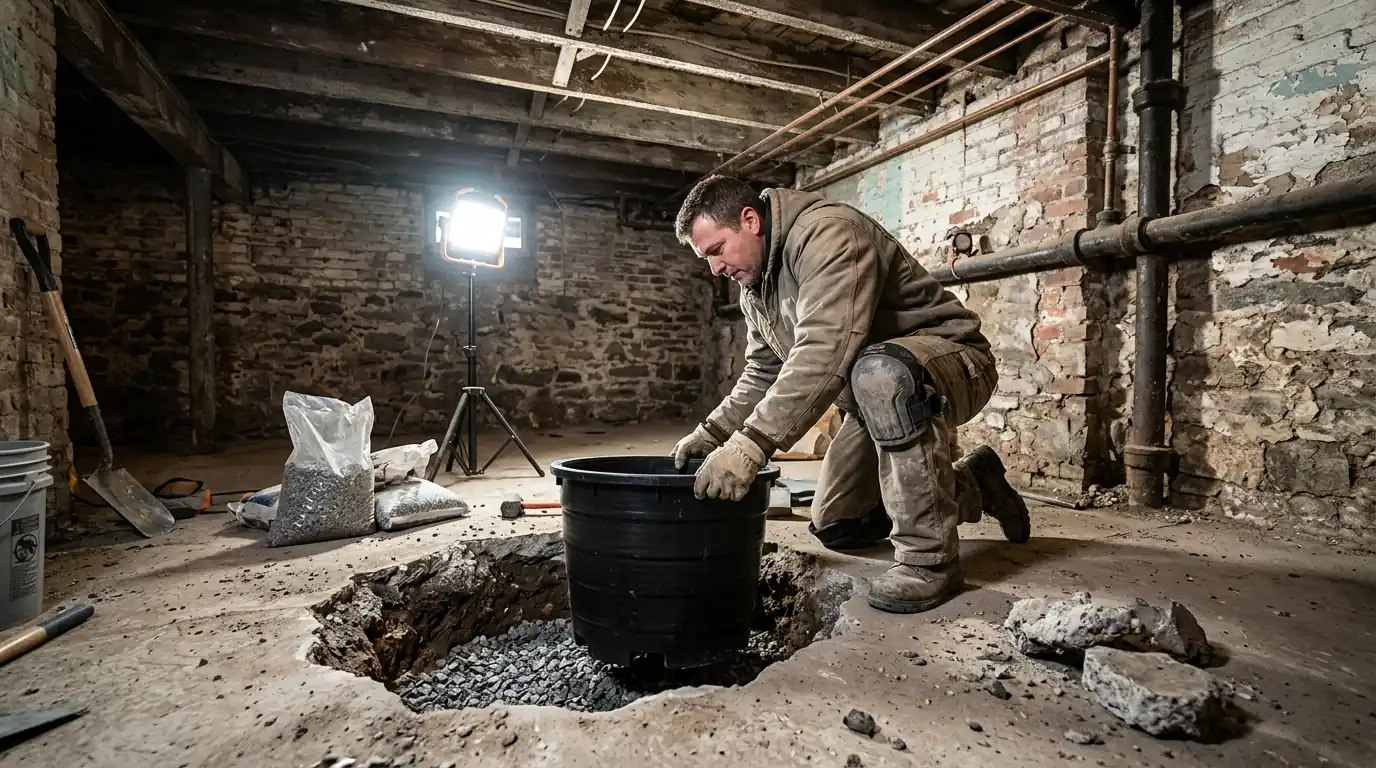
The basin is the pit the pump lives in. We use a lined, perforated basin sized so the pump isn't switching on and off every few seconds, because a basin that's too small burns out motors early. It sits in a hole cut through the slab at the lowest point that collects water, surrounded by washed stone so groundwater can reach it without dragging silt along. A tight, gasketed lid keeps out debris, basement odors and curious kids or pets.
Submersible pumps sit down inside the basin, run quieter and move more water, which is why we put them in most finished basements and anywhere the inflow is heavy. Pedestal pumps keep the motor up on a column above the pit; they're easy to service and last a long time in a dry utility room, but they're louder and move less water. Horsepower is really about lift and volume. Most houses run a one-third or one-half horsepower pump, and we size up when the discharge has to climb higher or travel farther to reach a safe outlet.
We map where water enters and check how the floor slopes to pick the basin location. We also look at where the discharge can exit and where it can safely drain.
We saw-cut the slab, break out the concrete and dig the hole for the basin. Spoil is bagged and carried out so nothing gets tracked through the house.
The perforated basin goes in on a bed of washed stone, with more stone packed around its sides. We then patch the slab tight to the rim with new concrete.
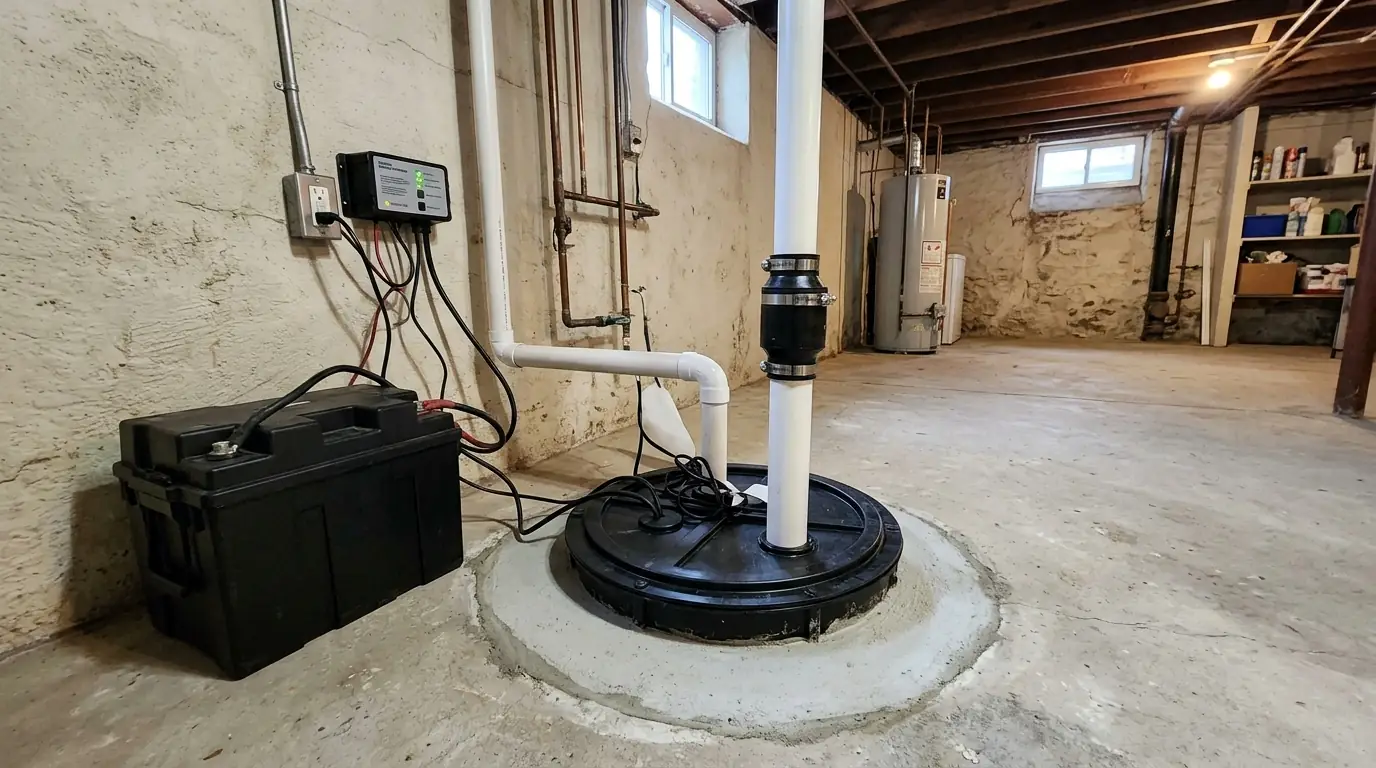
The pump, check valve and discharge pipe go in, with a union so the pump can be pulled for service. The lid is sealed and the alarm is mounted.
We drill or core through the rim joist or wall and run the line to its outlet. Exterior runs are pitched to drain empty before winter.
We fill the basin with a hose until the float trips and watch a full cycle. You see the pump start, empty the pit and shut off before we leave.
A pump is only as good as its discharge. A check valve above the pump stops the water standing in the pipe from falling back into the basin every time the motor shuts off, which keeps the pump from short-cycling. From there, the line runs up and out through the rim joist or the foundation wall, and we carry it far enough from the house that it doesn't soak straight back into the same soil. Dumping it at the wall just sends the same water around in a loop.
Winter brings the other risk. A discharge line that holds water outdoors can freeze solid in a January cold snap, and a frozen line leaves the pump pushing against a plug. We pitch exterior runs so they drain empty, and we add a freeze relief fitting where the line leaves the wall so water has an escape if the pipe downstream ices up. Where the yard allows, the discharge can tie into an underground drain line or a dry well instead of spilling across a small rear yard.
Storms that fill a sump are the same storms that knock out power. When the remnants of Ida swept across north Jersey in 2021, plenty of basements flooded within hours, and a pump without electricity is just a weight sitting in a hole. We leave space in the basin and on the discharge for a battery backup pump, and if you want it fitted on day one, we install the two together. Our guide to sump pumps and backups explains how the two pumps share the work.
If sewer water rather than groundwater is your problem, a sump won't stop it. Gray water, a sewage smell and debris coming up a floor drain during a cloudburst point to the combined sewer pushing back, and that calls for a backwater valve on the sewer line instead. We'll tell you which problem you actually have when we look, and we never pipe sump water into a line that a backwater valve is protecting.
| Setup | Best for | Trade-offs |
|---|---|---|
| Submersible pump | Finished basements and heavy, frequent inflow | Quieter and moves more water; motor is harder to inspect |
| Pedestal pump | Unfinished utility basements with light, occasional water | Easy to service and long-lived; louder with lower capacity |
| Primary plus battery backup | Basements that flood when the power fails | Higher upfront cost; keeps pumping through storm outages |
| Primary plus water-powered backup | Houses on city water with steady pressure | No battery to replace; uses city water and needs a plumbing connection |
$1,190 to $2,780
per pump system, typical range
Most jobs land between $1,190 and $2,780 for a complete install with basin, pump, check valve, lid and discharge. Where yours falls depends on what we find once we see the basement.
Not listed? See every area we serve or call (201) 578-5199.
Membranes, sealers, pumps and dehumidifiers we work with come from makers such as
Most single-pump installs take one working day: cutting the slab, digging the pit, setting the basin, plumbing the discharge and testing. A rubble-stone wall that needs coring, rock under the slab or a long discharge run can push it into a second day. The new concrete around the basin needs time to cure, so we ask you to keep heavy traffic off that patch for a day or two.
We route sump discharge outdoors, away from the foundation, rather than into a floor drain. In Jersey City and Hoboken, storm water and sewage share the same pipes, and adding groundwater to that system during a storm works against you and your neighbors. Where an outdoor outlet is hard to reach, we explain the options and whether the local utility has a say in the connection.
Water along the floor edges usually means seepage at the cove joint, where the wall meets the slab. A pump alone drains only the soil near its basin, so for edge seepage we usually pair it with an interior drain that catches water along the walls and carries it to the pit. We show you where the water comes in before suggesting either one.
Most houses do well with a standard residential basin that gives the pump room to run a full cycle instead of switching on every few seconds. In a narrow rowhouse basement we place it where it collects the most water without blocking the stair, the boiler or the meter. If a backup pump may come later, we size the basin so both pumps fit side by side.
Call (201) 578-5199 and tell us what you're seeing. We'll set up a visit and give you a typical range before any work starts.