Key points
- Exterior work stops water at the outside face; interior systems collect it and pump it out.
- Shared party walls and front stoops often rule out digging on attached rowhouses.
- Interior drains usually cost less per foot and cause less disruption outside the house.
- Sealer paint alone can't hold back water under hydrostatic pressure.
Two ways to deal with the same water
Every basement waterproofing system does one of two things. It either keeps water from reaching the wall in the first place, or it accepts that some water will get through and gives it a controlled path out. Exterior foundation waterproofing is the first kind: we dig down to the footing, clean and repair the wall, apply a membrane and add drainage at the bottom. An interior drain system is the second: we cut a trench along the inside of the wall, lay perforated pipe in clean stone and route it to a sump.
Neither one is the right answer everywhere. The choice depends on the ground, the building, what sits on the other side of each wall and what you need the basement to be. An owner planning to finish the space as a family room has different priorities than one who keeps bikes and a boiler down there. The comparison below is the same one we walk through when we're standing in a basement with an owner, deciding which way to go.
It also helps to be clear about what each approach can't do. Neither one fixes a sewer backup, which comes up through floor drains and needs a backwater valve. Neither one stops a wall that's bowing inward under soil pressure; that wall needs anchors or bracing first. And neither one replaces basic site drainage. Leaders dumping beside the foundation and a yard that slopes toward the house will keep loading the wall with water, so we fix those alongside whichever system the basement gets.
What exterior waterproofing does well
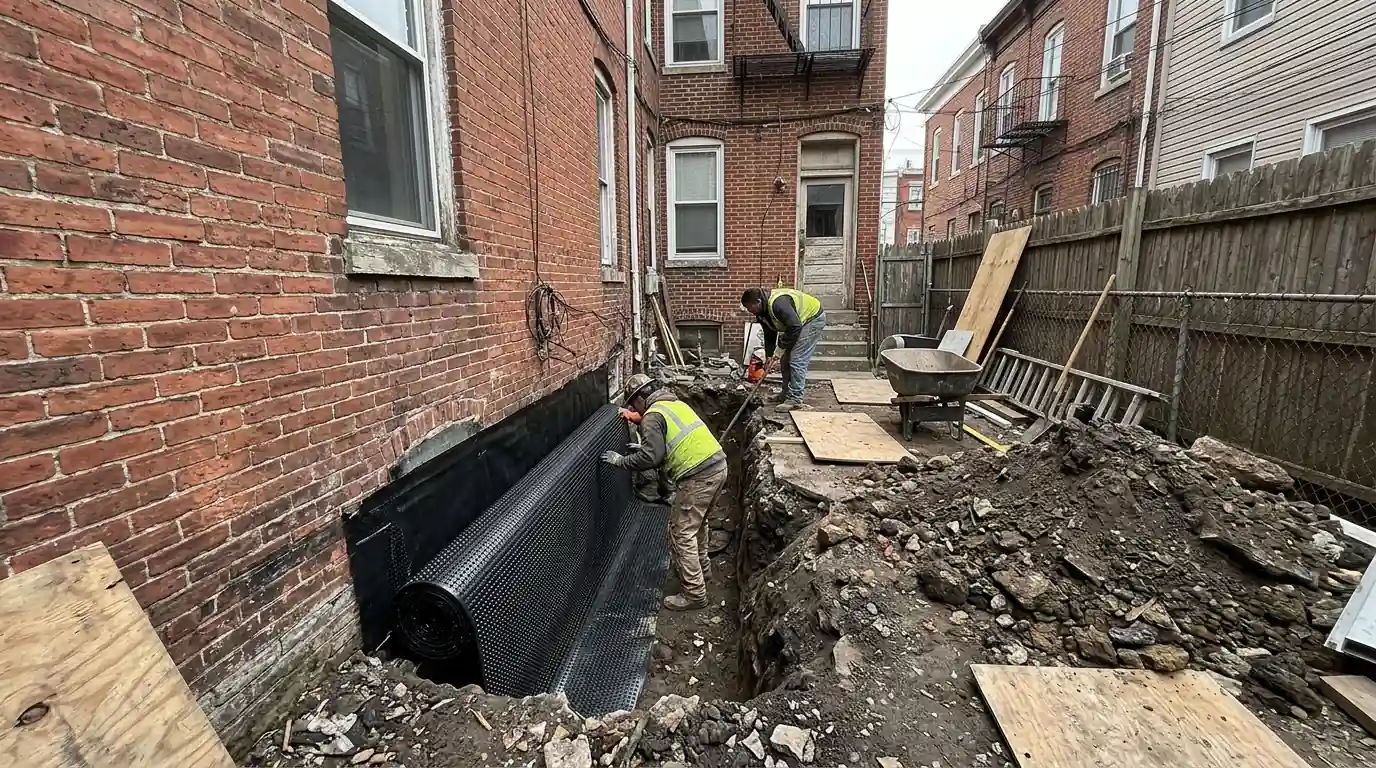
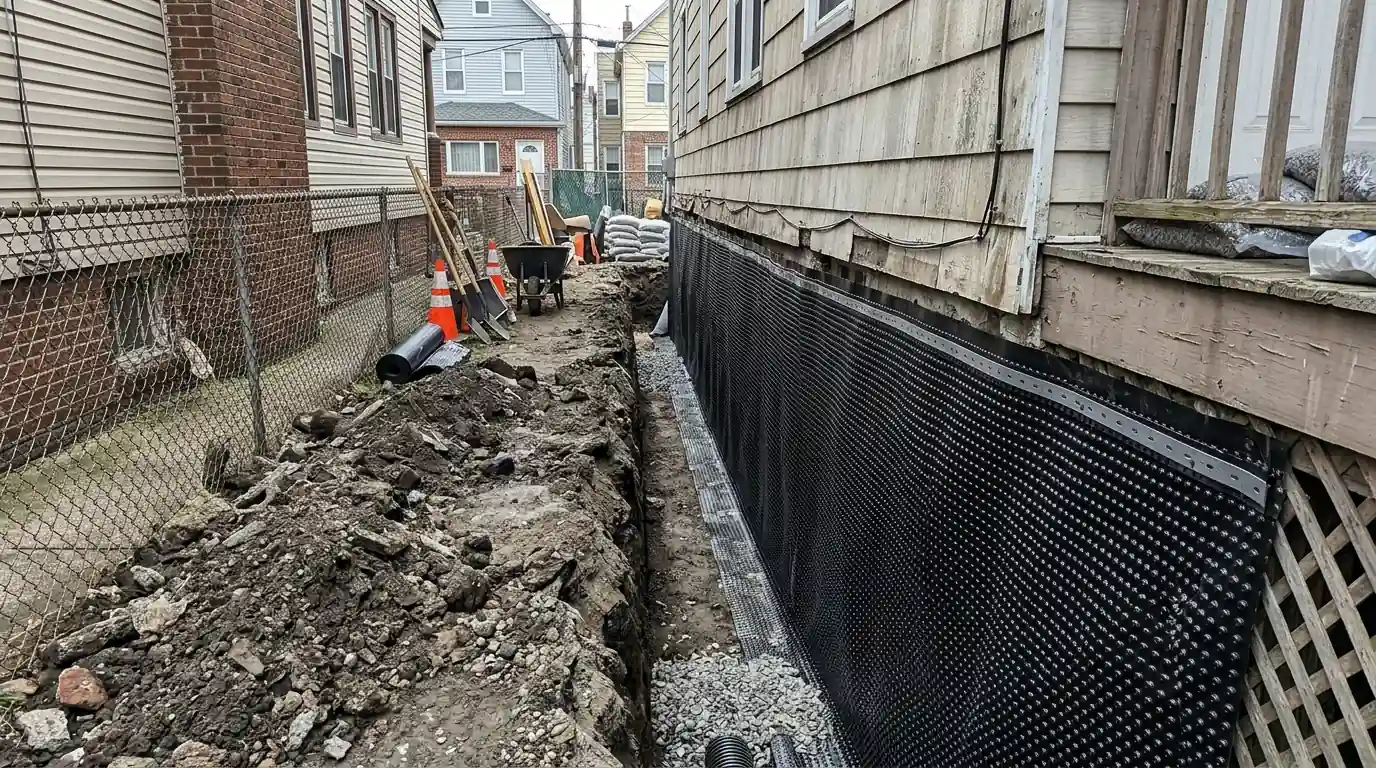
Exterior work treats the problem where it starts. Once the soil is excavated to the footing, the wall can be repaired, parged where needed and covered with a sheet membrane or liquid-applied waterproofing, then protected with dimple board before backfill. A footing drain at the base carries groundwater away. Done properly, the wall itself stays dry, which matters for old brick and stone that suffers when water keeps moving through its joints. Exterior foundation waterproofing is also the natural choice when a cracked wall will be repaired from outside anyway.
It helps to understand the difference between damp-proofing and waterproofing here. Many houses built in recent decades have a thin black damp-proofing coat on the outside of the foundation. It slows vapor, but it was never meant to resist water under pressure, and it often cracks within a few years of backfill. When we excavate a wall like that, the old coating is cleaned off and replaced with a true waterproofing membrane rather than simply covered over.
The cost of exterior work is mostly in the digging. Depth to the footing, the soil, buried utilities, concrete walks and patios that have to be cut out and replaced, and how much can be done by machine versus by hand all move the price. On tight Jersey City lots, much of the excavation is hand work, and the soil often has to be hauled out through the house or along a narrow side passage. That's a big part of why exterior work costs more per foot.
Why attached rowhouses limit the exterior option
On a freestanding house with a yard, a crew can usually dig along two or three sides. Attached buildings are different. The brownstones and brick rowhouses of downtown share party walls with the houses next door, so those side walls simply can't be reached from outside. The front wall usually has a stoop, an areaway and a public sidewalk against it, and the rear wall may sit under a deck, an addition or right along a neighbor's fence line.
That leaves exterior work possible on one wall at best, often the rear. Digging under a stoop or along a sidewalk raises its own permit questions, and in the downtown historic districts exterior changes may go through the city's Historic Preservation Commission review. For most attached houses in Jersey City, that's why the practical answer is an interior system around the whole perimeter, sometimes combined with exterior work on the one wall where digging makes sense.
Side by side: interior and exterior systems
The comparison below is general, and every building shifts it a little. It reflects what we see across the mix of brownstones, two-family frame houses and pre-war walk-ups in Hudson County. Read it as a starting point for the conversation rather than a verdict, and expect a site visit to change at least one line once the walls, the floor and the drainage are actually in front of us.
Price ranges like these move with depth, access, the number of walls, the amount of concrete or stone to remove and what has to be rebuilt afterward. Most whole-basement systems on a typical Jersey City house land between $3,900 and $14,800 once everything is counted. For a closer look at where that money goes, our waterproofing cost guide breaks it down line by line.
- Where water is stopped: exterior keeps it off the wall; interior catches it after it passes through.
- Typical cost: interior drains run about $68 to $112 per linear foot; exterior work runs about $145 to $310 per linear foot.
- Disruption: interior work means jackhammering and dust inside; exterior work means excavation, yard damage and possibly stoop or sidewalk work.
- Attached houses: interior can reach all four walls; exterior often reaches only one.
- Wall condition: exterior protects the masonry itself; interior leaves the wall damp but keeps the floor dry.
- Ongoing care: interior systems depend on a sump pump, power and a backup; exterior drains depend on a working outlet.
When an interior drain is the smarter choice
An interior drain system makes sense when water comes in at the cove joint or up through the floor, when the walls can't be reached from outside, or when the building sits on filled ground with a high water table. In those cases the problem is pressure from below, and a perimeter drain under the slab relieves it. We cut the slab along the walls, set perforated pipe in clean stone, run a dimple membrane up the wall to guide seepage down, and connect everything to a sump with a check valve.
The trade-off is that you now own a pump. An interior system only works while the sump does, so it needs a battery backup and regular testing, especially before big storms. Our guide to sump pumps and battery backups covers that upkeep. The wall itself may still show some dampness, which is why we often pair interior drainage with a dehumidifier holding the basement around 45 to 55 percent relative humidity.
Interior work is also gentler on the schedule. A typical basement takes a few days, the yard and stoop stay untouched, and nothing outside the building needs to be opened. The mess is concentrated inside: slab cutting is loud and dusty, so we seal off the work area, run dust control and haul the broken concrete out in buckets. Owners usually clear a strip about three feet wide along each wall, and everything else in the basement can stay where it is.
Why sealer paint alone rarely holds
Waterproof masonry paint is the first thing many owners try, and it's easy to see why: it's cheap and it makes the wall look clean. The problem is physics. Paint sits on the inside face of a wall that has water pushing on it from outside. Hydrostatic pressure works behind the coating, and within a season or two it blisters, peels or flakes off, often taking a layer of efflorescence with it. On old stone and brick, trapping moisture in the wall can even speed up the mortar loss you were trying to stop.
Coatings do have a role. A crystalline sealer on sound poured concrete can reduce dampness, and a coating makes sense over a wall that already has drainage working behind it. They just aren't a fix for active leaks. If you've painted twice and the wall still weeps, the water needs a path, not another coat. We answer (201) 578-5199 day and night if you'd like someone to look at the walls and talk through which approach suits your building.
Owner Guides Editor at Waterproofing Services Carteret. Writes the owner guides from the questions our crews hear in Jersey City basements and on its roofs every week.