Key points
- Most whole-basement systems here run $3,900 to $14,800, and the system type drives most of that spread.
- Drain and excavation work are priced per linear foot, so wall length matters more than room size.
- Attached rowhouses, stone foundations and finished rooms all add labor you can see coming.
- A sump with a check valve and battery backup belongs in the budget from the start.
Typical price ranges for the main repairs
Basement waterproofing prices in Jersey City cover a wide span because the phrase covers very different jobs. Sealing one crack in a poured wall is a morning's work. Draining the full perimeter of an old stone foundation in a downtown rowhouse can keep a crew busy for most of a week. The figures below are typical ranges for jobs around Hudson County, not quotes, and each one moves with the details covered in the sections that follow. Use them to sanity-check a number you've been given.
Most basements need a combination rather than a single item. A frame house in the Heights might need two crack injections and nothing else, while a Paulus Hook rowhouse on wet fill could need a full perimeter drain, a sump and work at the front areaway. For prices across every kind of work we do, from basements and walls to roof decks and flat roofs, see our waterproofing cost guide, which lays the ranges out by service.
- Whole-basement system: most jobs land between $3,900 and $14,800
- Interior drain system: typically $68 to $112 per linear foot
- Exterior excavation and membrane: typically $145 to $310 per linear foot
- Crack injection: typically $485 to $1,180 per crack
- Sump pump installation: typically $1,190 to $2,780
Interior drain, exterior dig or injection: the system sets the floor
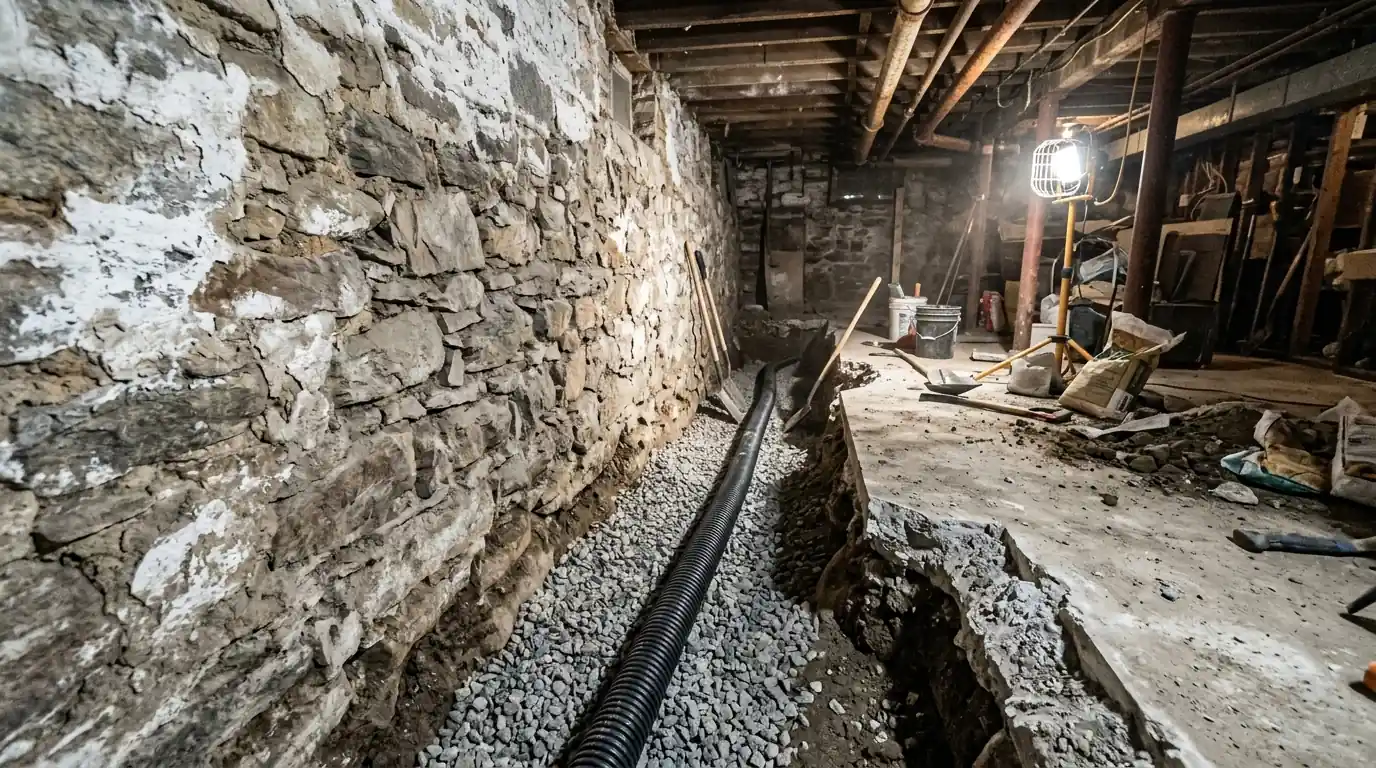
The biggest single factor is which system the basement actually needs. Crack injection with polyurethane or epoxy fills one specific crack in a poured concrete wall from the inside, and it's priced per crack because each one is its own small job. An interior drain system handles water that's already reaching the floor: we cut the slab along the walls, lay perforated pipe in stone, set a dimple membrane against the wall and carry everything to a sump. It doesn't stop water entering the wall. It controls that water before it reaches the room.
Exterior waterproofing works from the other side. We excavate down to the footing, clean the wall, apply a sheet or liquid membrane with drainage board, and often lay a new footing drain before backfilling. That keeps water out of the masonry entirely, which is why it costs more per foot: digging, hauling soil and restoring whatever sat on top. Damp-proofing, a thin asphalt coat, is cheaper but isn't waterproofing and won't hold back hydrostatic pressure. Our guide on interior versus exterior waterproofing covers how to choose between them.
Linear feet, slab cutting and what turns up under the floor
Drain and excavation work are priced by the foot, so the length of wall that needs treatment matters more than the square footage of the room. A long, narrow rowhouse has two long party walls and short runs at the front and back, while a detached two-family house can take water on all four sides. Sometimes only one or two walls leak, usually the side under a downspout or facing the slope of the yard, and a partial drain is enough. We show you which walls are wet, and why, before anyone talks about a full loop.
Slab cutting is where the surprises live. A thin, older slab cuts and breaks out quickly. A thick slab, one with heavy reinforcing, or one poured over old brick pavers takes longer and produces more debris to carry out. Under the floor we sometimes find abandoned pipes or wet clay that has to be dug deeper to give the drain a stable bed. Patching the concrete afterward is part of the job, and so is hauling the broken slab out of the house, bucket by bucket if that's the only way out.
Attached rowhouses and stone foundations take more labor
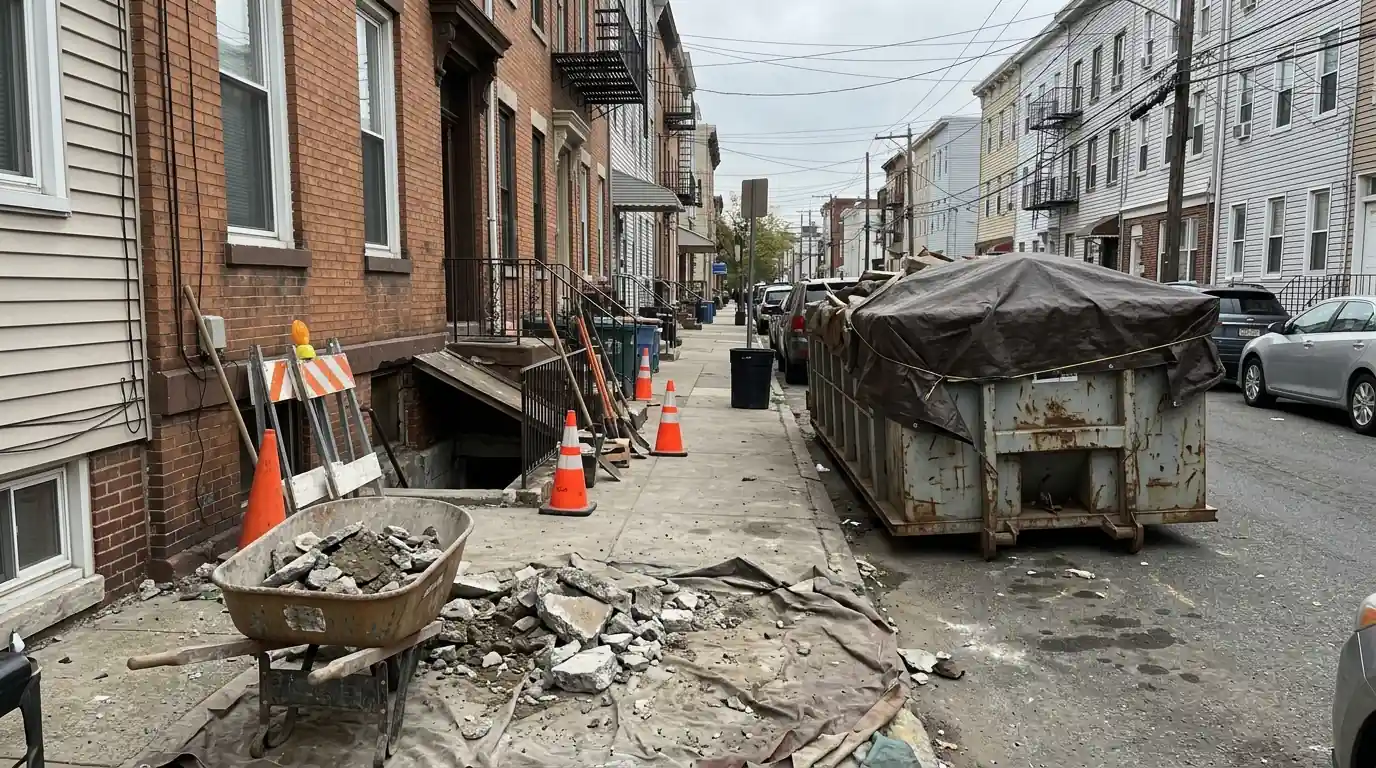
Access drives labor, and labor drives price. In an attached rowhouse there's usually no side yard to dig in, so exterior excavation is only possible at the front areaway or the rear yard, and the party walls can only be treated from inside. Everything that comes out of the basement goes up a narrow stair or through the areaway door. On blocks with permit parking and tight streets, staging a debris container takes planning as well, and that time shows up in the number.
Stone and brick foundations cost more than poured concrete for good reasons. A rubble stone wall laid in lime mortar doesn't have one crack to inject; water comes through hundreds of washed-out joints. Treating it usually means repointing or parging the worst areas, then pairing a drain with a membrane that collects whatever still seeps through. That's why stone and brick foundation waterproofing is its own line of work, and why a brownstone in Van Vorst Park rarely lands at the low end of the whole-basement range.
Location adds its own cost. Downtown Jersey City and Hoboken sit largely on old marsh and fill with a high water table, so groundwater pushes up under the slab after long rains, which favors a full drain and sump. In the Heights, on the Palisades ridge, water tends to run along rock and enter through cracks, so targeted injection often solves the problem for far less.
The sump, the discharge line and the backup
Any drain system ends at a sump, and sump pump installation typically runs $1,190 to $2,780 depending on where the basin goes, how much slab has to be cut, the pump chosen and how far the discharge line has to travel. A check valve keeps pumped water from falling back into the basin. The discharge has to carry water well away from the foundation, not drop it beside the wall where it cycles straight back into the drain you just paid for.
A battery backup belongs in the budget from the start. The storms that fill basements are the same storms that knock out power, and a pump with no electricity is just a pit full of water. Where a basement takes sewer water through a floor drain in heavy rain, which happens on combined sewer systems like Jersey City's, a backwater valve is a separate line item, and it may need a plumber and a permit depending on the work. We tell you when that applies and coordinate it.
Finished basements, permits and the costs people forget
A finished basement adds work before the waterproofing starts. Drywall, framing and flooring along the wet walls usually have to come out so the slab can be cut and the membrane run up the wall, and anything that stayed wet for weeks needs to go anyway. We can often keep the removal to a strip along the walls, but rebuilding the finishes afterward is a separate cost, normally handled by your carpenter or general contractor once the walls are dry.
Permits depend on the job and the town. Sewer-side work, some excavation and exterior work in Jersey City's designated historic districts can involve the city, its Historic Preservation Commission or the local sewer utility, and in those cases we say so up front and coordinate the paperwork. Fees vary, so we don't guess at them here. Other costs owners forget: moving stored belongings, a dedicated outlet for the pump, and a dehumidifier if the basement still sits damp through the summer.
How to compare two estimates fairly
Two numbers for the same basement can look far apart until you line up what each one includes. Check the linear feet of drain, whether the membrane runs up the wall, the sump basin size, whether a check valve and battery backup are included, where the discharge leaves the house, and who patches the slab and hauls debris. An estimate that skips the backup or leaves the discharge at the foundation isn't cheaper. It's unfinished.
Ask, too, what each estimate assumes about the source of the water. Injecting a crack on a wall that really leaks at the cove joint won't solve the problem, and a full perimeter drain for a basement that only leaks under one window well is more than you need. If you want a second look at a number you've been given, or you'd like one of our technicians to measure your basement and trace the water, we answer (201) 578-5199 day and night.
Owner Guides Editor at Waterproofing Services Carteret. Writes the owner guides from the questions our crews hear in Jersey City basements and on its roofs every week.